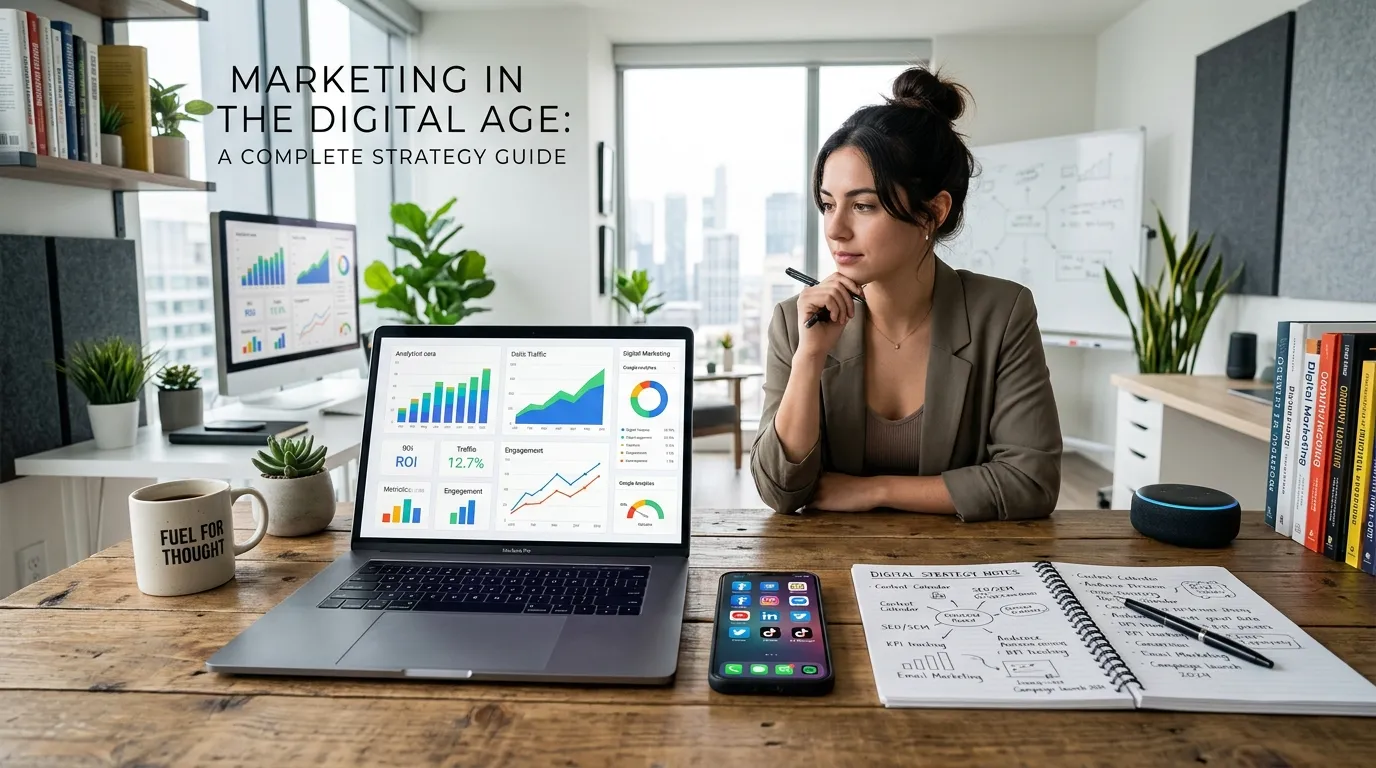
Marketing in the Digital Age explores how businesses use digital channels such as search engines, social media, email, mobile apps, and content marketing to reach customers, build relationships, increase brand awareness, and drive growth in an increasingly connected world.
Marketing in the digital age means reaching customers through online channels like SEO, content, social media, email, and paid ads. Success depends on knowing your audience, setting clear goals, and using data to refine campaigns in real time for measurable growth.
The way businesses connect with customers has been rewritten. For most of the 20th century, brands relied on newspaper ads, radio jingles, and highway billboards to spread their message. Then the internet arrived—and the rules changed forever. Today, a small business can reach a global audience overnight, track every click, and adjust a campaign before lunch.
Marketing in the digital age is not a single tactic. It’s a connected ecosystem of channels, tools, and strategies that work together to attract, engage, and convert customers. From search engines to social feeds, every touchpoint offers a chance to build trust and drive sales.
This guide breaks down everything you need to know about marketing in the digital age. You’ll learn the core pillars that power modern campaigns, the trends shaping the industry, how to build a strategy from scratch, and how to measure what actually works. Whether you run a startup or a growing company, these insights will help you compete and thrive.
What does marketing in the digital age really mean?
 Marketing in the digital age refers to promoting products and services through online platforms and electronic devices. Instead of broadcasting one message to everyone, brands now reach specific people based on their behavior, interests, and location.
The biggest shift is from one-way communication to two-way conversation. Traditional marketing pushed a message out and hoped it landed. Digital marketing invites customers to comment, share, review, and respond—while brands collect data on every action. That data fuels constant improvement, so campaigns get smarter as they run.
This change matters for one simple reason: that’s where your customers spend their time. People research products online, read reviews, and compare options long before they buy. If your brand isn’t visible during that research phase, you lose the sale to a competitor who is. Understanding how digital marketing differs from traditional marketing is the first step toward building a strategy that meets buyers where they already are.
What are the core pillars of marketing in the digital age?
Successful marketing in the digital age rests on six connected pillars. Each one plays a distinct role, and the strongest strategies use them together.
How does SEO drive organic traffic?
Search Engine Optimization (SEO) earns your website visibility on Google and other search engines without paying for ads. When done well, SEO delivers a steady stream of free, high-intent traffic for years. It breaks down into three areas:
- On-page SEO: Optimizing the content on your pages—titles, headings, keywords, and internal links—so search engines understand what each page is about.
- Off-page SEO: Building authority through backlinks, mentions, and reviews from other trusted websites.
- Technical SEO: Improving site speed, mobile usability, and crawlability so search engines can index your pages easily.
SEO takes time, but the payoff compounds. A well-optimized blog post can keep attracting visitors long after you hit publish.
Why is content marketing the engine of digital strategy?
Content marketing creates and shares valuable material—blogs, videos, guides, and infographics—to attract and educate your audience. Instead of pitching products directly, you provide information people actually want.
The most effective content comes in several formats:
- Blog posts and articles drive SEO and answer specific customer questions.
- Videos explain complex topics and humanize your brand.
- Infographics turn dense data into shareable visuals.
Creating content is only half the job. You also need a distribution plan—sharing posts on social media, sending them to your email list, and amplifying top performers with paid ads. The relationship between content marketing and advertising shows how earned content and paid promotion work better together than alone.
How do you build a winning social media strategy?
Social media marketing covers organic and paid campaigns on platforms like Instagram, Facebook, LinkedIn, and TikTok. The first decision is platform selection—you don’t need to be everywhere, just where your audience actually spends time.
A B2B software company will find better results on LinkedIn, while a fashion brand may thrive on Instagram and TikTok. Once you pick your platforms, the goal shifts to engagement and community building. Reply to comments, ask questions, and share user-generated content. Communities built on genuine interaction outperform follower counts every time.
What makes email marketing so effective?
Email marketing delivers direct messages straight to subscribers who already chose to hear from you. It consistently ranks among the highest-ROI channels in digital marketing.
Success starts with building an email list the right way—offering a free guide, discount, or newsletter in exchange for an address. From there, personalization and automation do the heavy lifting. Automated sequences can welcome new subscribers, recover abandoned carts, and re-engage inactive customers, all while feeling personal and timely.
When should you use paid advertising (PPC)?
Pay-per-click (PPC) advertising puts your brand in front of buyers instantly. Unlike SEO, which builds over time, paid ads deliver immediate visibility—you turn the budget on, and traffic flows.
The two main channels are:
- Google Ads: Paid search results that appear when users search for specific keywords, capturing people with clear buying intent.
- Social media ads: Sponsored posts on platforms like Facebook and Instagram that target users by age, interests, location, and behavior.
PPC works best for product launches, seasonal promotions, and any goal that needs fast results. Choose paid advertising if you need immediate traffic; lean on SEO and content if you want sustainable, long-term growth.
How does affiliate marketing expand your reach?
Affiliate marketing lets other people promote your products in exchange for a commission on each sale they generate. It’s a performance-based model—you only pay when you get results.
The benefits are clear: low upfront risk, expanded reach through trusted voices, and access to new audiences. The challenges include finding the right partners and maintaining quality control over how your brand is represented. When managed well, affiliate marketing turns advocates into a sales force that scales.
What key trends are shaping marketing in the digital age?
 The marketing landscape changes fast. These four trends are defining how brands connect with customers right now.
How is AI transforming marketing?
Artificial intelligence and machine learning are reshaping marketing in the digital age. AI analyzes massive amounts of customer data to deliver personalization at scale—the right message, to the right person, at the right time.
AI also powers predictive analytics, helping brands forecast customer behavior, segment audiences automatically, and optimize ad targeting in real time. Tasks that once took a team of analysts now happen in seconds, freeing marketers to focus on strategy and creativity.
Why does influencer marketing keep growing?
Influencer marketing partners brands with content creators who carry sway over dedicated audiences. The choice between micro and macro influencers depends on your goal—micro-influencers offer niche credibility and high engagement, while macro influencers deliver broad reach.
The key to success is authenticity and transparency. Audiences quickly spot forced partnerships. When an influencer genuinely loves your product and discloses the partnership clearly, their endorsement carries real weight.
Is video marketing now essential?
Video dominates digital attention. Short-form video on platforms like TikTok and Instagram Reels grabs attention fast, while long-form video on YouTube builds deeper engagement and authority.
Live streaming adds another layer, letting brands interact with audiences in real time through Q&As, product launches, and behind-the-scenes content. The format you choose should match your message—quick tips work as short clips, while tutorials and stories deserve more room.
How do you balance data privacy and personalization?
Consumers want personalized experiences, but they also demand control over their data. Regulations like GDPR in Europe and CCPA in California set strict rules on how businesses collect and use personal information.
The path forward is ethical data collection—being transparent about what you gather, asking for clear consent, and using data responsibly. Brands that respect privacy build deeper trust, which translates directly into long-term loyalty.
How do you build a digital marketing strategy from scratch?
A great strategy turns scattered tactics into a coordinated plan. Follow these five steps to build yours.
1. Define your target audience
Everything starts with knowing who you’re talking to. Create detailed buyer personas that capture your ideal customer’s age, interests, challenges, and online behavior. The more specific you get, the easier every other decision becomes.
2. Set measurable goals (SMART objectives)
Vague goals lead to vague results. Use the SMART framework—Specific, Measurable, Achievable, Relevant, and Time-bound. Instead of “get more traffic,” aim for “increase organic traffic by 30% in six months.”
3. Conduct competitor analysis
Study what your competitors do well and where they fall short. Look at their content, keywords, social presence, and ad strategies. These gaps reveal opportunities you can claim for your own brand.
4. Plan your budget and resources
Decide how much you’ll invest and where. Allocate budget across channels based on your goals—more toward paid ads for fast results, more toward content and SEO for long-term growth. Factor in tools, talent, and time.
5. Implement and monitor
Launch your campaigns, then watch the data closely. Digital marketing’s biggest advantage is flexibility. If something underperforms, you can pause, tweak, and relaunch within minutes. Many brands find that blending digital with offline tactics, such as integrating traditional and digital marketing, delivers stronger results than either approach alone.
How do you measure success in marketing in the digital age?
You can’t improve what you don’t measure. Digital marketing gives you a precise view of what’s working.
Start with Key Performance Indicators (KPIs) tied to your goals—click-through rates, conversion rates, cost per acquisition, and customer lifetime value. These numbers tell you whether your spending pays off.
Analytics tools make tracking simple. Google Analytics reveals where your traffic comes from and how visitors behave on your site. Social media insights show which posts resonate and which fall flat. Together, they paint a complete picture of your performance.
Finally, use A/B testing and optimization to refine constantly. Test two versions of a headline, ad, or landing page to see which performs better. Small, data-driven improvements add up to major gains over time.
What challenges does digital marketing face, and how do you solve them?
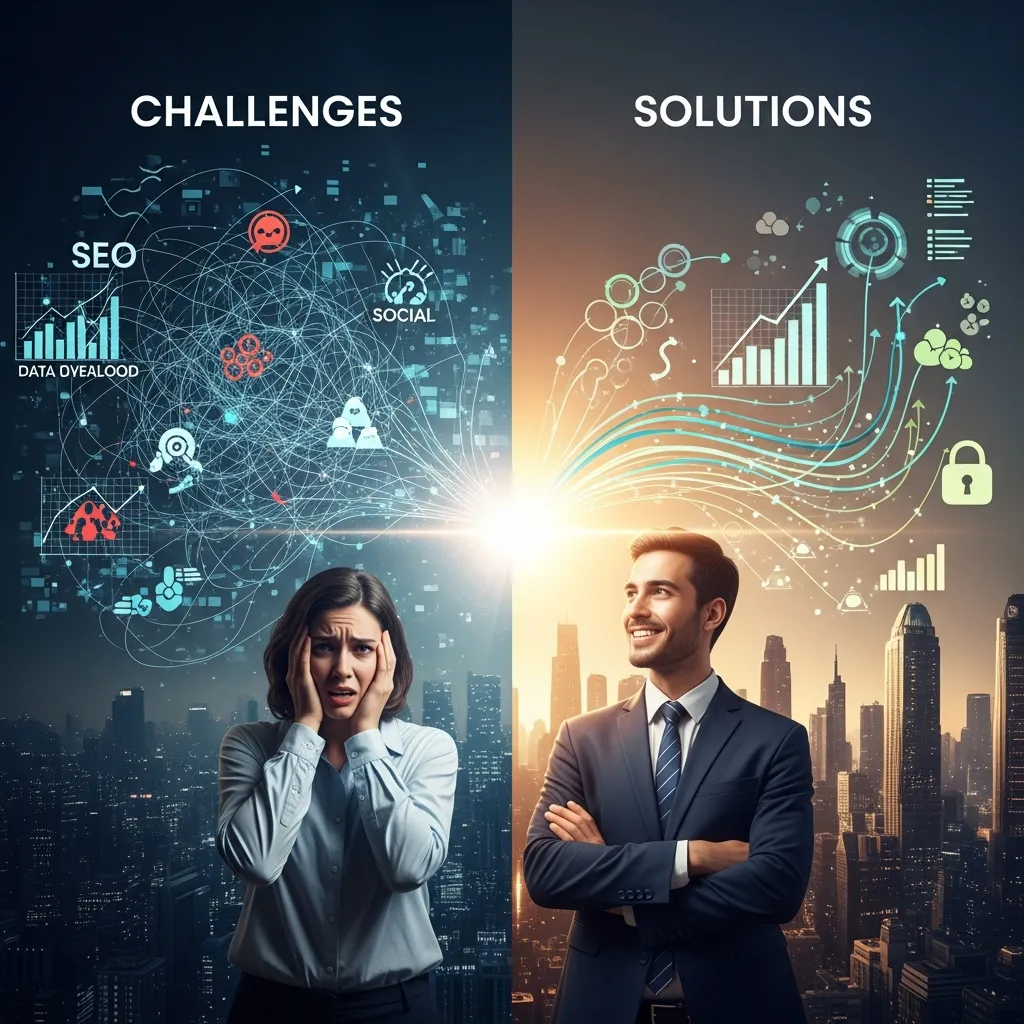 Marketing in the digital age brings real obstacles. Here’s how to handle the most common ones.
Information overload and audience fatigue. Consumers see thousands of messages daily, and many simply tune out. The solution is quality over quantity. Create genuinely useful, well-targeted content instead of flooding feeds with noise.
Rapid technological change. Platforms, algorithms, and tools shift constantly. Stay adaptable by committing to ongoing learning—follow industry news, test new features early, and treat change as opportunity rather than threat.
Building trust and credibility. Online audiences are skeptical, especially of paid promotions. Build trust through transparency, authentic content, customer reviews, and consistent messaging. A strong reputation makes every other marketing effort more effective.