If you’re wondering what is integrated marketing, it is a strategy that aligns all marketing channels to deliver a consistent brand message. An effective integrated marketing strategy and integrated marketing communications help improve customer engagement, strengthen brand recognition, and drive better business results.
Most brands don’t have a messaging problem. They have a coordination problem. The email team writes one thing. The social media team posts another. The print ad says something different altogether. Customers notice. And when they do, trust erodes.
That’s the exact problem integrated marketing solves. Rather than running separate campaigns across disconnected channels, integrated marketing aligns every touchpoint—online and offline—into one coherent system that speaks with a single voice. The result is stronger brand recognition, better customer experiences, and measurable gains in ROI.
This guide covers everything you need to know about integrated marketing: what it means, how integrated marketing communications (IMC) works, the core benefits of integrated marketing, a step-by-step process for building an integrated marketing strategy, and where the discipline is heading next. By the end, you’ll have a clear, actionable framework you can apply to your own organization.
What Is Integrated Marketing?
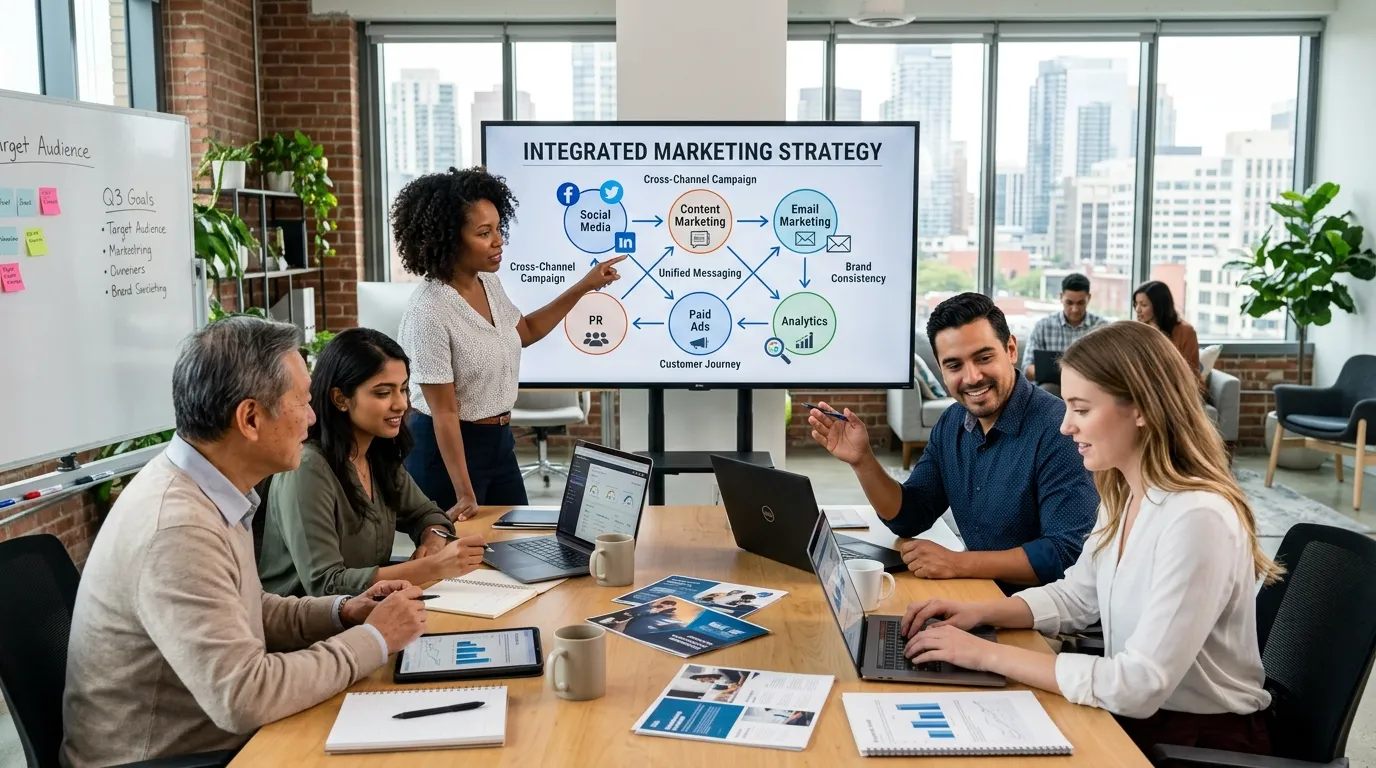
 Integrated marketing is the practice of coordinating all marketing channels, messages, and tools into a unified strategy that delivers a consistent brand experience at every customer touchpoint. Every channel—advertising, public relations, social media, email, content, direct mail, and personal selling—reinforces the same core message rather than operating independently.
The definition matters because what integrated marketing is not is just as important as what it is. Running a Facebook ad and a billboard at the same time isn’t integration—that’s just multichannel marketing. True integration means every channel is designed to feed the others. A TV commercial drives viewers to a branded hashtag. A QR code on a direct mail piece links to a campaign-specific landing page. A loyalty email references an in-store promotion. That deliberate connection is what separates integrated marketing from scattered tactics running side by side.
What Makes an Integrated Marketing Approach Different?
The fundamental shift in integrated marketing is moving from siloed execution to holistic thinking. Traditional marketing departments are often built around specialties: a PR team, a digital team, a content team, a sales team. Each group sets its own goals, manages its own budget, and reports on its own metrics. This structure creates friction.
Integrated marketing breaks down those silos. Every team works from the same brand story, the same core message, and the same overarching objectives. The PR team’s press release reinforces what the social media team is posting. The email sequence aligns with the paid search campaign running in parallel. This coordination is what turns fragmented marketing spend into a compounding system.
What Is Integrated Marketing Communications (IMC)?
Integrated marketing communications (IMC) is the specific discipline within integrated marketing that governs how promotional messages are developed and delivered across all channels. First formalized by the American Association of Advertising Agencies in the early 1990s, IMC expanded the traditional view of advertising to encompass every communication a brand makes with its audience.
The core elements of integrated marketing communications include:
- Advertising (Traditional & Digital): TV, radio, print, outdoor, and digital ads—each reinforcing a unified campaign message.
- Public Relations: Earned media coverage, press releases, and thought leadership content that builds brand authority.
- Sales Promotion: Discounts, contests, limited-time offers, and loyalty programs that drive immediate action.
- Direct Marketing: Personalized outreach via email, direct mail, and SMS that speaks to individual customer behavior.
- Personal Selling: One-to-one interactions between sales representatives and prospects, informed by the same brand story across all channels.
- Digital Marketing: SEO, content marketing, social media, email automation, and PPC—the digital layer that connects and amplifies everything else.
Each element carries weight on its own. Combined under a unified integrated marketing communications strategy, they create synergy. The advertising builds awareness. The PR builds credibility. The sales promotion drives conversion. The digital layer tracks and optimizes every step. For a deeper look at how traditional and digital channels work together in this model, see our guide on convergence marketing strategies.
What Are the Key Components of an Integrated Marketing Strategy?
 A strong integrated marketing strategy rests on four interconnected pillars. Remove any one of them, and the system starts to fracture.
1. Unified Messaging
Every campaign must start from a single, clearly articulated core message. This isn’t a tagline—it’s a value proposition that answers why customers should choose your brand, expressed in terms that resonate with their specific needs. That message gets translated into channel-appropriate executions, but the underlying idea never changes.
2. Consistent Brand Voice and Visuals
Consistency is what turns repeated exposure into recognition. Your brand’s visual identity—colors, typography, imagery style—and its tone of voice must remain identical across every channel. A customer who encounters a formal, authoritative brand voice on your website and a casual, jokey tone in your email newsletter receives a mixed signal. Mixed signals slow buying decisions.
3. Coordinated Channels and Touchpoints
Channels should be designed to reinforce each other, not compete for credit. A paid social ad drives traffic to a landing page optimized for the same offer. A blog post earns organic search traffic and feeds an email nurture sequence. An event generates press coverage that amplifies an ongoing PR campaign. This coordination is the operational heart of integrated marketing.
4. Data-Driven Insights and Optimization
An integrated marketing strategy without data is just coordination without improvement. Unified analytics—pulling performance data from every channel into a single dashboard—enables marketers to see which touchpoints are driving results and which are draining budget. According to Forrester Research (2024), organizations using unified marketing measurement tools improve campaign effectiveness by up to 30%.
What Are the Benefits of Integrated Marketing?
The benefits of integrated marketing are both strategic and financial. Here is what brands consistently experience when they make the shift from siloed to integrated execution.
Enhanced Brand Recognition and Consistency
Customers exposed to consistent messaging across multiple channels recognize and recall brands faster. Each additional touchpoint reinforces the last, reducing the cognitive effort required for a buyer to identify and trust your brand. According to Nielsen’s 2024 consumer research, buyers interact with brands across an average of six distinct touchpoints before making a purchase. Integrated marketing ensures those six moments tell one coherent story.
Improved Customer Experience and Engagement
A fragmented experience—where a customer receives conflicting offers across channels or has to repeat their purchase history to different service representatives—destroys trust. Integrated marketing creates a seamless journey. The customer feels understood regardless of which channel they use, which deepens engagement and reduces friction at every stage of the buying process.
Increased Marketing Efficiency and ROI
When channels share messaging, data, and creative assets, marketing teams spend less time recreating work from scratch. Campaigns built on a unified strategy also perform better, because each channel amplifies the others. Behaviorally targeted marketing consistently outperforms non-targeted efforts—and integration is what makes behavioral targeting possible across both online and offline channels.
Stronger Brand Loyalty and Trust
Brands that communicate consistently build credibility. Credibility builds trust. Trust builds loyalty. This chain reaction is why the long-term benefits of integrated marketing compound over time. A customer who receives the same brand experience across a social ad, a purchase confirmation email, and an in-store interaction becomes a repeat buyer far more reliably than one who encounters inconsistency at every touchpoint.
Better Data Collection and Analytics
Integration connects data that siloed systems keep separate. When an e-commerce platform, a CRM, a point-of-sale system, and a marketing automation tool share information, the combined dataset reveals behavioral patterns no single channel could surface alone. Those insights drive smarter decisions about audience targeting, channel investment, and message refinement.
Competitive Advantage in a Crowded Market
Most competitors are still running disconnected campaigns. A brand that integrates achieves something rare: a customer experience that feels deliberate and coherent at every stage. That quality of experience becomes a differentiator, particularly in markets where product differentiation alone is difficult to sustain.
How to Build an Integrated Marketing Strategy: 7 Steps

Step 1: Define Your Target Audience and Buyer Personas
Every effective integrated marketing strategy starts with audience clarity. Build detailed buyer personas that cover demographics, psychographics, media habits, and purchase motivations. A 45-year-old CFO who reads trade publications and attends industry conferences needs a different channel mix than a 28-year-old operations manager spending time on LinkedIn and YouTube. The more precisely you map your audience’s behavior, the more confidently you can select channels and craft messages that resonate.
Step 2: Establish Clear Marketing Objectives (SMART Goals)
Vague goals produce vague results. Define SMART objectives—Specific, Measurable, Achievable, Relevant, and Time-bound—for your integrated campaign. For example: “Increase qualified lead volume by 25% over 90 days through a combined content marketing and paid search campaign.” Clear objectives give every channel owner a shared target to work toward, which is essential for coordinated execution.
Step 3: Develop a Consistent Core Message and Brand Story
Before any channel-specific creative is developed, define the single value proposition your campaign will communicate. This statement should answer three questions: What problem do you solve? How do you solve it better than alternatives? Why should your specific audience trust you? Every channel adaptation—the LinkedIn post, the radio spot, the email subject line—must trace back to this core message.
Step 4: Identify and Select the Right Marketing Channels
Not every channel belongs in every campaign. Select channels based on where your audience spends their time, the stage of the buying journey you’re targeting, and the strengths of each medium. Broadcast and outdoor build top-of-funnel awareness. Search and email capture and convert intent-driven demand. Social and content build mid-funnel consideration. The right mix depends on your goals, audience, and budget.
Step 5: Allocate Budget and Resources Effectively
There is no universal ratio between traditional and digital spend in an integrated marketing strategy. Let your business objectives guide allocation. A brand launching in a new market may weight spend toward awareness channels. A brand focused on lead generation shifts toward conversion-oriented digital tactics. Reserve 15–20% of your budget for testing new channel combinations, then redirect spend toward what delivers the strongest ROI. For a detailed transition framework, see our guide on hybrid marketing model transition strategy.
Step 6: Implement and Execute Your Integrated Campaigns
Execution is where most integrated strategies break down. Coordination requires clear ownership, shared timelines, and centralized brand governance. Appoint a single person or team responsible for ensuring every channel-specific deliverable aligns with the approved core message and visual identity. Build a content calendar that maps each channel’s activity against the campaign arc, so messaging doesn’t overlap awkwardly or leave gaps.
Step 7: Monitor, Measure, and Optimize
An integrated marketing strategy is never static. Track channel-level metrics—conversion rate, cost per acquisition, click-through rate—alongside system-level metrics like cross-channel attribution and customer lifetime value. Review performance monthly and make allocation adjustments quarterly. For a practical framework on how to measure and optimize across channels, explore our convergence marketing strategies guide.
Common Challenges in Implementing Integrated Marketing
Overcoming Organizational Silos
The most common barrier to integrated marketing isn’t budget or technology—it’s organizational structure. PR teams, digital teams, and sales teams with separate KPIs and reporting lines naturally pull in different directions. Solve this by creating cross-functional marketing teams with shared goals and unified dashboards that make every channel’s contribution visible to the whole group.
Managing Diverse Teams and Agencies
Brands that work with multiple external agencies face an additional coordination layer. An SEO agency, a PR firm, and a creative studio may have no visibility into each other’s work. Establish a single point of contact responsible for cross-agency alignment, and hold shared briefings at the start of each campaign to ensure every partner understands the core message and their role in delivering it.
Measuring Cross-Channel Performance
Connecting an offline impression to an online conversion remains technically complex. The solution is to embed digital tracking mechanisms into traditional executions from the start: unique QR codes on print ads, vanity URLs on billboards, dedicated promo codes in radio spots. Route all of this into a CRM that acts as a single source of truth, so offline and online results sit side by side.
Adapting to Technological Changes
The tools available for integrated marketing evolve quickly. AI-powered automation, programmatic advertising, and real-time personalization platforms create both opportunities and complexity. Invest in foundational technology—a capable CRM, a marketing automation platform, and a unified analytics dashboard—before chasing emerging tools. The foundation is what makes everything else possible.
Real-World Examples of Successful Integrated Marketing

Coca-Cola’s “Share a Coke” Campaign
Coca-Cola’s “Share a Coke” campaign is one of the clearest illustrations of integrated marketing working at scale. The brand printed popular consumer names on physical bottles—a traditional product-marketing tactic—and then encouraged buyers to photograph and share their personalized bottles using a branded hashtag. The physical product drove digital engagement, and the social buzz amplified physical sales. Every channel reinforced the others, and the campaign lifted sales in every market where it ran.
Nike’s Direct-to-Consumer Ecosystem
Nike operates one of the most sophisticated integrated marketing strategies in consumer goods. The brand coordinates its direct-to-consumer website, physical retail stores, wholesale partnerships, and its app ecosystem around a consistent identity and customer experience. Nike has selectively pulled back from wholesale partners that couldn’t deliver the brand standard it requires—demonstrating that disciplined channel management is as important as channel breadth. For more on blending online and offline channels as Nike does, see our guide on hybrid advertising: how to blend online and offline for real ROI.
A Local Café’s Community-Led Campaign
Integrated marketing doesn’t require a global budget. A thriving independent café can execute a highly effective integrated campaign by combining local event sponsorships and in-store loyalty cards with a targeted social media presence and a simple email newsletter. Each element reinforces the others: the events drive social content, the social content drives email sign-ups, and the email newsletter drives repeat visits. The same principles apply at every scale.
The Future of Integrated Marketing
The Rise of AI and Personalization
Artificial intelligence is transforming how integrated marketing strategies are built and executed. AI-powered tools now enable real-time audience segmentation, predictive analytics, and automated content personalization at a scale no human team could match. Machine learning algorithms surface behavioral patterns across disparate data sets that individual channel analysis would never reveal. Brands that adopt these capabilities gain a compounding advantage in both efficiency and relevance.
Hyper-Personalization and Customer Journey Mapping
According to Salesforce research, 73% of consumers expect companies to understand their unique needs. Hyper-personalization—delivering tailored messages at the individual level, across every channel—is becoming the standard expectation rather than a premium differentiator. Integrated marketing provides the data infrastructure that makes hyper-personalization possible: a unified customer profile built from every touchpoint interaction.
Experiential Marketing and Physical-Digital Convergence
Augmented Reality is already turning print ads into interactive 3D experiences. Connected TV blends the mass reach of broadcast with household-level digital targeting. These technologies are collapsing the distinction between physical and digital touchpoints, making integrated marketing not just a strategic advantage but an operational necessity.
Data Privacy and Ethical Marketing
As personalization deepens, so do consumer concerns about how data is used. Brands building integrated marketing strategies must invest in transparent data practices, clear consent mechanisms, and compliance with regulations like GDPR and CCPA. Ethical data stewardship builds the very trust that makes integrated marketing effective in the first place. For more on how blended approaches are evolving, explore our resources on hybrid advertising in digital marketing and hybrid marketing model transition strategy.
Conclusion
Integrated marketing is, at its core, a commitment to coherence. Every message your brand sends, every channel you activate, every campaign you launch—all of it should point in the same direction, tell the same story, and create the same feeling in the customer who encounters it.
Start with an audit. Map every channel you currently use, assess whether the messaging is aligned, and identify the gaps where customers encounter inconsistency. Those gaps are your fastest wins. Close them systematically, build the data infrastructure that connects your efforts, and the compounding effect of true integration will follow.
Frequently Asked Questions
1. What is integrated marketing in simple terms?
If you’re wondering what is integrated marketing, it is the practice of coordinating all marketing channels to deliver one consistent brand message. This approach creates a seamless customer experience across every touchpoint.
2. What is the difference between integrated marketing and multichannel marketing?
Multichannel marketing uses several platforms, while an integrated marketing strategy connects those channels with consistent messaging and shared goals. Integration ensures every channel supports the others.
3. What is integrated marketing communications (IMC)?
Integrated marketing communications (IMC) focuses on delivering consistent promotional messages across advertising, email, PR, social media, and other channels. It is a core part of an integrated marketing strategy.
4. What are the benefits of integrated marketing?
The main benefits of integrated marketing include stronger brand recognition, improved customer experience, better marketing ROI, and more effective campaigns through consistent messaging across channels.
5. How do you create an integrated marketing strategy?
Start by defining your audience and goals, then develop a consistent message, choose the right channels, and measure results. A successful integrated marketing strategy evolves through continuous optimization.
6. What are the biggest challenges of integrated marketing?
Common challenges include disconnected teams, inconsistent messaging, and fragmented data. Strong collaboration and centralized planning help overcome these issues in an integrated marketing strategy.
7. Is integrated marketing suitable for small businesses?
Yes. Businesses of any size can benefit from integrated marketing communications by keeping branding and messaging consistent across websites, email, social media, and offline marketing.
8. How does integrated marketing improve ROI?
An integrated marketing strategy improves ROI by reducing duplicated efforts, strengthening customer engagement, and ensuring every marketing channel contributes toward the same business objectives.
9. How does AI support integrated marketing?
AI enhances integrated marketing by automating personalization, improving audience targeting, and providing insights from customer data. This helps marketers deliver more relevant experiences across channels.
10. Which metrics measure integrated marketing success?
Track conversion rates, engagement, customer acquisition cost, ROI, and customer lifetime value. These metrics help evaluate the effectiveness of your integrated marketing strategy and optimize future campaigns.