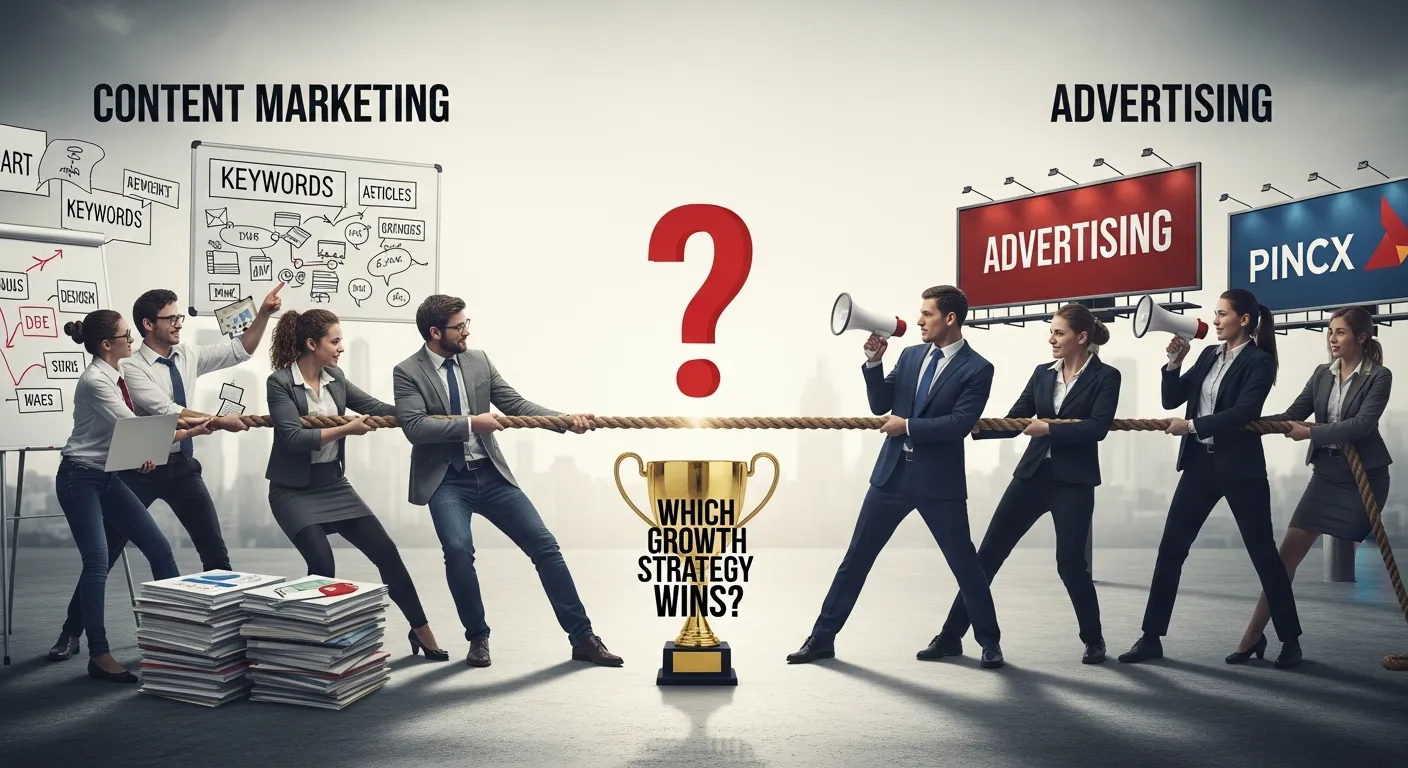
Content marketing vs advertising focuses on balancing short-term results and long-term growth. Advertising drives immediate sales and visibility, while content marketing builds trust, SEO authority, and lasting customer relationships. Together, they create a strong, sustainable business growth strategy.
Quick answer: The main difference in content marketing vs advertising lies in approach and timeline. Advertising pays for immediate, targeted placement to drive fast sales. Content marketing focuses on earning audience trust over time by publishing valuable, educational information. The most successful brands integrate both methods to secure short-term revenue and build long-term customer loyalty.
Business leaders constantly face difficult choices when allocating their promotional budgets. You want to attract new customers, build brand awareness, and increase revenue. When evaluating the best path forward, the conversation almost always turns to a classic debate: content marketing vs advertising.
Historically, companies relied almost entirely on buying attention. You paid for a spot in a newspaper, a slot on the radio, or a billboard on a busy highway. You interrupted the consumer’s day with a direct pitch. Today, consumer habits look completely different. Buyers actively research solutions online, read extensive reviews, and consume educational materials long before they ever speak to a sales representative. They block intrusive ads and seek out brands that provide genuine value upfront.
This shift does not mean paid promotions are dead. It simply means the marketing landscape has evolved into a more complex ecosystem. Modern businesses must understand how to attract an audience organically while simultaneously using paid channels to amplify their message. Navigating this new reality requires a deep understanding of the unique strengths of both disciplines.
What is content marketing and how does it work?
 Content marketing is a strategic approach focused on creating and distributing valuable, relevant, and consistent material to attract a clearly defined audience. Instead of directly pitching your products or services, you provide genuinely useful information to your prospects. This approach helps them solve their problems. Ultimately, this ongoing relationship drives profitable customer action.
The core principle of this strategy is reciprocity. When you consistently help someone answer their questions, they naturally begin to trust your brand. When the time comes for them to make a purchase, they turn to the company that has already proven its expertise.
What are the main benefits of a content strategy?
The benefits of content marketing compound over time. First, it builds long-term relationships. A customer who reads your weekly newsletter or listens to your podcast feels a personal connection to your business. This connection translates directly into higher retention rates.
Second, content marketing heavily supports Search Engine Optimization (SEO). Search engines exist to provide users with the most relevant answers to their queries. By publishing high-quality blog posts and guides, your website ranks higher in search results. This drives a steady stream of free, organic traffic to your digital storefront.
Finally, it proves highly cost-effective in the long run. Content marketing builds assets that appreciate in value over time. A well-written article published today can continue to generate fresh leads for years without requiring additional financial investment.
What types of content should you create?
Businesses utilize dozens of different formats to reach their audience. Popular types of content include:
- Blog posts and articles: These drive SEO and answer specific consumer questions.
- E-books and whitepapers: These long-form documents capture email addresses and establish industry authority.
- Videos and webinars: These highly engaging formats explain complex topics and humanize the brand.
- Podcasts: These audio shows build intimate, long-term relationships with dedicated listeners.
- Infographics: These visual assets make dense data easy to understand and share.
How do you measure content marketing success?
Tracking the performance of your educational materials requires patience. Marketers evaluate success by looking at organic website traffic, the amount of time visitors spend on a page, and social media engagement. More importantly, they track lead generation metrics. They measure how many people download an e-book or sign up for a newsletter. By analyzing these numbers, companies refine their topics and improve their material over time.
What is traditional advertising and how is it measured?
Advertising is the practice of paying for space or time to promote a product, service, or brand to a specific audience. It relies on direct, persuasive messaging designed to trigger an immediate commercial response.
The key characteristic of advertising is control. Because you pay for the placement, you dictate exactly what the message says, how it looks, and exactly when and where it appears. You do not have to wait for an audience to find you organically; you proactively place your brand directly in front of them.
What are the main benefits of advertising?
The primary advantage of advertising is immediate reach. If you launch a new product on a Tuesday, you can run a paid campaign and have thousands of targeted buyers looking at your offer by Tuesday afternoon.
Furthermore, modern advertising allows for highly targeted campaigns. Digital platforms let you display your message specifically to people based on their exact location, browsing history, and personal interests. You can even use traditional marketing channels to target specific neighborhoods with direct mail or localized radio spots. This precision ensures your budget only targets individuals most likely to buy your product.
What are the different types of advertising?
The advertising ecosystem spans both digital and physical realms. Common formats include:
- Search engine advertising: Paying to appear at the top of search results when users look for specific keywords.
- Social media ads: Sponsored posts that appear in a user’s digital feed.
- Display advertising: Banner ads placed on relevant websites or news publications.
- Broadcast and print media: Television commercials, radio spots, and magazine spreads.
- Outdoor advertising: Billboards, transit signs, and event sponsorships.
How do you measure advertising ROI?
Advertising performance is highly trackable. Companies measure success through Return on Ad Spend (ROAS). If you spend one thousand dollars on a campaign and generate five thousand dollars in sales directly from those clicks, your campaign is a success. Marketers track the Cost Per Click (CPC), the Cost Per Acquisition (CPA), and overall conversion rates to optimize their spending in real-time.
Content marketing vs advertising: What are the key differences?
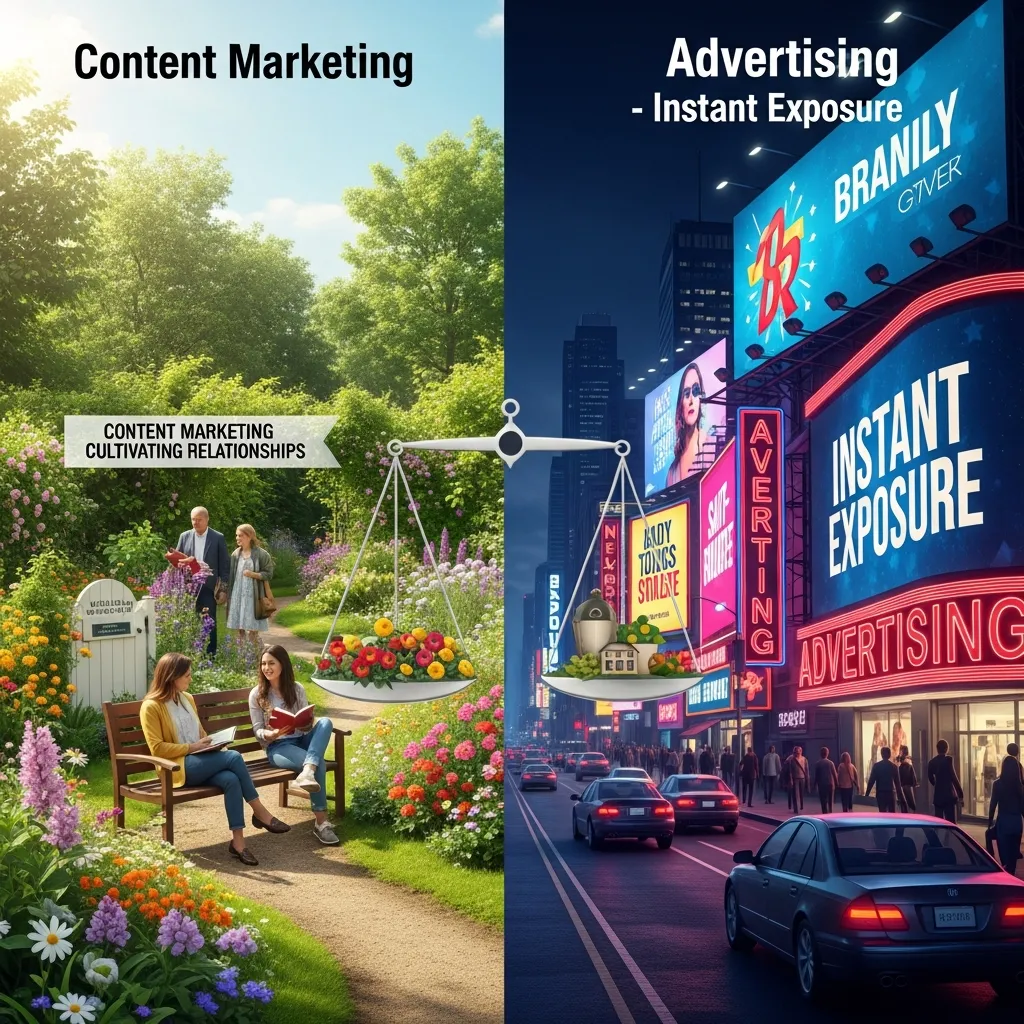 When directly comparing content marketing vs advertising, businesses must evaluate their specific needs across five distinct categories. Understanding these differences helps leaders allocate their budgets more effectively.
Objectives: Branding vs immediate sales
Content marketing aims to educate, entertain, and build brand awareness. The objective is lead generation through trust. Advertising aims to persuade the buyer to take a specific, immediate action. Choose advertising if you need immediate cash flow to move inventory quickly. Choose content marketing if your goal is sustained organic traffic and establishing industry authority.
Longevity and Impact: Short-term vs long-term
Advertising functions like a faucet. When you turn the budget on, the traffic flows immediately. When you turn the budget off, the traffic stops completely. It provides a short-term, immediate impact. Content marketing functions more like a financial investment. It takes time to build an audience and rank on search engines, but those assets continue to provide value long after the initial creation process ends.
Cost Implications: Initial outlay vs sustained investment
The cost structures differ significantly. Advertising requires a sustained financial investment to maintain visibility. You must continually pay the platform to keep your ads running. Content marketing requires a heavy initial outlay of time and resources to produce high-quality material. However, once published, the ongoing distribution costs drop dramatically. To explore how to balance these budgets across platforms, reviewing the differences between digital marketing vs traditional marketing provides valuable strategic context.
Audience Engagement: Interruption vs attraction
Advertising relies on interruption. You place your message in the middle of a television show or a social media feed, hoping to grab the viewer’s attention. Content marketing relies on attraction. The consumer actively searches for a solution, and your brand provides the answer they seek.
Control and Credibility: Paid placement vs earned trust
When you pay for an advertisement, consumers know you purchased that space. They approach the message with a natural level of skepticism. Content marketing earns credibility. When a consumer reads a thoroughly researched, 2,000-word guide on your website that genuinely solves their problem, they view your brand as a trusted advisor rather than a salesperson.
How can you integrate content marketing and advertising?
The most profitable businesses do not view content marketing vs advertising as an either-or scenario. They recognize that these disciplines work best when fully integrated.
Developing integrated strategies
A siloed approach wastes money. Your educational materials and your paid promotions must share the same core messaging and visual identity. According to HubSpot, 2023, companies with aligned promotional teams experience significantly higher customer retention rates.
Amplification through ads
You can use advertising budgets to amplify your best organic materials. If your team publishes a massive industry research report, relying strictly on organic search traffic might take months. Instead, you can run targeted social media advertisements pointing directly to that report. You pay to guarantee immediate distribution, but you use high-value educational material to capture the lead.
Creating content for conversion
Content marketing does not exist merely to entertain; it must eventually drive revenue. Marketers use advertising data to determine what topics perform best, then create comprehensive guides around those exact subjects. They use strong calls-to-action within their articles to move readers seamlessly from education into a purchasing mindset. Developing a cohesive public relations marketing strategy also helps align these public-facing messages across all your distribution channels.
Real-world examples of integrated marketing strategies
Examining how successful organizations blend these tactics provides a clear roadmap for execution.
Consider a B2B software company launching a new cybersecurity product. They begin by publishing a series of detailed blog posts explaining current security threats. This represents their content strategy. They then use retargeting advertisements. If a user reads three articles about cybersecurity on the company website, the company serves them a display ad offering a free trial of their new software. The content built the trust; the advertisement closed the sale.
Another example involves an outdoor apparel brand. They sponsor a massive community park cleanup event, generating significant organic press coverage and capturing beautiful video footage. They post this engaging documentary-style video on their blog to build brand loyalty. Simultaneously, they cut that video into 15-second segments and run them as highly targeted social media advertisements to drive immediate product sales.
What future trends will shape content marketing vs advertising?
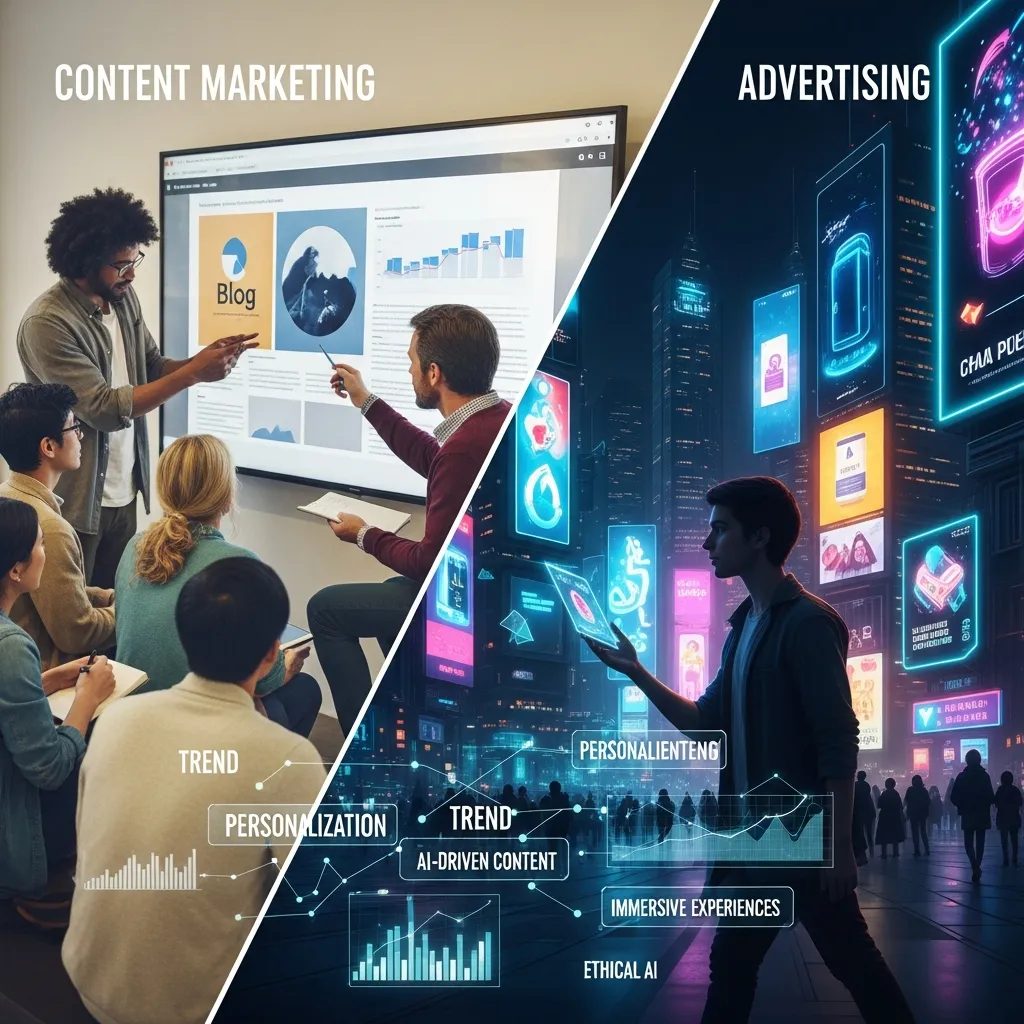 The marketing industry changes rapidly. Staying ahead of the curve requires an understanding of emerging technologies and shifting consumer behaviors.
AI in marketing
Artificial Intelligence (AI) platforms are revolutionizing how companies produce and distribute materials. AI writing assistants help teams generate blog outlines and social media captions faster than ever before. On the advertising side, machine learning algorithms analyze massive datasets to optimize ad bidding and targeting automatically.
Extreme personalization
Consumers increasingly demand personalized experiences. Generic advertisements perform poorly. Modern companies use complex data analytics to deliver specific articles, videos, and product recommendations tailored directly to an individual user’s previous browsing behavior.
New platforms and offline mastery
The line between physical and digital spaces continues to blur. Achieving true traditional marketing mastery now requires seamlessly connecting offline billboard campaigns with digital content hubs via QR codes and augmented reality experiences.
Choosing the best path for your business growth
The debate over content marketing vs advertising ultimately misses the larger picture. Both disciplines serve crucial, distinct functions within a healthy business ecosystem. Advertising delivers rapid visibility, targeted reach, and immediate sales necessary to keep a company financially stable in the short term. Content marketing builds trust, SEO authority, and long-term customer relationships that support sustainable growth and brand recognition.
A strong marketing strategy does not rely on one approach alone. Instead, it integrates both content marketing vs advertising to create a complete customer journey—from awareness to conversion and retention. Advertising captures attention quickly through paid channels such as search ads, social media campaigns, and display networks. Content marketing then nurtures those audiences through blogs, videos, guides, and educational resources that answer real customer questions and solve problems.
Evaluate your current business goals carefully. If your priority is immediate cash flow or launching a new product, allocate more budget toward highly targeted advertising campaigns. If your focus is reducing long-term customer acquisition costs and building a strong organic presence, invest in high-quality content creation and SEO-driven strategies. Over time, businesses that balance both approaches tend to outperform those relying on a single channel.
Additionally, analyzing performance data from both strategies is essential. Metrics such as cost per acquisition, conversion rates, organic traffic growth, and customer lifetime value help determine how effectively your content marketing vs advertising efforts are working together.
Ultimately, a balanced approach ensures stability and scalability. By combining the speed of advertising with the long-term value of content marketing, businesses can secure stronger visibility, better engagement, and sustainable growth in an increasingly competitive digital landscape.