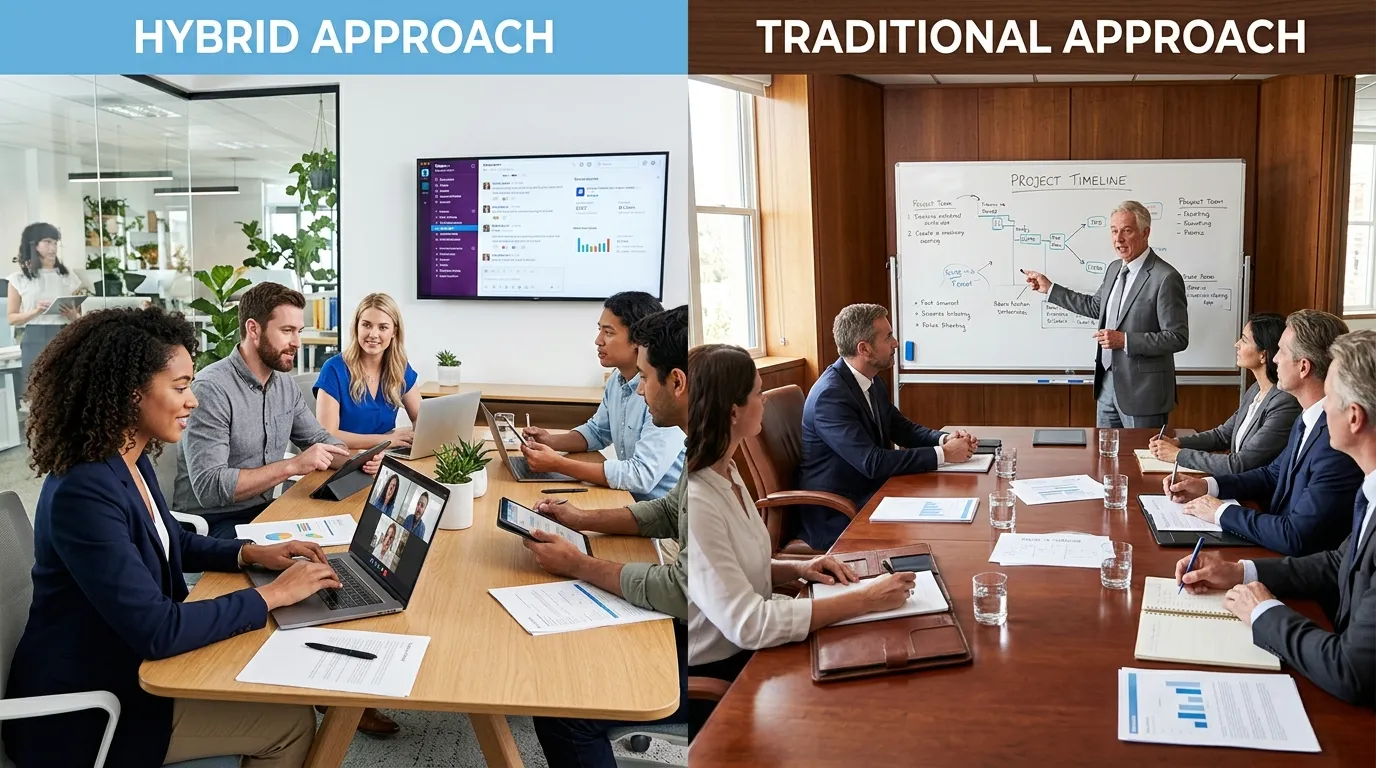
The hybrid approach blends traditional and modern methods for flexibility, while the traditional approach relies on fixed, centralized structures. Hybrid models suit fast-changing environments; traditional models suit stable, predictable ones. Most organizations now favor hybrid for its balance of structure and adaptability.
The way we work, learn, and run projects looks nothing like it did twenty years ago. Companies once managed everything from a single office, taught lessons in one classroom, and built products through rigid, step-by-step plans. Now, teams split time between home and headquarters, students learn online and in person, and projects shift direction mid-stream.
This shift sits at the heart of one big debate: the hybrid approach vs traditional approach. Each model carries real strengths and real trade-offs. Picking the right one can shape your productivity, your costs, and even your team’s happiness.
This post breaks down both approaches in plain terms. You’ll learn what each one means, where it shines, where it struggles, and how to choose the best fit for your business, school, or project. By the end, you’ll have a clear framework to make a confident decision.
What is the traditional approach and how does it work?
 The traditional approach relies on centralized, standardized, and rigid structures. Work happens in one place, follows set rules, and moves through clear stages. Everyone knows their role, their reporting line, and the steps ahead.
Think of the classic office job—employees clock in at a fixed location, follow a set schedule, and report to a defined chain of command. The traditional approach also shows up in waterfall project management, where each phase finishes before the next begins. Conventional education fits the mold too: students sit in a physical classroom and learn from a teacher at a fixed time.
What are the main characteristics of the traditional approach?
The traditional approach has a few defining traits:
- Centralized control: Decisions flow from the top down, with clear authority.
- Standardized processes: Everyone follows the same proven steps.
- Fixed location and schedule: Work, learning, and meetings happen at set times and places.
- Sequential workflow: Tasks move in a straight line, one stage after another.
What are the pros of the traditional approach?
The traditional approach offers several lasting benefits:
- Established processes: Tried-and-tested methods reduce guesswork and confusion.
- Clear hierarchy: Everyone knows who reports to whom, which speeds up accountability.
- Perceived stability: Predictable routines create a sense of security for teams.
- Easier oversight: Managers can monitor work directly when everyone shares one space.
Much like how traditional marketing still delivers strong ROI, the traditional approach proves that proven, stable methods still hold real value.
What are the cons of the traditional approach?
The traditional approach also carries clear downsides:
- Lack of flexibility: Rigid rules make it hard to adapt to sudden change.
- Slower adaptation: Top-down decisions can take time to reach the front lines.
- Limited innovation: Strict structures can stifle fresh ideas and experimentation.
- Higher overhead: Maintaining a central office or facility costs money.
What is the hybrid approach and how does it work?
The hybrid approach blends elements of traditional and modern methods. It mixes structure with flexibility, combining the best of established systems with the speed of newer ones. Instead of choosing one path, the hybrid approach integrates several.
A hybrid work model is the clearest example—employees split their time between the office and remote locations. Agile project management blends planning with quick, iterative sprints. Blended learning combines classroom teaching with online lessons, giving students more control over how and when they study.
What are the main characteristics of the hybrid approach?
The hybrid approach is defined by integration and flexibility:
- Blended methods: It merges traditional structures with modern, digital tools.
- Flexible location and schedule: People choose where and when they work or learn within set limits.
- Decentralized decisions: Teams gain more freedom to act without waiting for approval.
- Iterative workflow: Work moves in cycles, with room to adjust along the way.
What are the pros of the hybrid approach?
The hybrid approach delivers benefits that explain its rapid rise:
- Increased flexibility: People adapt their schedules to suit their lives and peak productivity.
- Enhanced collaboration: Digital tools connect teams across locations in real time.
- Improved satisfaction: Flexible models often boost morale and reduce burnout.
- Innovation potential: Mixing methods sparks fresh thinking and faster problem-solving.
This blended thinking mirrors how businesses now combine digital and traditional marketing to get the best of both worlds.
What are the cons of the hybrid approach?
The hybrid approach is powerful, but not without challenges:
- Management complexity: Coordinating remote and in-person work demands extra planning.
- Potential for inequality: Remote workers may feel left out of in-office conversations.
- Technological reliance: Hybrid models depend heavily on stable tools and connectivity.
- Blurred boundaries: Flexible schedules can make it harder to switch off from work.
 The hybrid approach vs traditional approach debate looks different depending on the field. Here’s how each one shows up across key sectors.
Workplace and business operations
In the workplace, the traditional approach means full-time office attendance. The hybrid approach lets staff split time between home and office. Many companies now favor hybrid because it widens the talent pool and lowers real estate costs—while still preserving some in-person connection.
Project management
Traditional project management follows the waterfall method, where each phase completes before the next starts. The hybrid approach often blends waterfall planning with agile sprints. This mix gives teams a clear roadmap and the freedom to adjust as they go.
Education and learning
Conventional education relies on classroom instruction. Blended learning—a hybrid model—combines in-person lessons with online modules. Students gain flexibility, while teachers keep the structure and face-to-face support that classrooms provide.
Marketing and customer outreach
Marketing shows this contrast clearly. The traditional approach uses offline channels like print, radio, and billboards. The hybrid approach pairs these with digital tools such as SEO, social media, and email. As detailed in the guide to marketing in the digital age, brands that blend both channels often outperform those that pick just one. A QR code on a billboard, for example, turns offline reach into measurable online action.
How do you choose between the hybrid approach and the traditional approach?
 Choosing between the two depends on your goals, your industry, and your people. There’s no universal winner—only the best fit for your situation.
Choose the traditional approach if stability, tight control, and predictable routines matter more than speed. It suits highly regulated industries, roles that need constant supervision, and tasks with clear, fixed steps.
Choose the hybrid approach if flexibility, innovation, and adaptability rank higher than rigid structure. It works well for knowledge-based teams, creative projects, and organizations facing fast market change.
Many leaders find the strongest results come from a thoughtful blend. You can keep the proven structure of traditional methods where it counts, while adopting hybrid flexibility where it adds value. Start small, measure the results, and refine your model over time. The same balanced thinking applies to promotion, as shown in the comparison of content marketing vs advertising, where combining both often beats relying on one.
To explore the broader research behind flexible work models, resources like the Gartner glossary on hybrid work and McKinsey’s insights on the future of work offer helpful context.
Final thoughts on choosing the right approach
The hybrid approach vs traditional approach debate is rarely about one being right and the other wrong. The traditional approach excels at structure, stability, and clear accountability. The hybrid approach wins on flexibility, speed, and innovation.
The smartest organizations don’t force a strict choice. They borrow the strengths of each, building a model that fits their goals, their teams, and their industry. Start by clarifying what you value most—control or agility, predictability or adaptability. Then test, measure, and adjust.
Whether you lean traditional, hybrid, or somewhere in between, the goal stays the same: a system that helps your people do their best work. Define your priorities, pick your starting point, and refine as you grow.
Frequently Asked Questions
1. What is the main difference between a hybrid approach and a traditional approach?
The main difference is flexibility. The traditional approach uses fixed, centralized structures with set locations and schedules, while the hybrid approach blends traditional methods with modern, flexible ones that let people choose where and how they work or learn.
2. Is the hybrid approach better than the traditional approach?
Neither is universally better. The hybrid approach suits fast-changing, knowledge-based environments that value flexibility, while the traditional approach suits stable, highly structured settings that value control and predictability.
3. What are examples of the traditional approach?
Common examples include full-time office work, waterfall project management, and conventional classroom education. Each relies on fixed locations, set schedules, and a clear top-down hierarchy.
4. What are examples of the hybrid approach?
Examples include hybrid work models that combine remote and office work, agile project management that blends planning with sprints, and blended learning that mixes classroom and online lessons.
5. What are the biggest challenges of the hybrid approach?
The biggest challenges include management complexity, the risk of inequality between remote and in-office staff, heavy reliance on technology, and blurred boundaries between work and personal life.
6. Does the hybrid approach save money compared to the traditional approach?
It often can. The hybrid approach can lower fixed costs like office space and utilities. However, it adds spending on digital tools, software, and security, so the savings depend on how the model is managed.
7. Which approach is better for innovation?
The hybrid approach usually supports innovation better. Its flexible, iterative structure encourages experimentation and quick feedback, while the traditional approach favors consistency and proven methods over rapid testing.
8. Can a business use both approaches at once?
Yes. Many organizations blend the two, keeping traditional structure where stability matters and adding hybrid flexibility where adaptability adds value. This balanced model often delivers the strongest results.
9. How does the hybrid approach apply to marketing?
In marketing, the hybrid approach combines traditional channels like print and radio with digital tools like SEO and social media. This blend often outperforms relying on either offline or online channels alone.
10. How do I choose the right approach for my organization?
Start by clarifying your priorities. Choose the traditional approach if you value stability and control, and the hybrid approach if you value flexibility and innovation. Test your chosen model, measure the results, and refine it over time.