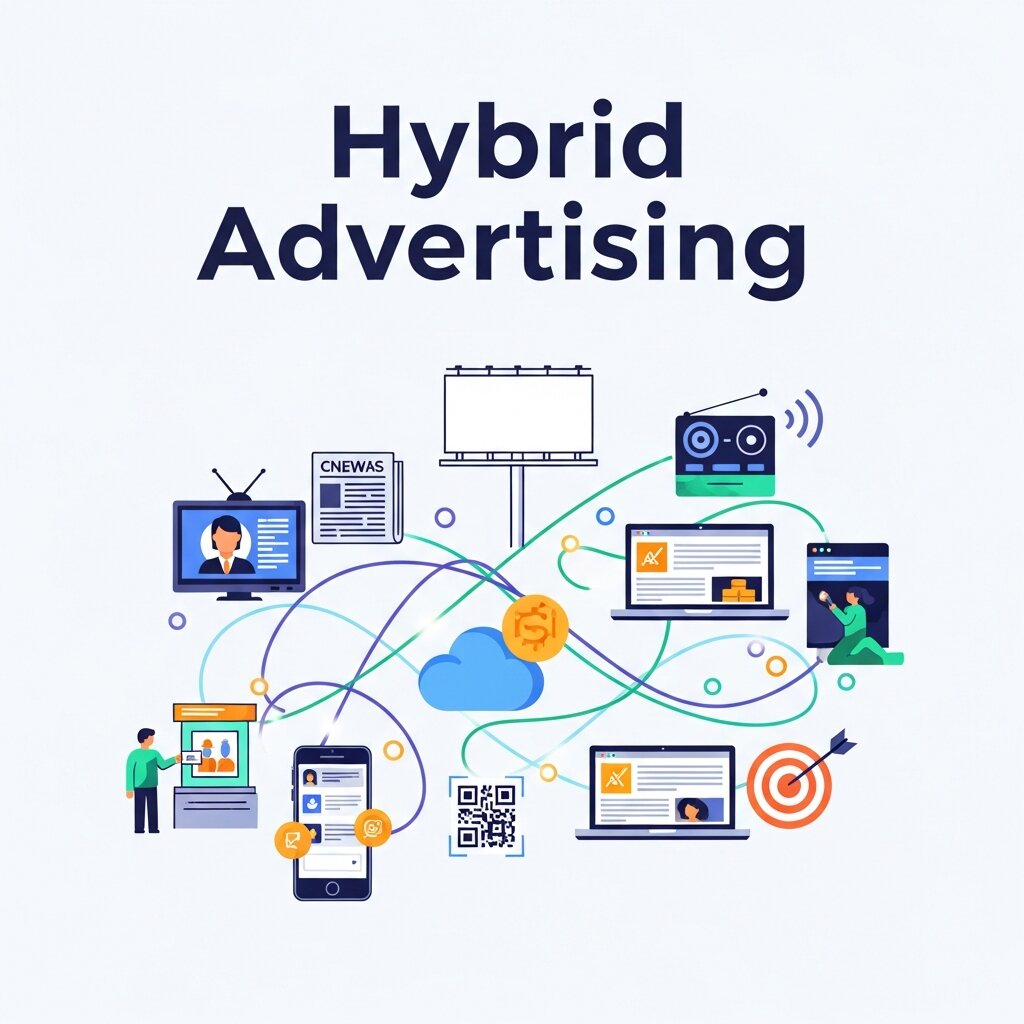
Hybrid advertising blends online and offline channels into one connected system, where each ad reinforces the others to lift reach, recall, and ROI across every customer touchpoint.
Your customers stopped sorting their lives into “online” and “offline” a long time ago. A prospect might catch your billboard on the morning commute, search your brand at lunch, and finally buy through a retargeted social ad that night. If your advertising shows up in only one of those moments, you hand the sale to a competitor who shows up in all three.
That gap is exactly what hybrid advertising closes. Rather than running print, TV, social, and search as separate campaigns with separate budgets, hybrid advertising weaves them into a single system. Traditional media builds broad awareness. Digital channels capture and convert that attention with precision.
According to Nielsen’s 2024 consumer research, buyers interact with brands across an average of six distinct touchpoints before making a purchase. A brand present in only one or two of those moments loses ground fast. This guide walks you through what hybrid advertising is, the channels that power it, how to build integrated marketing campaigns, and how to develop an omnichannel advertising strategy that performs. By the end, you’ll have a practical roadmap you can apply to your own brand.
What Is Hybrid Advertising?
Hybrid advertising is a promotional framework that intentionally combines traditional offline channels—print, TV, radio, direct mail, billboards—with digital channels like SEO, social media, email, and paid search into one unified strategy. The defining feature is integration: each channel reinforces the others rather than running in isolation.
The distinction matters. Running a TV commercial and a Facebook ad at the same time isn’t hybrid advertising—that’s just multichannel marketing. True hybrid advertising connects the two. A TV spot drives viewers to a branded hashtag, which feeds retargeting data into your social campaigns. A billboard with a QR code turns a passive impression into a trackable click. That deliberate connection is what separates online and offline advertising done well from scattered tactics running side by side.
The Evolution of Advertising: From Silos to Synergy
For most of the 20th century, advertising flowed one way. Brands bought commercials and print spreads, then waited to see what happened. There was no click data, no real-time targeting, and no easy way to know which ad drove which sale.
The internet rewrote those rules. Marketers could suddenly track every interaction, target audiences by behavior, and adjust campaigns within minutes. Many predicted digital would replace traditional advertising entirely. It didn’t. Physical channels still carry weight that digital struggles to match—billboards build recognition display ads can’t replicate, and direct mail achieves response rates email marketers envy. The smartest brands stopped choosing sides and started combining both. For a deeper look at where each approach wins, our guide on hybrid advertising in digital marketing breaks it down.
Why Hybrid Advertising Is Crucial Today
No single channel covers the entire customer journey anymore. Digital marketing delivers precision and measurable data, but it can’t manufacture the broad trust a full-page print spread builds. Traditional marketing builds authority and reach, but it struggles with targeting and attribution. Hybrid advertising captures the strengths of both while minimizing each one’s weaknesses.
There’s a resilience benefit too. A digital-only brand stays vulnerable to algorithm changes on Meta or Google. A traditional-only brand can’t respond to a viral moment or retarget warm leads. Combining both creates a system that performs across the full funnel and adapts when one channel stumbles.
The Core Components of Hybrid Advertising
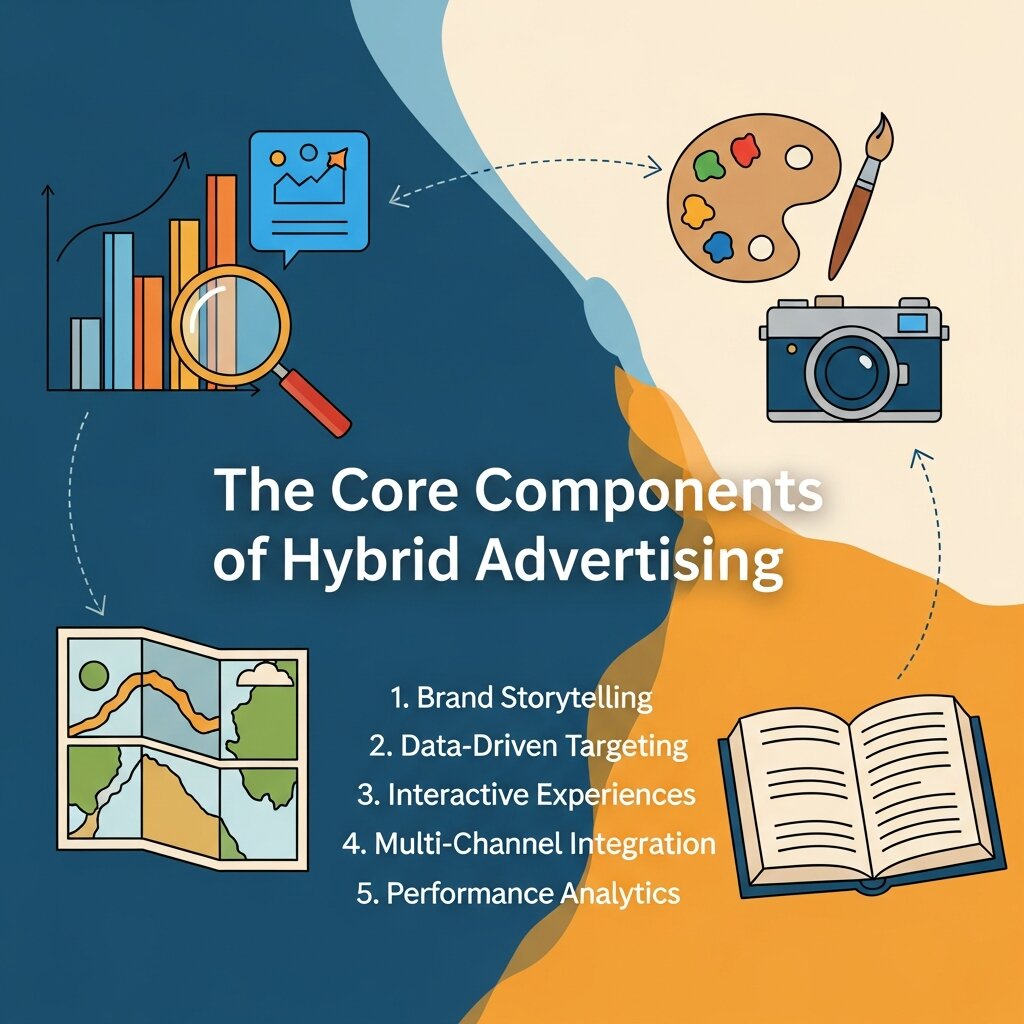 A strong hybrid advertising strategy draws from two distinct toolkits. Knowing what each contributes—and where each falls short—is the foundation of building a system that works.
Online Advertising Channels
Digital advertising delivers speed, precision, and measurable performance. The core components include:
- Search Engine Marketing (SEM) and SEO: SEO earns organic visibility that compounds over time, while paid search captures intent-driven prospects the moment they search for solutions.
- Social Media Marketing (SMM): Platforms like LinkedIn, Instagram, Facebook, and TikTok build communities and serve highly targeted ads based on demographics and behavior.
- Display Advertising and Programmatic Buying: Automated ad placement puts your message in front of the right audience across thousands of sites in real time.
- Content Marketing and Influencer Collaborations: Content educates buyers at every funnel stage, while influencers extend your reach into trusted, engaged communities.
- Email Marketing: Email delivers some of the highest ROI of any channel, especially when paired with personalization and automation.
Offline Advertising Channels
Traditional advertising builds broad reach and deep credibility. The core components include:
- Traditional Media (TV, Radio, Print): Broadcast and print reach mass audiences at once and signal an authority that digital ads can’t easily fake.
- Out-of-Home (OOH) Advertising: Billboards and transit signage create memorable, geographically targeted brand recognition.
- Direct Mail: Physical postcards and catalogs cut through crowded inboxes, often outperforming email for specific segments.
- Experiential Marketing and Events: Hands-on brand experiences create emotional connections that screens rarely match.
- Public Relations (PR): Earned media and thoughtful storytelling build trust and authority that paid ads can’t buy.
The hybrid element isn’t running both at once—it’s designing them to amplify each other. A direct mail postcard with a QR code creates tactile engagement and trackable online traffic simultaneously. A radio spot promotes a social giveaway, turning broadcast reach into measurable digital action. Our hybrid marketing channel complete guide breaks down how these channel combinations perform across the journey.
Crafting Integrated Marketing Campaigns: The Art of Synergy
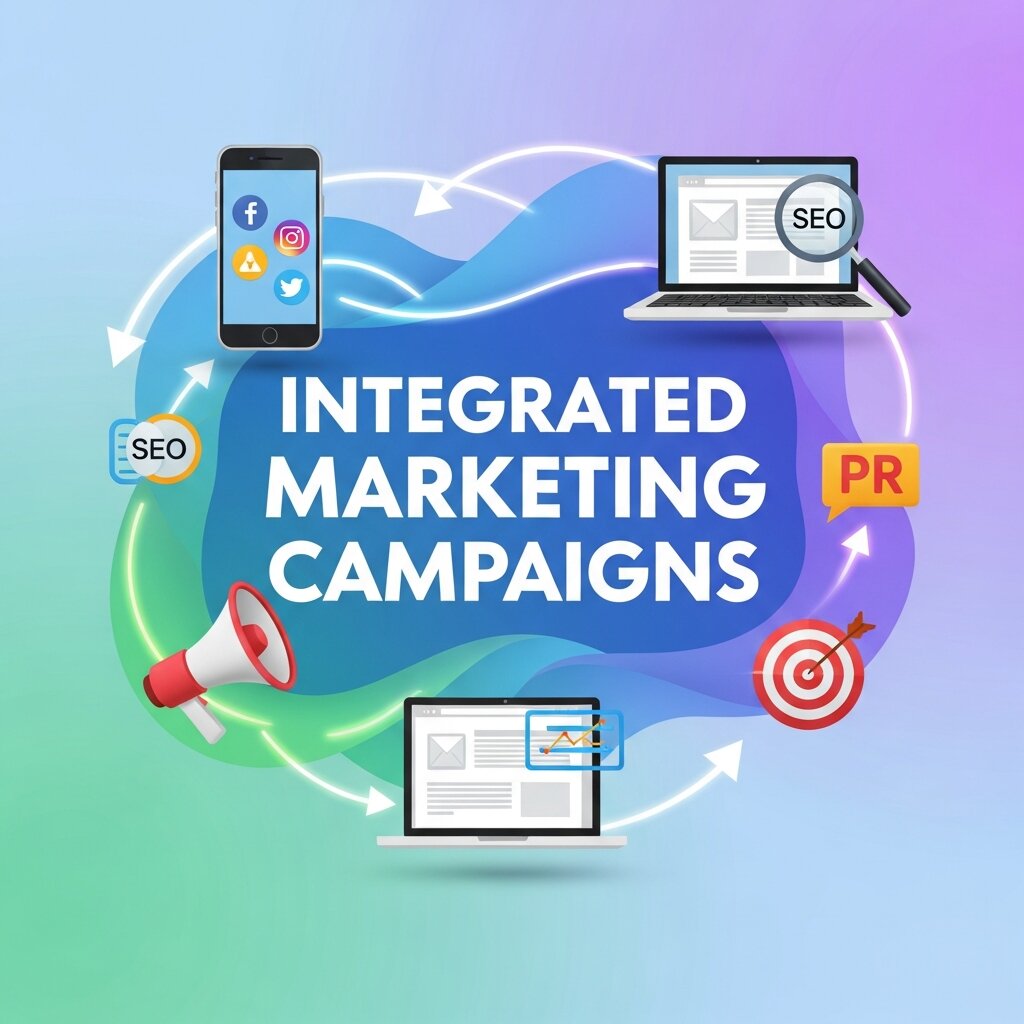 Knowing the components is one thing. Weaving them into integrated marketing campaigns that actually perform takes deliberate design.
Why a Unified Brand Message Matters
Consistency turns scattered ads into a memorable brand. Your core value proposition must stay identical whether a customer sees a billboard or an Instagram story. Inconsistency creates cognitive friction that slows the buying decision. Establish a clear brand style guide—governing color, tone, and offer—before launching any campaign, and centralize approval under a single owner to prevent messaging drift.
Aligning Online and Offline Objectives
Online and offline channels should chase shared goals, not separate ones. Define what role each channel plays in the funnel: broadcast and OOH build top-of-funnel awareness, while PPC and social capture and convert that demand. When every channel feeds a single objective, integrated marketing campaigns stop competing for credit and start compounding results.
Data Integration and Cross-Channel Analytics
You can’t improve what you don’t measure. Combining data from physical point-of-sale systems, e-commerce platforms, and CRM records creates a far richer picture than any single channel can provide. Embed digital tracking into offline efforts—unique promo codes on direct mail, vanity URLs on billboards, dedicated phone numbers in radio spots—so offline exposure connects to digital conversions. According to Forrester Research (2024), organizations using unified marketing measurement tools improve campaign effectiveness by up to 30%.
Personalization at Scale Across All Touchpoints
Personalization transforms a generic interaction into a relevant experience. Behaviorally-targeted marketing is roughly twice as effective as non-targeted marketing. The challenge is doing this at scale. Hybrid advertising makes it possible by connecting data across channels, so personalization follows the customer whether they’re reading an email, browsing your site, or walking past a geofenced billboard.
Developing an Omnichannel Advertising Strategy
An omnichannel advertising strategy is the operational backbone of hybrid advertising. It ensures every channel a customer encounters delivers the same consistent experience.
Understanding the Customer Journey in a Hybrid Landscape
The classic marketing funnel assumed a tidy path: awareness, consideration, decision. Today’s reality is messier. A buyer might discover a product through a podcast ad, research it on their phone, see it in a store, read reviews online, and finally purchase weeks later. Map every touchpoint your customers encounter so you know which channels matter at each stage.
Seamless Transitions: Guiding Customers Across Channels
Moving from one channel to another should feel frictionless. A social commerce buyer should access the same loyalty program as an in-store shopper. Practical bridges make this tangible: QR codes on print ads that link to campaign-specific landing pages, branded hashtags that unlock in-store discounts, and direct mail paired with geofenced digital ads hitting the same postal codes twice.
Leveraging Technology for Omnichannel Orchestration
Three technology categories make an omnichannel advertising strategy functional. CRM platforms like HubSpot or Salesforce track every interaction into a single source of truth. Marketing automation tools deliver personalized, timely communication at scale. Unified analytics dashboards pull digital and offline data into one performance picture, enabling fast reallocation decisions.
Measuring Omnichannel Effectiveness
Track channel-level metrics like conversion rate, cost per acquisition, and average order value alongside system-level metrics like cross-channel attribution and customer lifetime value. According to McKinsey’s research on consumer decision journeys, brands that measure cross-channel behavior consistently make better resource allocation decisions than those tracking efforts in isolation.
Benefits of Hybrid Advertising
When traditional and digital advertising work as one system, the payoff shows up across four measurable dimensions.
Increased Reach and Brand Awareness
Hybrid advertising meets customers wherever they are. Some prefer physical touchpoints—an event, a catalog, a TV spot. Others live in digital spaces. Campaigns that span five or more channels consistently generate higher brand recall than single-channel efforts, because each additional touchpoint reinforces recognition.
Enhanced Customer Engagement and Loyalty
Cross-promotion turns a single impression into a multi-touchpoint experience. Loyalty programs that span both physical and digital channels reward customers for engaging everywhere, not just one place. Responsive, two-way communication—acknowledging customers by name and answering questions in real time—deepens the kind of loyalty that compounds over time.
Improved ROI and Cost Efficiency
Hybrid advertising solves traditional media’s old measurement problem by embedding digital tracking into offline efforts. Feed that data into a CRM, and you can prove how offline awareness lowers the cost-per-click of your online retargeting. Behaviorally-targeted marketing being twice as effective as non-targeted marketing means spend drops while ROI climbs.
Deeper Data Insights for Strategic Decision-Making
Every channel generates data about customer behavior and purchasing patterns. Combined into one view, that data set reveals which channels drive value and which drain budget—giving stakeholders the evidence they need to allocate resources with confidence.
Challenges and Solutions in Hybrid Advertising Implementation
 The hybrid model is powerful, but the rollout comes with real hurdles. Each one has a clear solution.
Budget Allocation and Resource Management
Splitting budget across channels is both a financial and political challenge, since every channel owner advocates for their own priorities. Base decisions on performance data, not internal lobbying. There’s no universal ratio between traditional and digital spend—let business goals guide it. Reserve 15–20% of your budget for testing new channel combinations, then shift spend toward whatever delivers the strongest ROI.
Data Silos and Integration Hurdles
Channel data frequently lives in disconnected systems. The fix is a CRM that acts as a single source of truth, mapping every interaction back to one customer profile. Establishing this infrastructure early prevents costly data migration projects later.
Maintaining Brand Consistency
The more channels you run, the greater the risk of messaging drift. Centralize brand governance under a single owner who approves all channel-specific creative, build a clear brand style guide before launch, and conduct regular audits to keep every touchpoint aligned.
Measuring Attribution in a Complex Ecosystem
Connecting a billboard impression to a website conversion is technically tricky. Establish attribution models before launch using QR codes, vanity URLs, and unique promo codes, then route everything into your CRM so offline and online results sit side by side.
Case Studies: Successful Hybrid Advertising in Action
A Retail Brand’s Integrated Product Launch
Coca-Cola’s “Share a Coke” campaign remains the textbook example of hybrid advertising. The company printed popular consumer names on physical bottles—a traditional product-marketing tactic—then encouraged buyers to photograph and share their personalized bottles using a branded hashtag. The physical product drove digital engagement, and the digital buzz amplified physical sales. The campaign lifted sales across every market where it ran.
A Service Provider’s Local and Digital Outreach
A regional furniture retailer ran a hybrid advertising strategy by mailing high-quality catalogs to targeted postal codes while using geo-fencing to serve Facebook and Instagram ads to mobile devices in those exact areas. Customers received a physical catalog and a digital ad within the same window. The dual exposure built familiarity and drove measurable foot traffic to showrooms—proof that the whole outperformed the sum of its parts. For more on shifting toward this model, see our hybrid marketing model transition strategy guide.
Future Trends in Hybrid Advertising
The line between traditional and digital advertising will keep narrowing. Four shifts are accelerating that convergence.
- AI and Machine Learning in Campaign Optimization: AI-powered tools enable real-time audience segmentation, predictive analytics, and automated personalization at a scale no human team could match.
- Augmented Reality (AR) and Virtual Reality (VR) Experiences: AR already lets consumers point a phone at a print ad to trigger interactive 3D experiences, blurring the line between physical and digital.
- Hyper-Personalization and Predictive Analytics: Customers increasingly expect physical and digital touchpoints to feel like one continuous conversation rather than separate brand interactions.
- The Evolving Role of Data Privacy: As personalization deepens, clear consent, compliance with regulations like GDPR and CCPA, and regular audits become non-negotiable.
The Data & Marketing Association continues to document how integrated campaigns outperform isolated channel efforts. To see how these principles apply to live events, explore our guide on hybrid event marketing strategies.
The Future Is Hybrid
Hybrid advertising answers a simple truth: your customers don’t live in just one channel, so your advertising can’t either. Brands that build systems where traditional and digital efforts reinforce each other consistently outperform those treating the two as rivals.
Start by auditing your current advertising mix. Find the gaps—where messaging diverges, where data doesn’t flow, where online and offline efforts run on separate tracks. Those gaps are your fastest wins. Close them one at a time, and the compounding effect of a truly integrated approach will follow: wider reach, richer data, and stronger ROI. Brands that invest in hybrid advertising now will be best positioned as it becomes the default expectation rather than a competitive edge.
Frequently Asked Questions
1. What is hybrid advertising?
Hybrid advertising combines traditional offline channels—print, TV, radio, direct mail, billboards—with digital channels like SEO, social media, and PPC into one coordinated strategy. The goal is to reach customers across multiple touchpoints while ensuring each channel reinforces the others with consistent messaging.
2. How is hybrid advertising different from multichannel advertising?
Multichannel advertising runs ads across several channels that operate independently. Hybrid advertising integrates online and offline advertising so the channels actively reinforce each other, sharing data, messaging, and a unified customer experience.
3. What are the main benefits of integrated marketing campaigns?
Integrated marketing campaigns expand reach, strengthen brand recognition, and improve ROI. They also make offline performance measurable by embedding digital tracking into traditional ads, and they reduce a brand’s dependency on any single channel.
4. How do you measure the ROI of offline channels in hybrid advertising?
Embed trackable digital mechanisms into offline materials—unique QR codes, custom vanity URLs, dedicated promo codes, and trackable phone numbers. Feed that data into a centralized CRM so offline conversions are attributed accurately alongside digital results.
5. Is hybrid advertising suitable for small businesses?
Yes. A small business can pair affordable flyers or local event sponsorships with targeted Facebook or Google ads. Hybrid advertising doesn’t require a large budget—it requires strategic integration of whatever channels you already use, supported by a simple CRM.
6. How should I allocate budget between online and offline advertising?
There’s no fixed ratio. Brands chasing mass awareness weight spend toward broadcast and outdoor; those prioritizing lead generation lean toward PPC and social. Reserve 15–20% of your total budget for testing new channel combinations, then scale what works.
7. What technology do I need to build an omnichannel advertising strategy?
Core requirements include a CRM platform that tracks offline and online leads, marketing automation tools for personalized communication, and a unified analytics dashboard that aggregates data from every channel into one performance view.
8. What are the biggest challenges in hybrid advertising?
The three most common challenges are data integration and attribution across disconnected systems, budget allocation across competing channels, and maintaining brand consistency as channels multiply. Each is solved with clear attribution models, data-driven budgeting, and centralized brand governance.
9. How does content marketing fit into hybrid advertising?
Content marketing is the educational backbone of the model. Traditional ads capture attention and direct audiences to your website, where blogs, guides, and videos build the trust needed to convert a prospect into a customer—while also supporting SEO.
10. How quickly can I expect results from hybrid advertising?
Digital elements like PPC can generate traffic within hours. Traditional elements like direct mail and PR typically take three to six months to build measurable brand authority. A strong hybrid advertising strategy balances immediate performance with long-term growth.