
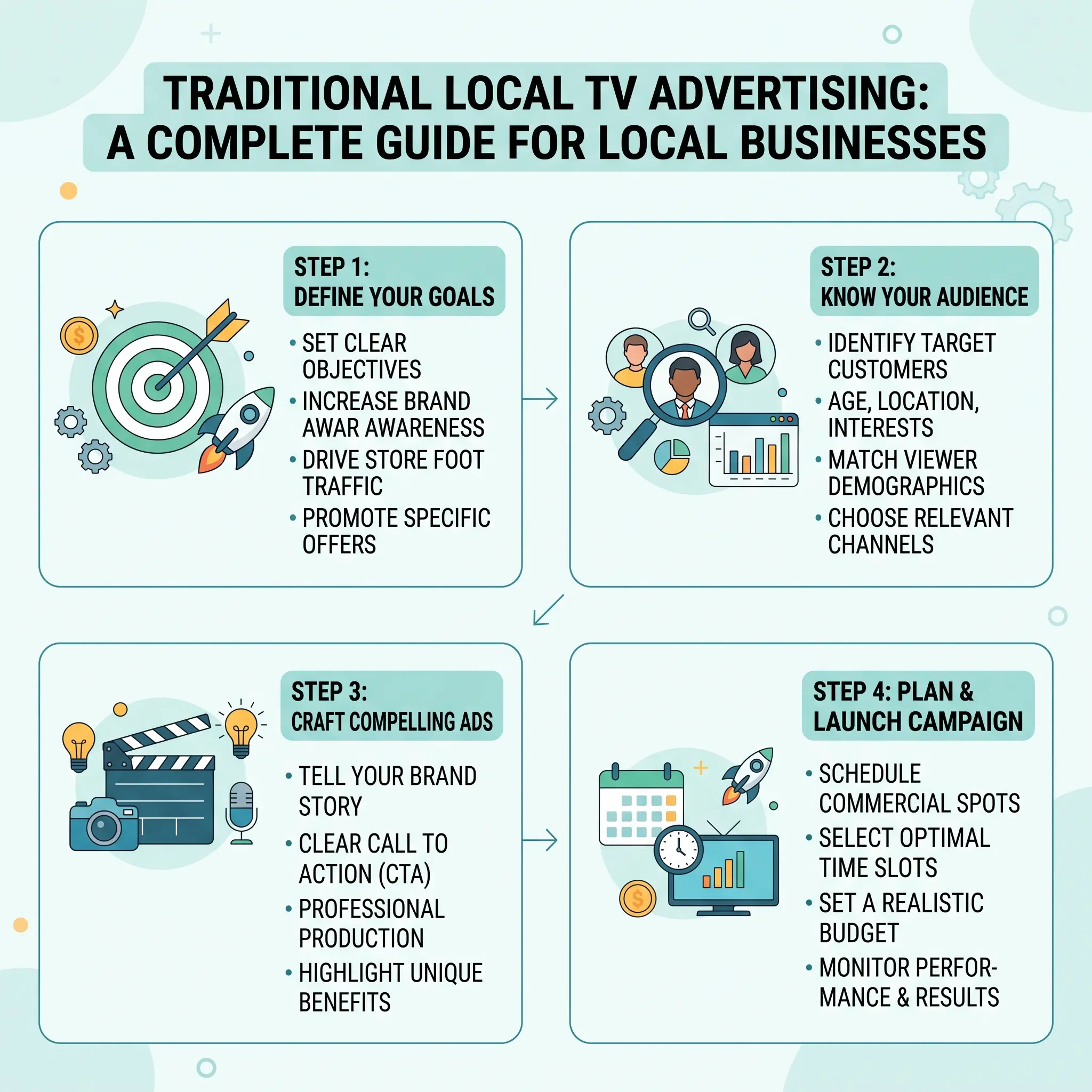
Traditional local TV advertising helps businesses reach audiences within a specific geographic market through local television stations, programs, and commercial slots. It can build brand awareness, establish local credibility, promote products or services, and drive customers to physical locations or websites. This guide explains how local TV advertising works, its benefits, costs, targeting strategies, campaign planning process, common mistakes, and ways to measure results.
In an increasingly digital marketing environment, businesses have more ways than ever to reach potential customers. Search engines, social media, email, and online advertising provide highly targeted digital opportunities. However, traditional local TV advertising remains a valuable channel for businesses that want to build awareness within a specific community.
Local television allows companies to combine sight, sound, storytelling, and repetition to communicate their message. A well-produced commercial can introduce a business to thousands of households while creating a sense of familiarity and local presence.
For restaurants, retailers, healthcare providers, real estate companies, law firms, automotive businesses, educational institutions, and service providers, local television can be particularly useful because many of their customers live within a defined geographic area.
This guide explains how traditional local TV advertising works and how businesses can create effective campaigns without wasting their advertising budget.
What Is Traditional Local TV Advertising?
Traditional local TV advertising is the practice of purchasing commercial airtime on television stations that serve a particular geographic market.
Instead of trying to reach viewers across an entire country, a business can advertise within a specific:
- City
- Metropolitan area
- County
- Region
- Television market
- Community
For example, a local restaurant does not necessarily need national television exposure. Its potential customers are people who live or work close enough to visit the restaurant.
Similarly, a local roofing company, dental clinic, car dealership, or law firm can focus its advertising on households within its service area.
Traditional local TV advertising generally involves three main components:
- Commercial production
- Media placement
- Campaign measurement
Businesses create a television commercial, purchase appropriate airtime, and then measure whether the campaign generates awareness, inquiries, visits, leads, or sales.
How Traditional Local TV Advertising Works
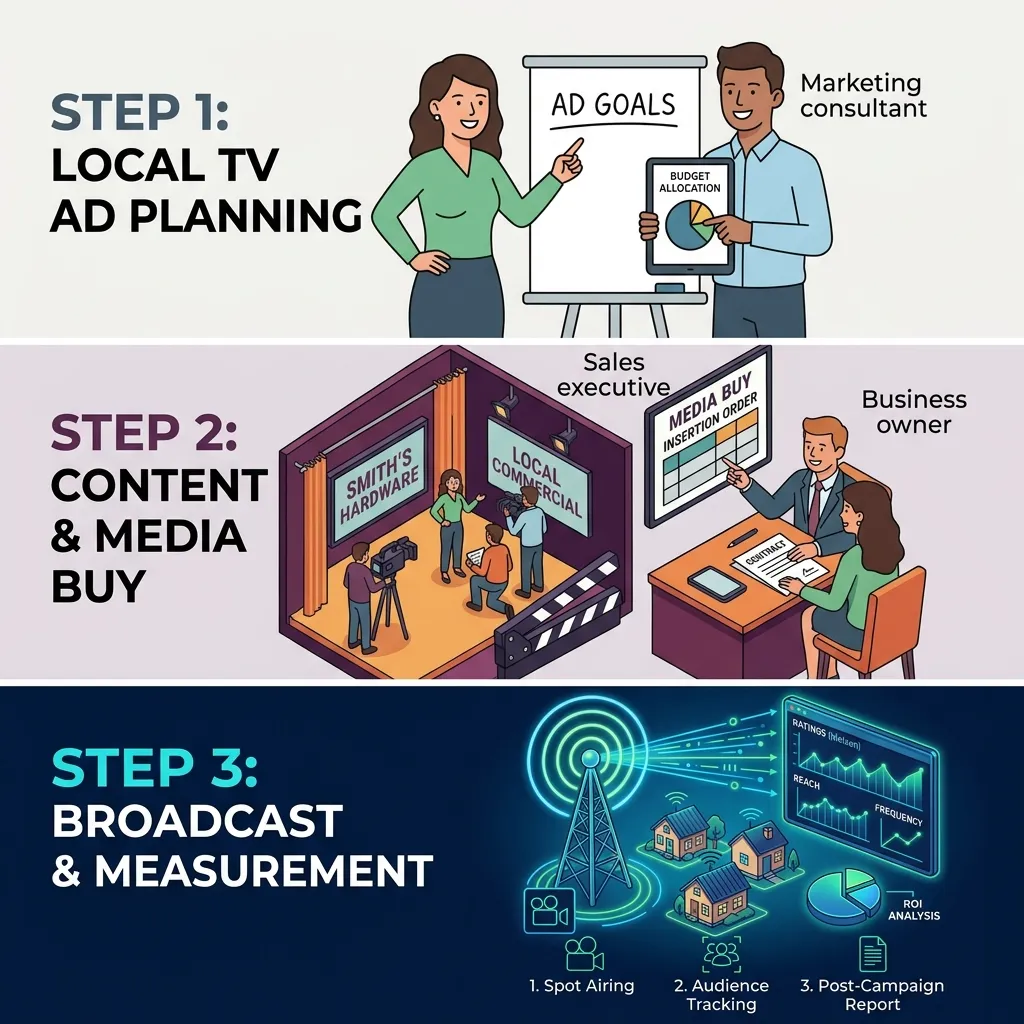
The process is relatively straightforward, but successful campaigns require careful planning.
1. Define the Target Market
First, determine exactly where potential customers are located.
Consider:
- Service area
- Population
- Customer demographics
- Household income
- Age groups
- Consumer interests
- Local competition
- Purchasing behavior
A local TV campaign should focus on areas where the business can realistically serve customers.
2. Select Local TV Stations
Different stations attract different audiences.
For example, one station may have a strong news audience while another may attract viewers interested in sports, entertainment, or specific programming.
Compare stations based on:
- Audience demographics
- Geographic coverage
- Programming
- Viewing patterns
- Commercial rates
- Audience reach
- Frequency opportunities
3. Choose Programming and Time Slots
The timing of a commercial can significantly affect who sees it.
Common placements include:
- Morning news
- Daytime programming
- Evening news
- Prime time
- Sports programming
- Weekend programming
- Special events
The best placement depends on the target audience.
4. Produce the Commercial
The commercial should communicate one central message clearly.
A local commercial can feature:
- Business location
- Employees
- Customers
- Products
- Services
- Local landmarks
- Community involvement
- Special offers
- Contact information
Authentic local elements can make the advertisement feel more relevant to the community.
5. Schedule the Campaign
Once the commercial is approved, the advertiser purchases a schedule based on budget and campaign goals.
A campaign may run for several weeks or longer.
6. Measure Results
Finally, track whether the advertising is producing meaningful business outcomes.
Useful metrics include:
- Website visits
- Phone calls
- Store visits
- Appointment requests
- Leads
- Coupon redemptions
- Branded searches
- Sales
For broader information about television advertising, see the complete guide to traditional TV advertising.
Why Traditional Local TV Advertising Still Works
Traditional local television has several characteristics that make it useful for local businesses.
Strong Local Reach
Local stations are designed to serve specific communities. This makes them naturally relevant to businesses whose customers are geographically concentrated.
Visual Storytelling
Television combines moving images, sound, music, dialogue, and graphics.
This allows businesses to demonstrate their products or services rather than simply describing them.
Builds Familiarity
Repeated exposure can make a local business more familiar to viewers.
When people repeatedly see a company, its logo, employees, location, or message, the business may become easier to recognize when a purchasing need arises.
Creates Local Credibility
Appearing on a recognized local television station can contribute to the perception that a business is established and active within the community.
Reaches Multiple Demographics
Television can reach different age groups and household types, depending on programming and market selection.
Benefits of Traditional Local TV Advertising
1. Builds Local Brand Awareness
Local businesses need customers to know they exist.
A television commercial can introduce a company to a large number of people within its target market.
2. Supports Geographic Targeting
Local TV allows businesses to concentrate their media budget on areas where they operate.
This can be particularly useful for:
- Local retailers
- Restaurants
- Medical practices
- Home service companies
- Auto dealerships
- Real estate agencies
- Financial businesses
- Educational institutions
3. Demonstrates Products and Services
A video commercial can show how a product works or what a service experience looks like.
For example, a furniture store can show its showroom, while a restaurant can showcase its food and atmosphere.
4. Creates Emotional Connections
Television is effective for storytelling.
A local business can tell a short story involving:
- A customer problem
- The business solution
- A positive experience
- A memorable brand message
5. Supports Promotional Campaigns
Local businesses can use TV to promote:
- Seasonal sales
- Grand openings
- New products
- Special events
- Limited-time offers
- Community activities
6. Strengthens Other Marketing Channels
TV advertising does not have to operate independently.
A commercial can encourage viewers to:
- Search for the company
- Visit its website
- Follow social media accounts
- Call a phone number
- Visit a physical location
Businesses can also combine TV with other traditional channels through an integrated marketing strategy.
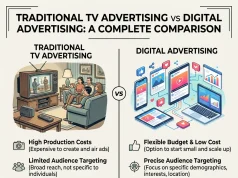
Traditional Local TV Advertising vs. Digital Advertising
Traditional television and digital advertising have different strengths.
| Factor | Local TV Advertising | Digital Advertising |
|---|---|---|
| Geographic reach | Strong | Strong |
| Visual storytelling | Excellent | Excellent |
| Immediate interaction | Limited | Strong |
| Audience targeting | Moderate | Highly granular |
| Local credibility | Strong | Varies |
| Measurement | Improving | Extensive |
| Creative format | Video-focused | Multiple formats |
| Frequency | Schedule-based | Highly adjustable |
| Local awareness | Strong | Strong |
Digital advertising can provide detailed targeting and immediate performance data, while local TV can provide broad local exposure and powerful audiovisual storytelling.
Businesses do not necessarily have to choose one over the other.
A combination of television and digital marketing can create a stronger overall strategy.
For a deeper comparison, see traditional TV advertising vs. digital advertising.
How to Create an Effective Local TV Commercial

Creating a successful commercial starts with a clear strategy.
Start With One Main Message
Viewers have limited attention.
Do not try to explain everything about your company in one commercial.
Instead, focus on one primary idea.
For example:
“Your neighborhood’s trusted family dental clinic.”
The rest of the commercial should reinforce that message.
Show the Business
Whenever possible, show real elements of the business.
This could include:
- Storefront
- Employees
- Products
- Service process
- Customers
- Interior
- Local surroundings
Real footage can help create authenticity.
Use a Strong Opening
The first few seconds matter.
A commercial could begin with:
- A customer problem
- A surprising statement
- A product demonstration
- An emotional moment
- A compelling question
- A strong visual
The goal is to make viewers want to continue watching.
Keep the Message Simple
Use straightforward language.
Avoid excessive technical terminology or complicated explanations.
Include a Clear Call to Action
Tell viewers exactly what they should do.
Examples include:
- Visit us today
- Call now
- Schedule an appointment
- Shop our new collection
- Visit our website
- Stop by our local store
Best Industries for Traditional Local TV Advertising
Local television can work across many industries.
Automotive
Car dealerships can use local TV to promote:
- New vehicles
- Used cars
- Financing offers
- Service departments
- Sales events
Restaurants
Restaurants can showcase:
- Signature dishes
- New menu items
- Special offers
- Restaurant atmosphere
- Grand openings
Healthcare
Hospitals, clinics, dental practices, and specialists can use television to increase local awareness.
Real Estate
Real estate businesses can showcase:
- Properties
- Neighborhoods
- Agents
- Market expertise
- New developments
Legal Services
Law firms can use local television to establish brand recognition and explain the types of cases they handle.
Home Services
Companies offering:
- Roofing
- Plumbing
- HVAC
- Electrical services
- Remodeling
- Landscaping
can target homeowners within their service areas.
Education
Schools, training centers, colleges, and educational organizations can use local television to promote enrollment and programs.
For small organizations specifically, this guide to traditional TV advertising for small businesses provides additional strategies.
How Much Does Traditional Local TV Advertising Cost?
The cost of local television advertising varies considerably.
Factors include:
- Market size
- Station popularity
- Program popularity
- Time of day
- Commercial length
- Campaign frequency
- Season
- Competition for airtime
- Production costs
Production Costs
Producing the commercial may involve:
- Scriptwriting
- Actors
- Videographers
- Equipment
- Locations
- Editing
- Voiceover
- Music
- Graphics
Media Costs
The second major expense is purchasing airtime.
Prime-time placements generally have different pricing from less competitive time slots.
For a detailed explanation of TV advertising expenses, see the traditional TV advertising cost guide.
How to Choose the Right Local TV Schedule
A successful campaign is not necessarily the one with the most expensive placements.
The goal is to reach the right audience repeatedly.
Consider Audience Fit
Ask:
- Who watches this program?
- Does the audience match our customers?
- What age groups are represented?
- Where do viewers live?
- When are they watching?
Consider Frequency
Seeing a commercial once may not be enough.
Repeated exposure can help improve recognition and message recall.
Consider Timing
Different businesses may benefit from different schedules.
For example:
- Restaurants may focus on meal-related viewing periods.
- Retailers may promote weekend offers.
- Financial services may target news programming.
- Family services may use daytime or evening programming.
Local TV Advertising Strategy for Small Businesses
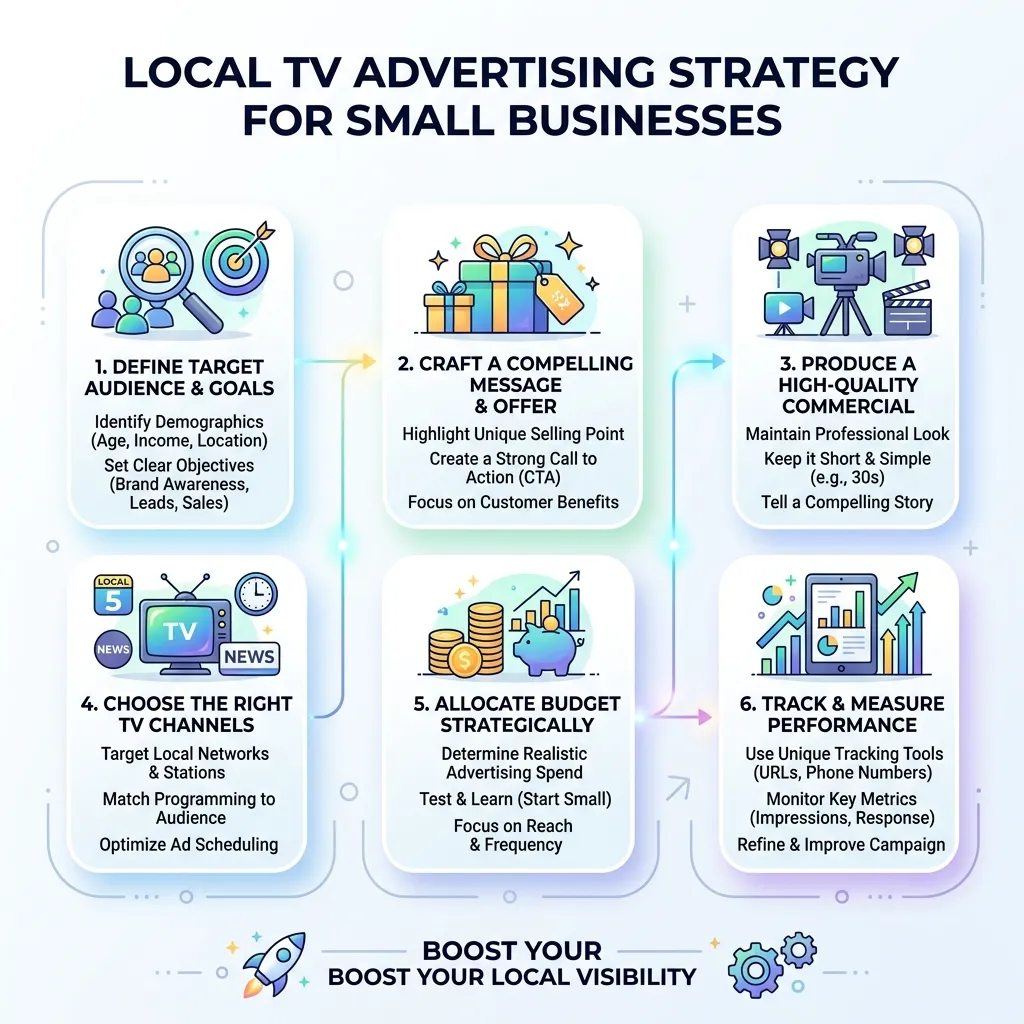
Small businesses often have limited budgets, so planning becomes especially important.
Set a Realistic Budget
Determine how much you can spend on:
- Production
- Airtime
- Creative revisions
- Tracking
- Supporting digital campaigns
Start With a Focused Market
Instead of attempting to reach an entire region, concentrate on your strongest service area.
Reuse Strong Creative Carefully
A commercial can run repeatedly when the message remains relevant.
However, refresh creative when:
- The offer changes
- Branding changes
- Audience response declines
- The commercial becomes outdated
Connect TV With Digital
Add a memorable website, branded search strategy, or campaign-specific landing page.
This allows viewers to continue their journey after seeing the commercial.
Measuring Traditional Local TV Advertising Results
Measuring local TV can be more complicated than measuring a digital ad click, but businesses can still establish useful tracking systems.
Track Calls
Use a dedicated campaign phone number where appropriate.
Track Website Traffic
Monitor increases in:
- Direct traffic
- Branded searches
- Local landing-page visits
Use Promo Codes
A unique offer or code can help identify customers influenced by the commercial.
Ask Customers
At checkout, during appointments, or when receiving inquiries, ask:
“How did you hear about us?”
Include television as one of the options.
Monitor Sales Trends
Compare sales or lead volume during the campaign with relevant periods before the campaign.
Measure Overall ROI
ROI should consider the revenue or business value generated relative to total campaign costs.
For broader offline measurement strategies, explore this guide to offline marketing metrics.
Common Traditional Local TV Advertising Mistakes
Mistake 1: Targeting Everyone
Trying to reach everyone can make a local campaign unnecessarily expensive.
Mistake 2: Making the Commercial Too Complicated
A viewer should understand the main message quickly.
Mistake 3: Weak Branding
The company name and brand should be memorable.
Mistake 4: No Clear Call to Action
Without a next step, viewers may remember the commercial but never act.
Mistake 5: Ignoring Frequency
One exposure may not generate enough recognition.
Mistake 6: Focusing Only on Airtime
A great media schedule cannot compensate for a poor commercial.
Mistake 7: Not Tracking Results
Without tracking, it becomes difficult to determine whether television is contributing to business growth.
How to Improve Traditional Local TV Advertising Performance
Use Local Storytelling
People often respond to stories that feel relevant to their community.
Highlight Your Difference
Explain why customers should choose your business instead of competitors.
Your differentiator could be:
- Better service
- Local ownership
- Experience
- Convenience
- Unique products
- Faster service
- Specialized expertise
Repeat Your Core Message
Consistency improves recognition.
Make the Brand Memorable
Use consistent:
- Logo
- Tagline
- Voice
- Visual identity
- Brand message
Combine TV With Other Channels
Integrating TV with digital advertising, social media, direct mail, radio, and local events can create multiple touchpoints.
For example, businesses can support their TV campaigns with traditional marketing strategies across other offline channels.
Traditional Local TV Advertising Checklist
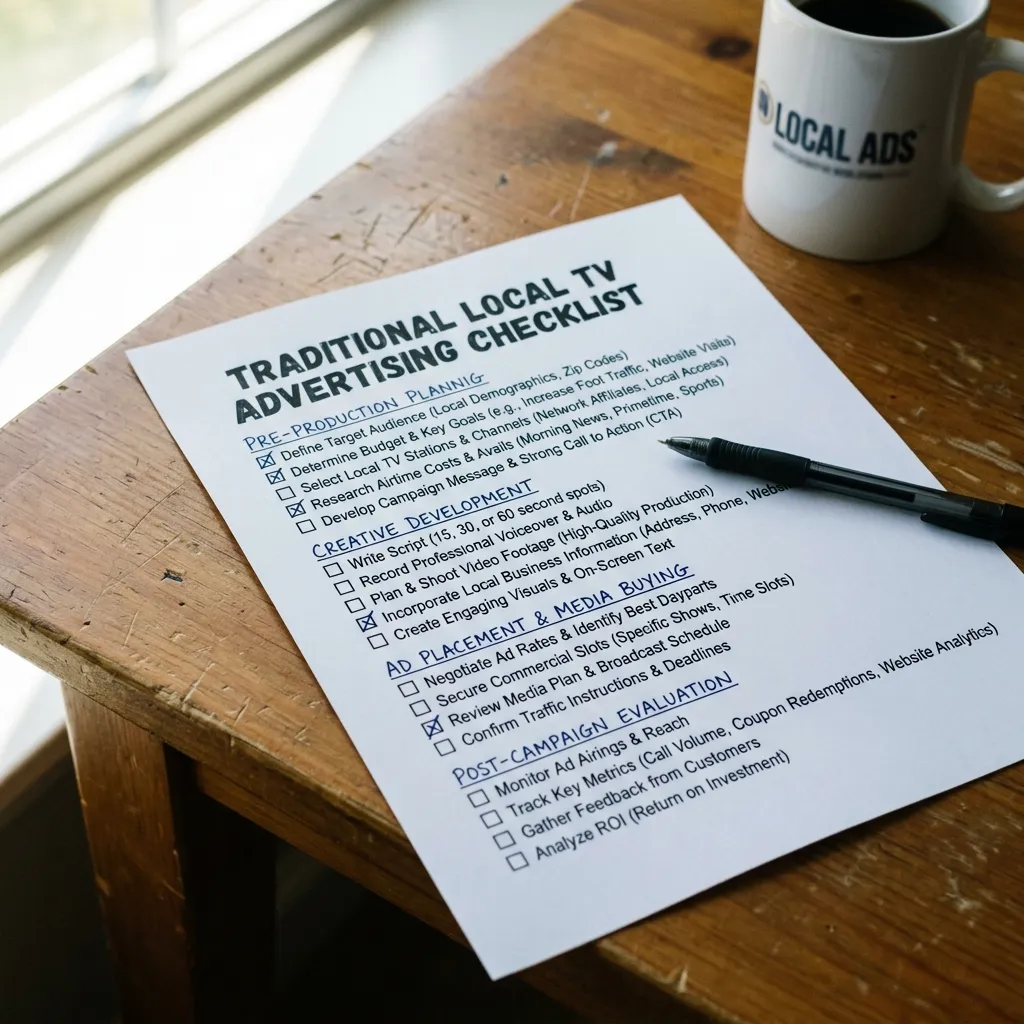
Before launching your campaign, make sure you have:
- Defined your target market
- Selected the appropriate geographic area
- Researched local TV stations
- Evaluated audience demographics
- Established a campaign budget
- Defined one primary advertising objective
- Created a clear commercial concept
- Produced professional video
- Added strong branding
- Included a clear call to action
- Selected appropriate programs
- Planned sufficient frequency
- Created a tracking method
- Connected the campaign with digital channels
- Established performance KPIs
Future of Traditional Local TV Advertising
Traditional television is evolving rather than simply disappearing.
Local advertisers increasingly have access to technologies that can improve targeting, measurement, and integration with digital campaigns.
Connected TV, addressable advertising, data-driven planning, and cross-channel measurement are changing how advertisers think about television.
However, traditional local television continues to provide an important advantage: the ability to communicate a brand story to a geographically concentrated audience through sight and sound.
Businesses can therefore use traditional TV as part of a broader marketing mix instead of treating it as an isolated advertising channel.
Conclusion
Traditional local TV advertising remains a useful strategy for businesses that want to build awareness and reach customers within a specific geographic market.
Its biggest strengths are local reach, visual storytelling, brand familiarity, credibility, and the ability to communicate a message through sight and sound. However, successful campaigns require more than purchasing airtime.
Businesses need to identify the right audience, select suitable programming, create a focused commercial, maintain sufficient frequency, provide a clear call to action, and track meaningful business outcomes.
When local TV is combined with digital marketing and other traditional channels, it can become an important part of an integrated marketing strategy. The key is to focus on the right audience, the right message, and the right measurement approach.
Frequently Asked Questions
1. What is traditional local TV advertising?
Traditional local TV advertising involves purchasing commercial airtime on television stations that serve a specific geographic area, such as a city, region, or local television market.
2. Is local TV advertising effective for small businesses?
Yes. Local TV can help small businesses build awareness among customers within their service area, especially when the campaign uses focused targeting and consistent messaging.
3. How much does local TV advertising cost?
Costs vary depending on the market, station, program, time slot, commercial length, campaign frequency, and production requirements.
4. What businesses benefit most from local TV advertising?
Restaurants, automotive dealerships, healthcare providers, real estate companies, law firms, retailers, home service companies, educational institutions, and other location-based businesses can benefit from local TV.
5. How long should a local TV commercial be?
Common formats include 15-, 30-, and 60-second commercials. A 30-second commercial is often useful when a business needs enough time to communicate a message while keeping production and airtime requirements manageable.
6. How do I choose the right local TV station?
Evaluate the station’s audience, geographic coverage, programming, demographics, advertising rates, reach, and frequency opportunities.
7. Can local TV advertising increase website traffic?
Yes. A commercial can encourage viewers to search for the business or visit its website. Branded search and direct website traffic can be useful supporting indicators.
8. How often should a local TV commercial run?
There is no universal frequency. The appropriate schedule depends on budget, campaign length, audience behavior, competition, and the level of awareness the business wants to achieve.
9. Should local businesses combine TV and digital advertising?
Yes. Combining television with digital channels can provide both broad local awareness and more measurable online engagement.
10. How can I measure local TV advertising ROI?
Businesses can track calls, website activity, leads, appointment requests, promotional codes, customer surveys, store visits, sales, and other campaign-specific indicators.
11. Is traditional local TV advertising still relevant?
Yes. Although digital advertising has expanded significantly, local television remains useful for geographic awareness, audiovisual storytelling, and repeated brand exposure.
12. What makes a local TV commercial successful?
A successful local TV commercial typically has a clear target audience, one strong message, memorable branding, professional production, a compelling opening, local relevance, sufficient frequency, and a clear call to action.







[…] venue. It sits firmly within the world of traditional, offline advertising, alongside channels like local TV advertising and outdoor billboards, but it comes with a few characteristics that make it genuinely […]
[…] during daytime hours, while television carries the emotional and visual weight. Our guide on local television advertising covers how smaller advertisers approach TV buying without national-scale […]