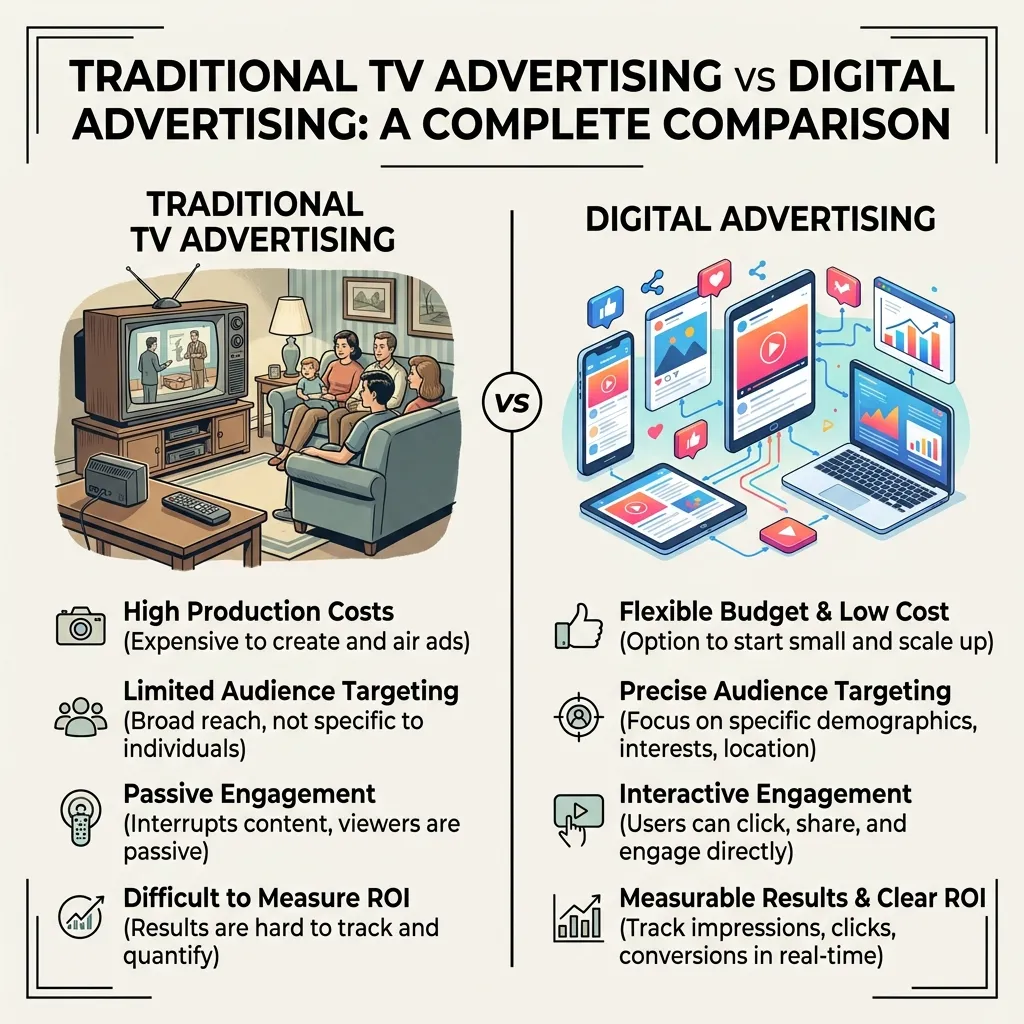
Businesses today have more advertising choices than ever. Traditional television remains a powerful way to reach large audiences, while digital advertising offers precise targeting, flexible budgets, and detailed performance tracking. Choosing between them is not always about deciding which channel is universally better. It is about understanding how each medium works and matching it to your business goals.
This guide compares traditional TV advertising vs digital advertising across cost, audience reach, targeting, engagement, measurement, flexibility, brand awareness, and return on investment. It also explains when businesses should use TV advertising, when digital advertising makes more sense, and why combining both channels can create a stronger marketing strategy.
What Is Traditional TV Advertising?
Traditional TV advertising is the practice of promoting a business, product, service, or organization through television commercials broadcast to viewers. Advertisers typically purchase commercial spots during specific programs, time periods, or audience segments.
TV advertising can include:
- 15- or 30-second commercials
- 60-second commercials
- Sponsored programming
- Product placements
- Local television commercials
- National television campaigns
- Cable TV advertising
- Broadcast TV advertising
Television combines sight, sound, motion, storytelling, and repetition. These characteristics can make it particularly useful for companies trying to establish strong brand recognition.
Businesses interested in the fundamentals can also explore this traditional TV advertising complete guide for a broader overview.
What Is Digital Advertising?
Digital advertising involves promoting products or services through internet-connected platforms and digital channels. Instead of relying on a television broadcast schedule, advertisers can deliver ads across websites, search engines, social media platforms, streaming services, mobile apps, and other online environments.
Common digital advertising formats include:
- Search ads
- Display ads
- Social media ads
- Video ads
- Shopping ads
- Native advertising
- Retargeting campaigns
- Connected TV advertising
- Programmatic advertising
Digital advertising is highly data-driven. Advertisers can often define audiences based on factors such as interests, search behavior, demographics, location, device, or previous interactions with a business.
Traditional TV Advertising vs Digital Advertising: Key Differences
The biggest difference between traditional TV advertising vs digital advertising is how audiences are reached and measured.
| Factor | Traditional TV Advertising | Digital Advertising |
|---|---|---|
| Audience reach | Broad | Highly targeted |
| Targeting | Program, location, demographics | Demographics, interests, behavior, intent, location |
| Budget flexibility | Often requires larger commitments | Can start with smaller budgets |
| Measurement | Relies on audience estimates and campaign data | Detailed clicks, impressions, conversions, and other metrics |
| Engagement | Primarily passive | Often interactive |
| Creative format | Video and audio | Text, image, video, interactive formats |
| Optimization | Less immediate | Can be adjusted quickly |
| Brand awareness | Very strong | Strong, depending on channel |
| Conversion tracking | More difficult | Generally easier |
| Local targeting | Available | Often highly precise |
| Campaign flexibility | Lower | High |
| Retargeting | Limited | Widely available |
Neither channel automatically wins every category. The better option depends on the campaign objective, audience, budget, and sales process.
1. Audience Reach
Television has traditionally been associated with mass-market reach. A commercial placed during a popular program can potentially expose a brand to a large number of viewers at the same time.
This makes TV particularly valuable for businesses that want widespread awareness.
Digital advertising works differently. Instead of broadcasting one message to everyone watching a program, advertisers can define specific audience groups and deliver different messages to different users.
For example, an online retailer might target people who have recently searched for a particular product. A local service company could focus advertising on users within a specific geographic area.
Therefore:
TV is generally stronger for broad awareness, while digital advertising is generally stronger for targeted reach.
2. Audience Targeting
Targeting is one of the clearest advantages of digital advertising.
Digital campaigns can often be structured around:
- Age
- Gender
- Location
- Interests
- Search intent
- Online behavior
- Previous website visits
- Purchase activity
- Device type
- Customer lists
Traditional television also provides targeting opportunities, but they usually operate differently. Advertisers can choose programs, channels, geographic markets, and time periods that are likely to attract their desired audience.
For example, a sports brand may advertise around sports programming because of the audience associated with those programs.
However, digital advertising can usually go further by targeting specific user characteristics and behaviors.
3. Advertising Cost
Cost is another major consideration when comparing traditional TV advertising vs digital advertising.
TV campaigns can involve several expenses, including:
- Commercial production
- Media placement
- Airtime
- Talent
- Video production
- Editing
- Distribution
The total investment can become significant, particularly for national campaigns.
However, TV advertising should not automatically be considered too expensive. The value depends on the size and quality of the audience reached and the business outcome generated.
Digital advertising generally provides more flexible entry points. A small business can often begin with a relatively modest budget and increase spending based on campaign performance.
For businesses specifically researching television expenses, this traditional TV advertising cost guide provides additional information about the factors that influence TV campaign costs.
4. Brand Awareness
Traditional television can be extremely effective for brand-building because it combines visuals, sound, storytelling, and repetition.
A well-produced commercial can create a recognizable brand identity and associate a product with emotions, lifestyles, situations, or memorable characters.
Digital advertising can also build awareness, particularly through video, social media, display advertising, and connected TV.
However, the experience can be different.
A television commercial may reach viewers while they are watching a program specifically for entertainment. Digital ads often appear alongside content that users are actively searching for, scrolling through, or consuming.
For major awareness campaigns, TV can therefore remain a valuable channel, while digital advertising can provide additional frequency and targeting.
5. Engagement and Interaction
Traditional television is primarily a one-way communication medium. Viewers see and hear the advertisement, but interaction usually happens outside the commercial itself.
Digital advertising can be much more interactive.
Users may:
- Click an advertisement
- Visit a website
- Watch a video
- Download an app
- Fill out a form
- Send a message
- Add a product to a cart
- Make a purchase
This creates a shorter path between advertisement exposure and consumer action.
For businesses focused on immediate online conversions, digital advertising often has an advantage.
6. Measurement and Analytics
Measurement is one of the biggest differences between the two channels.
Traditional television campaigns can be evaluated through audience estimates, reach, frequency, brand studies, website traffic changes, sales data, promotional codes, and other methods.
But directly connecting an individual TV impression to a specific conversion can be challenging.
Digital advertising provides a much more granular measurement environment. Depending on the platform and tracking setup, advertisers can monitor metrics such as:
- Impressions
- Click-through rate
- Cost per click
- Conversion rate
- Cost per acquisition
- Video views
- Engagement
- Revenue
- Return on ad spend
This makes digital advertising particularly attractive to performance-focused marketers.
7. Campaign Flexibility
Television campaigns generally require considerable planning. Advertisers need to develop creative assets, select placements, negotiate schedules, and coordinate media buying.
Once a commercial has been scheduled, making immediate changes can be more difficult.
Digital campaigns are typically more flexible.
Advertisers can often:
- Change budgets
- Pause campaigns
- Modify targeting
- Test multiple creatives
- Adjust bids
- Change landing pages
- Shift spending toward better-performing audiences
This ability to optimize campaigns quickly can be particularly useful for businesses operating in competitive markets.
8. Creative Impact
Television gives advertisers a strong storytelling environment.
A commercial can combine:
Visuals + music + dialogue + movement + emotion + storytelling
This combination can help advertisers create memorable brand experiences.
Digital advertising also supports rich creative formats, particularly video advertising. However, users may encounter digital ads while multitasking, scrolling quickly, or actively searching for information.
The best creative approach therefore depends on the audience and context.
A major brand campaign may benefit from cinematic TV storytelling, while a direct-response campaign may perform better with a concise digital video showing a product and a clear call to action.
9. Local Advertising
Traditional TV can be useful for businesses serving specific geographic markets. Local television advertising allows businesses to reach viewers within particular broadcast or cable markets.
This can work well for:
- Retail stores
- Restaurants
- Automotive dealerships
- Healthcare businesses
- Home services
- Local financial services
- Regional brands
Digital advertising can provide even more precise geographic targeting. Advertisers can often focus campaigns on cities, regions, postal areas, or defined geographic boundaries depending on the platform.
For highly localized campaigns, digital advertising may therefore offer greater control.
10. Speed of Results
Television campaigns can generate awareness quickly because many people may see the same commercial within a relatively short period.
However, measuring immediate response can be more complicated.
Digital campaigns can provide performance feedback much faster. Advertisers can see how audiences respond to ads and adjust campaigns based on that information.
For businesses that need rapid testing and optimization, digital advertising often has an advantage.
11. Trust and Brand Credibility
Television can contribute to perceived brand legitimacy. Appearing in a professional commercial environment can signal that a company has invested in its brand.
This can be particularly helpful for companies operating in competitive industries where credibility matters.
Digital advertising can also build trust, but users are exposed to an enormous number of online advertisements every day. A business may need strong creative assets, relevant messaging, reviews, social proof, and landing pages to convert attention into trust.
The strongest approach is often not choosing one channel but making the same brand promise consistent across both.
12. Which Is Better for Small Businesses?
For many small businesses, digital advertising can be easier to test because campaigns can often begin with smaller budgets and precise targeting.
A local company could launch a campaign targeting people within a specific service area, monitor results, and gradually increase spending.
That does not mean TV advertising is unsuitable for small businesses.
Local television can be valuable when a business wants to establish recognition across a community or reach a large regional audience. The key is choosing the right market, program, frequency, and budget.
Businesses considering television specifically for smaller operations can review this traditional TV advertising guide for small businesses before planning a campaign.
Traditional TV Advertising vs Digital Advertising: Advantages and Disadvantages

Advantages of Traditional TV Advertising
- Broad audience exposure
- Strong visual storytelling
- High brand visibility
- Emotional impact
- Ability to reach mass audiences
- Potential credibility benefits
- Strong awareness-building potential
- Useful for regional and national campaigns
Disadvantages of Traditional TV Advertising
- Production can be expensive
- Airtime can require substantial investment
- Targeting is less granular
- Measurement can be more complicated
- Campaign changes may take longer
- Direct response can be harder to attribute
Advantages of Digital Advertising
- Precise audience targeting
- Flexible budgets
- Detailed analytics
- Fast optimization
- Multiple creative formats
- Strong conversion tracking
- Retargeting capabilities
- Easy campaign testing
Disadvantages of Digital Advertising
- High competition
- Ad fatigue
- Ad blocking
- Short attention spans
- Platform dependency
- Privacy and tracking limitations
- Creative can quickly become outdated
When Should You Choose Traditional TV Advertising?
TV advertising may be a strong choice when your primary goal is:
- Building broad brand awareness
- Reaching a large regional or national audience
- Creating emotional brand associations
- Launching a major consumer product
- Supporting a large integrated marketing campaign
- Establishing strong market visibility
- Reaching audiences who consume substantial television content
TV is especially useful when your product or service benefits from visual demonstration and storytelling.
When Should You Choose Digital Advertising?
Digital advertising may be more appropriate when you need:
- Precise audience targeting
- Flexible spending
- Rapid campaign testing
- Direct-response advertising
- Detailed performance analytics
- Online lead generation
- E-commerce conversions
- Retargeting
- Rapid campaign optimization
Businesses with limited budgets often appreciate the ability to start small, evaluate results, and scale campaigns gradually.
Should Businesses Use Both?
In many cases, the best answer is both.
Rather than treating traditional TV advertising vs digital advertising as an either-or decision, businesses can use the two channels to support different stages of the customer journey.
For example:
TV → Awareness → Digital Video → Website Visit → Retargeting → Conversion
A consumer might first see a television commercial, later encounter the brand through a digital video advertisement, visit the company’s website, and eventually receive a retargeting message.
This creates a connected advertising experience instead of isolated campaigns.
An integrated approach can also help businesses maintain consistent messaging across offline and online channels. Companies interested in this strategy can explore this integrated marketing complete guide.
How to Build a Combined TV and Digital Strategy
Step 1: Define the Main Objective
Determine whether the campaign is designed to generate:
- Awareness
- Website traffic
- Leads
- Sales
- App downloads
- Store visits
- Brand consideration
The objective should determine how much emphasis you place on each channel.
Step 2: Understand Your Audience
Research where your customers spend their time.
If your audience watches specific television programs or channels, TV may provide valuable reach.
If they spend significant time searching online, watching digital video, or using social platforms, digital advertising may deserve a larger share of the budget.
Step 3: Create Consistent Messaging
Your TV commercial and digital advertisements should communicate the same core brand promise.
You can adapt the format without changing the central message.
For example:
- TV: Emotional brand story
- YouTube/video: Short product demonstration
- Search: High-intent offer
- Social media: Customer-focused creative
- Retargeting: Promotional message
Step 4: Use Unique Tracking Methods
To understand whether TV contributes to digital activity, use campaign-specific tracking.
Possible methods include:
- Dedicated landing pages
- Unique URLs
- Promotional codes
- Campaign-specific phone numbers
- Search trend analysis
- Website traffic monitoring
- Geographic performance comparisons
Step 5: Evaluate the Full Customer Journey
Do not judge television only by direct conversions.
TV may influence people before they search for the brand online. A consumer may see a commercial today and search for the company several days later.
Therefore, evaluate awareness, branded search activity, website traffic, leads, sales, and other relevant outcomes together.
Traditional TV Advertising vs Digital Advertising: Which One Should You Choose?
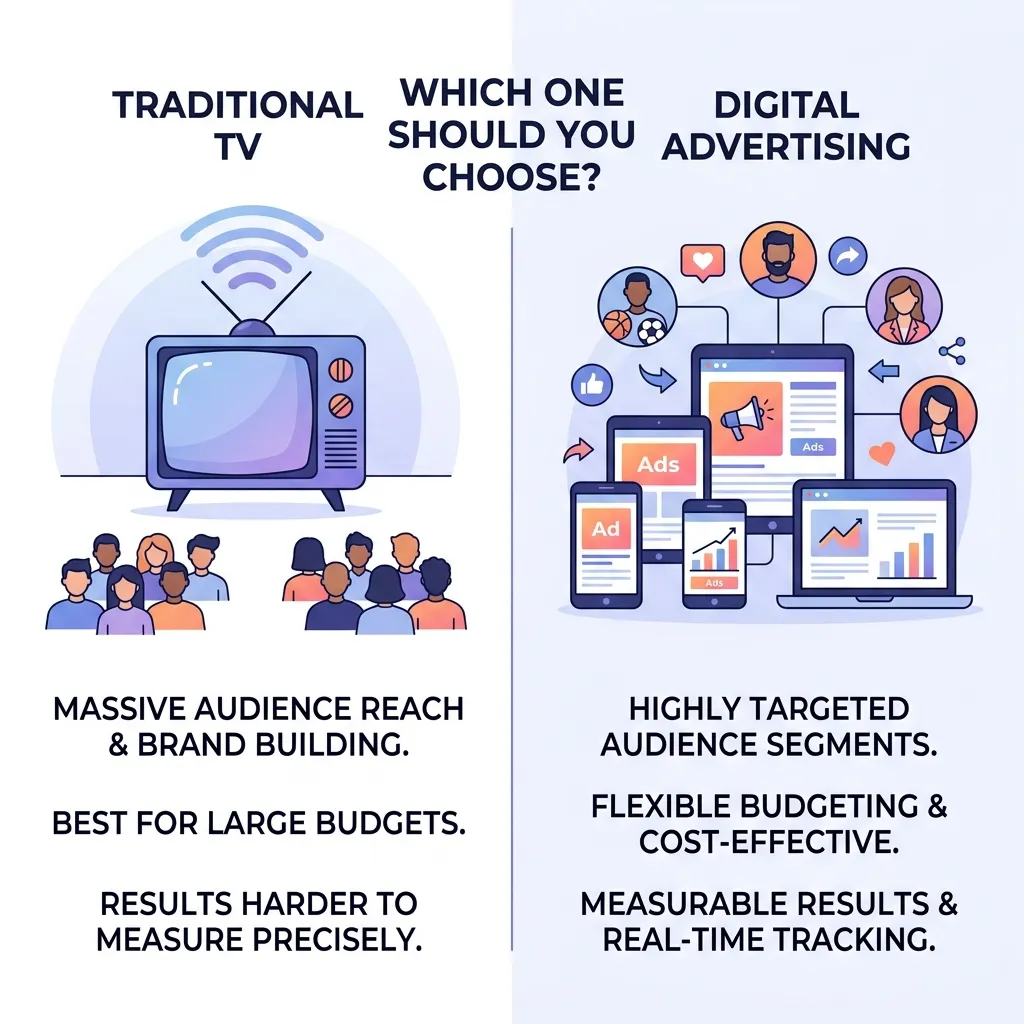
There is no universal winner.
Traditional TV advertising is particularly strong for mass reach, storytelling, emotional impact, and brand awareness.
Digital advertising is particularly strong for precise targeting, measurable performance, flexible budgets, rapid optimization, and direct response.
For a business focused mainly on immediate online conversions, digital advertising may be the better starting point.
For a company launching a major consumer brand and seeking broad awareness, television may offer significant value.
For many established businesses, however, combining both can provide the strongest strategy.
The key is not simply asking which advertising channel is better. Ask which channel is better for your audience, objective, budget, and customer journey.
Final Thoughts
The debate over traditional TV advertising vs digital advertising is less about replacing one channel with another and more about understanding what each medium does best.
Television remains valuable for reaching broad audiences and building memorable brand experiences. Digital advertising provides powerful targeting, measurement, flexibility, and conversion opportunities.
A smart advertising strategy uses these strengths strategically. Businesses that understand their audience and measure performance across the entire customer journey can determine when TV deserves investment, when digital should take priority, and when a combination of both can deliver the greatest impact.
Frequently Asked Questions
1. What is the main difference between traditional TV advertising and digital advertising?
Traditional TV advertising primarily delivers commercials to television audiences through scheduled programming, while digital advertising reaches users through internet-based platforms with more precise targeting and measurement.
2. Is TV advertising more expensive than digital advertising?
TV campaigns can require larger upfront investments because of production and airtime costs. Digital advertising generally offers more flexible budget options, although actual costs vary by platform, audience, industry, and campaign goals.
3. Is digital advertising better for small businesses?
Digital advertising can be easier for small businesses to test because advertisers can often start with smaller budgets, target specific audiences, and monitor performance.
4. Is traditional TV advertising still effective?
Yes. TV can remain effective for brand awareness, mass-market reach, storytelling, and building familiarity, particularly when the campaign is well targeted and creatively strong.
5. Which provides better audience targeting?
Digital advertising generally provides more granular targeting based on factors such as demographics, interests, behavior, location, and online intent.
6. Which advertising method is easier to measure?
Digital advertising generally provides more detailed performance metrics, including clicks, conversions, cost per acquisition, and return on ad spend.
7. Can TV advertising generate online sales?
Yes. TV advertising can influence online searches, website visits, direct traffic, and purchases. Unique URLs, promotional codes, and other tracking methods can help measure its impact.
8. Which is better for brand awareness: TV or digital?
Both can build awareness. TV is particularly strong for broad reach and emotional storytelling, while digital advertising can build awareness among precisely defined audiences.
9. Can businesses use TV and digital advertising together?
Yes. Combining the two can help businesses use TV for awareness and digital channels for engagement, consideration, retargeting, and conversion.
10. What type of business benefits most from TV advertising?
Businesses with broad consumer audiences, strong visual products, regional or national markets, and significant brand-building goals may benefit from TV advertising.
11. What type of business benefits most from digital advertising?
Digital advertising can be particularly useful for e-commerce companies, local businesses, service providers, startups, and companies that need measurable leads or online conversions.
12. How should a business decide between TV and digital advertising?
Start with your campaign objective, target audience, budget, customer journey, and measurement requirements. Then select the channel or combination of channels that best supports those factors.