
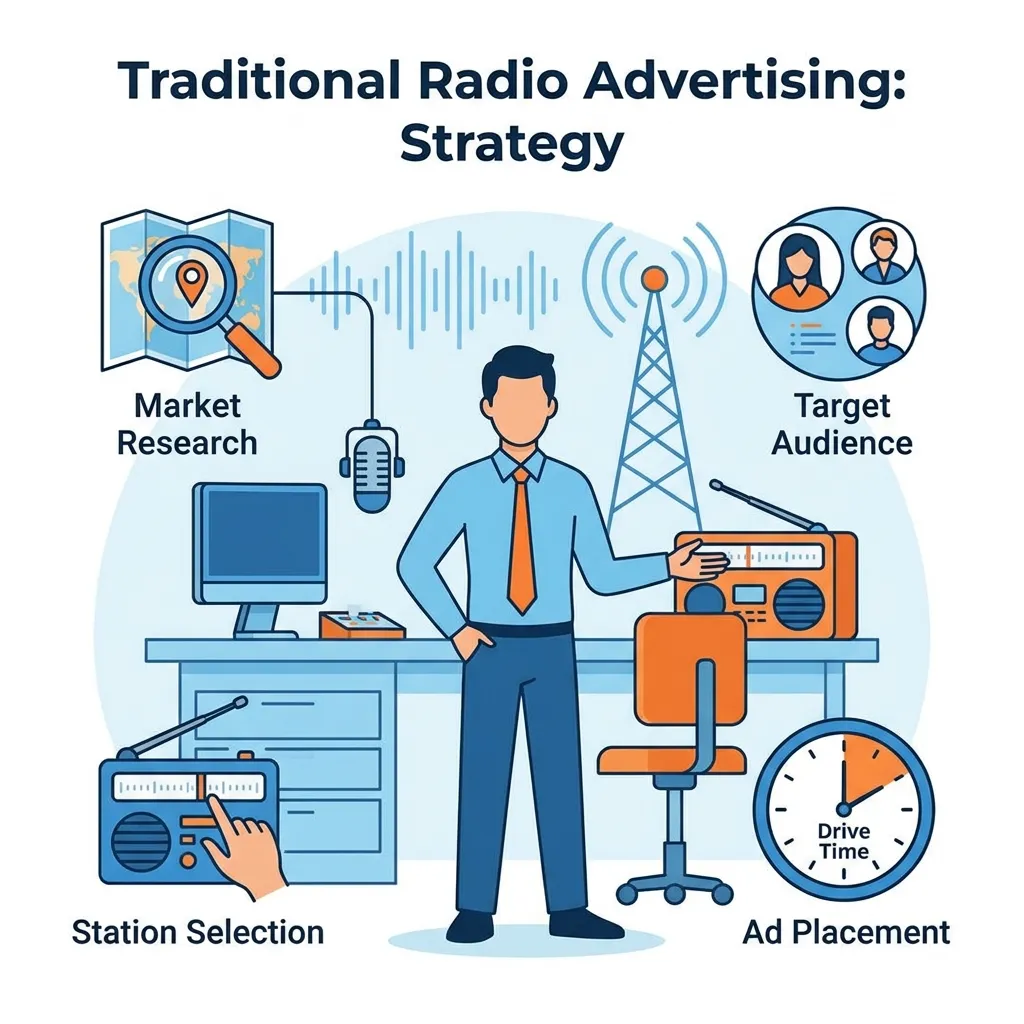
Traditional radio advertising remains a practical way for businesses to reach local and regional audiences through targeted audio messaging. This guide explains how traditional radio advertising works, its benefits, costs, campaign strategies, audience targeting methods, creative best practices, measurement techniques, and how businesses can combine radio with modern marketing channels.
Traditional radio advertising has remained an important part of the marketing mix even as businesses increasingly invest in digital channels. Radio offers something many digital platforms cannot replicate in exactly the same way: repeated audio exposure during everyday activities such as driving, working, shopping, exercising, or commuting.
For businesses trying to build awareness within a specific geographic market, radio can provide a valuable combination of reach, frequency, local relevance, and relatively flexible campaign planning.
The key to successful traditional radio advertising is not simply purchasing airtime. Businesses need to select the right audience, stations, programs, time slots, creative formats, frequency levels, and calls to action. They also need a clear method for measuring whether the campaign is contributing to business results.
This guide explores how to create a successful radio advertising strategy from planning through measurement.
What Is Traditional Radio Advertising?
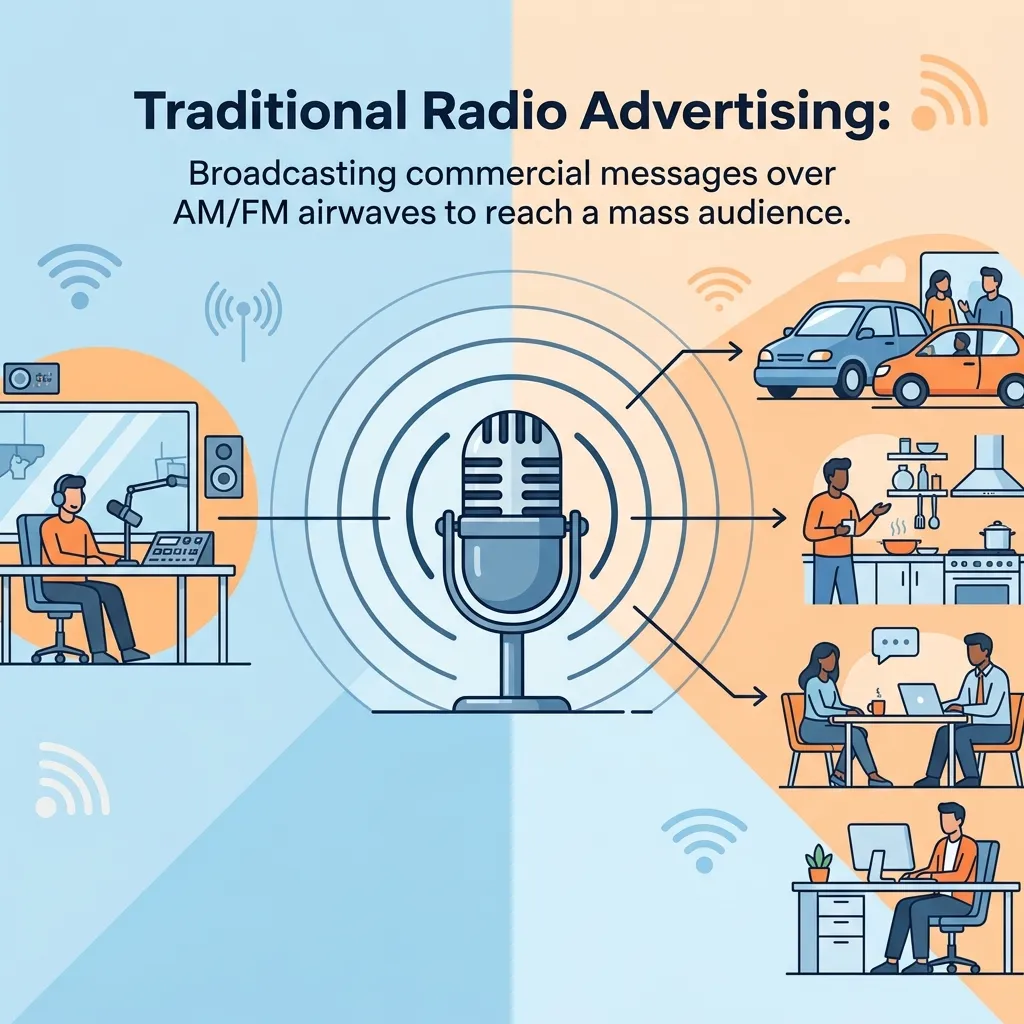
Traditional radio advertising is the practice of promoting a product, service, brand, event, or organization through commercials broadcast on conventional radio stations.
Unlike digital advertising, where advertisers can often target individual users based on extensive behavioral data, traditional radio typically reaches audiences through factors such as:
- Radio station format
- Geographic market
- Program type
- Time of day
- Audience demographics
- Listening habits
- Sponsorship opportunities
- Commercial frequency
Radio advertisements can take several forms, including traditional recorded commercials, live reads, sponsorship messages, promotional announcements, and other station-integrated formats.
The primary strength of radio is its ability to repeatedly expose listeners to a message without requiring them to look at a screen.
Businesses interested in understanding the broader role of offline promotion can also explore this traditional marketing channels guide.
How Traditional Radio Advertising Works
A typical radio advertising campaign involves several stages.
1. Define the Marketing Objective
The first step is determining what the campaign needs to accomplish.
Possible objectives include:
- Increasing brand awareness
- Promoting a new product
- Driving store visits
- Generating phone calls
- Promoting an event
- Increasing local recognition
- Supporting a sales promotion
- Building brand familiarity
- Reaching a new geographic market
A campaign designed for awareness may prioritize reach and frequency, while a direct-response campaign may focus more heavily on a memorable offer and call to action.
2. Identify the Target Audience
Businesses should determine who they want to reach before selecting a station.
Consider:
- Age
- Location
- Lifestyle
- Occupation
- Interests
- Purchasing behavior
- Commuting patterns
- Household characteristics
Audience selection should influence both the station and the commercial’s message.
3. Select the Radio Station
Different stations attract different audiences.
A business should evaluate:
- Station format
- Audience profile
- Geographic coverage
- Listening frequency
- Program popularity
- Advertising rates
- Schedule availability
- Audience alignment
The cheapest station is not necessarily the best option. Reaching a smaller but highly relevant audience can be more valuable than buying inexpensive impressions from listeners who are unlikely to become customers.
Benefits of Traditional Radio Advertising
Traditional radio advertising offers several advantages for businesses.
Strong Local Reach
Radio is particularly useful for businesses that operate within specific geographic markets.
Restaurants, retailers, dealerships, healthcare providers, educational institutions, real estate businesses, and local service companies can use radio to reach people within their operating areas.
High Frequency Potential
Radio campaigns can repeat the same message multiple times.
Repetition helps improve brand familiarity and gives listeners multiple opportunities to remember a company, offer, phone number, or website.
Audio Creates Mental Imagery
Radio does not provide visual information, but that can actually become a creative advantage.
A strong voice, sound effect, story, or carefully written description can encourage listeners to imagine a scene in their minds.
For example, a restaurant commercial can use sound and descriptive language to make listeners imagine the atmosphere, food, or experience.
Reaches People Away From Screens
People often listen to radio while:
- Driving
- Working
- Shopping
- Cooking
- Exercising
- Commuting
This allows brands to communicate with consumers during activities when screen-based advertising may be less practical.
Supports Brand Familiarity
Repeated exposure can make a brand feel familiar before someone actively needs its product or service.
This is particularly valuable for businesses operating in competitive local markets.
Traditional Radio Advertising vs. Digital Advertising
Radio and digital advertising operate differently.
Digital platforms can offer detailed targeting, interactive creative, real-time optimization, and extensive performance data.
Traditional radio advertising generally provides broader audience exposure through stations, markets, programs, and time slots.
Instead of treating the two channels as competitors, businesses can use them together.
For a broader comparison of offline and online approaches, see this guide to digital vs. traditional marketing.
A potential integrated campaign might work like this:
Radio awareness → online search → website visit → digital remarketing → conversion
A listener may hear a company name on the radio and later search for it online. That means a business’s digital presence should support the promise made in its radio campaign.
Choosing the Right Radio Advertising Format
Different creative formats can serve different marketing objectives.
Recorded Commercials
A professionally produced commercial is one of the most common radio formats.
It can include:
- Voiceover
- Music
- Sound effects
- Brand messaging
- Promotional offers
- Call to action
Recorded commercials provide strong control over the final message.
Live Reads
A radio personality or host reads the advertising message during a program.
This can provide a more conversational and personal feel.
Live reads may work particularly well when the station personality has a strong relationship with its audience.
Sponsorship Messages
A business can sponsor a particular segment, program, or feature.
This can increase brand association with a specific part of the station’s programming.
Promotional Radio Segments
Some campaigns involve contests, event promotions, giveaways, or station-hosted activities.
These formats can generate additional engagement beyond a standard commercial.
How to Write an Effective Radio Commercial
Because listeners cannot see the advertisement, the script must communicate clearly through sound.
A strong radio commercial usually includes several core elements.
Start With Attention
The first few seconds should establish why the listener should pay attention.
Possible approaches include:
- A question
- A surprising statement
- A relatable problem
- A short story
- A distinctive sound
- A compelling offer
Present One Main Message
Avoid trying to explain every feature of a business.
Choose one primary benefit.
For example:
“Need reliable home repairs in your area? Call…”
The message immediately establishes the problem and introduces the solution.
Make the Brand Name Clear
Listeners should easily understand and remember the business name.
Repeat it naturally if appropriate.
Use a Strong Call to Action
Tell listeners what to do next.
Examples include:
- Call now
- Visit the store
- Search the company online
- Visit a specific website
- Use a promotional code
- Attend an event
- Schedule an appointment
Repeat Important Information
Phone numbers, websites, offers, and brand names can be repeated when the commercial length allows.
Repetition is especially important because listeners cannot pause a traditional radio broadcast and reread the information.
The Importance of Frequency in Radio Advertising
One exposure may not be enough to create strong brand recall.
Radio campaigns often depend on repeated exposure.
Frequency refers to how often the target audience hears the advertisement over a specific period.
However, more frequency is not automatically better.
Too much repetition can create listener fatigue, especially when the same commercial is played too frequently without creative variation.
A balanced campaign should consider:
- Campaign duration
- Number of weekly spots
- Time slots
- Audience size
- Commercial variation
- Budget
- Marketing objective
The objective is to achieve sufficient repetition without wasting budget or irritating listeners.
Choosing the Best Time to Advertise
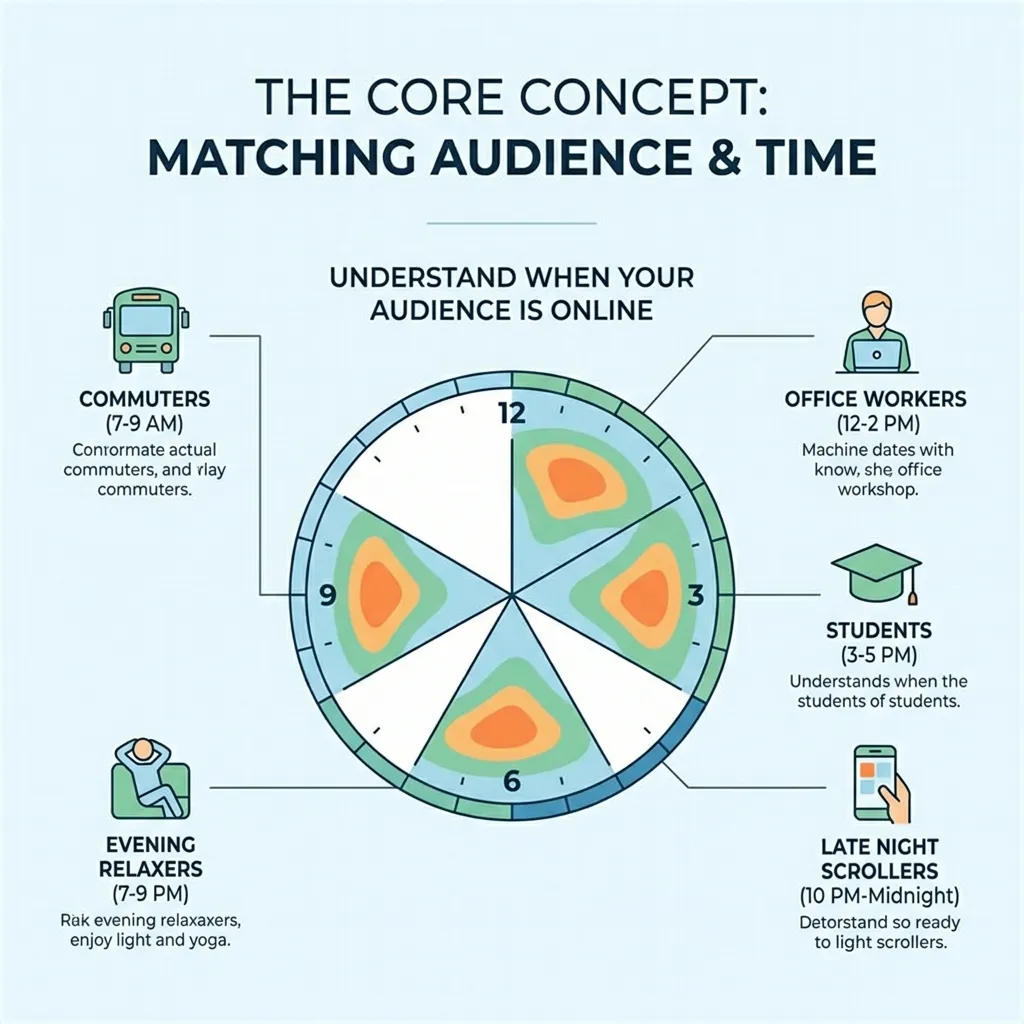
Radio audiences can change significantly throughout the day.
Common advertising periods include:
Morning Drive
People may listen while commuting to work or school.
Midday
This period can reach people during work, errands, or shopping activities.
Afternoon Drive
The afternoon commute can provide another opportunity to reach local listeners.
Evening
Evening programming can attract different audience segments depending on the station and market.
Businesses should not automatically assume that the most expensive time slot is the most effective.
The best time depends on the target audience’s listening behavior.
Local Radio Advertising Strategy
Local businesses can benefit significantly from geographically focused radio campaigns.
A local radio strategy can reinforce community familiarity by referencing:
- Local neighborhoods
- Regional events
- Community issues
- Local landmarks
- Nearby locations
- Seasonal activities
A locally relevant commercial can feel more personal than a generic national advertisement.
Radio can also complement other offline strategies. For example, a local retailer could combine radio promotion with direct mail, community sponsorship, and in-store promotions.
Businesses can explore direct mail marketing strategies when building a broader offline campaign.
Creating Emotional Radio Advertising
Radio is an audio-first medium, which makes emotion particularly important.
Voice tone, pacing, music, pauses, and sound effects can influence how an advertisement feels.
A commercial can create emotions such as:
- Excitement
- Trust
- Comfort
- Urgency
- Curiosity
- Happiness
- Nostalgia
For example, a holiday campaign might use familiar seasonal music and warm storytelling to create a sense of nostalgia.
A financial service advertisement might use a calm and confident voice to communicate stability.
However, emotional messaging should support the brand’s actual value rather than replace it.
For broader insights into emotional communication in advertising, see the guide to emotional advertising strategies from TeleAdvertise.
Using Radio Advertising for Small Businesses
Small businesses often have limited advertising budgets, making strategic targeting especially important.
Rather than attempting to reach an entire market, a small business can focus on:
- A specific city
- A defined geographic radius
- A relevant station format
- Specific high-value time periods
- Seasonal promotions
- Local events
A smaller campaign with a highly relevant audience can be more useful than a broad campaign with little audience alignment.
Radio can also help smaller businesses appear more established by creating repeated local brand exposure.
Traditional Radio Advertising and Integrated Marketing
Radio does not need to operate independently.
An integrated marketing campaign can connect radio with:
- Television
- Direct mail
- Search marketing
- Social media
- Website content
- Events
- Outdoor advertising
For example:
Radio commercial: Introduces a special offer.
Website: Explains the offer in detail.
Social media: Reinforces the promotion.
Email: Reminds existing customers.
In-store experience: Converts the audience into buyers.
This approach is consistent with the principles discussed in the integrated marketing complete guide.
How to Measure Traditional Radio Advertising
Measuring offline advertising can be more challenging than tracking digital clicks, but businesses still have several options.
Track Calls
Use a campaign-specific phone number where appropriate.
Track Website Visits
Create a memorable campaign URL or landing page.
Use Promotional Codes
Give radio listeners a unique code that can be used during purchases.
Monitor Store Traffic
Compare customer traffic during the campaign with previous periods while accounting for other factors.
Track Branded Search
An increase in searches for the business name can provide an additional indication of growing awareness.
Ask Customers
Businesses can simply ask new customers:
“How did you hear about us?”
This can provide useful qualitative information.
For businesses focused on broader offline measurement, an offline marketing metrics strategy can help organize these performance indicators.
Common Traditional Radio Advertising Mistakes
1. Making the Commercial Too Complicated
Listeners should understand the message quickly.
2. Using Too Many Offers
Multiple promotions can make the commercial difficult to remember.
3. Weak Audio Production
Poor voice recording, distracting music, or unclear speech can reduce credibility.
4. Forgetting the Brand Name
A memorable message is useless if listeners cannot remember who delivered it.
5. Using an Unclear Call to Action
Tell the audience exactly what to do.
6. Choosing Stations Based Only on Price
Cheap airtime is not valuable if it reaches the wrong audience.
7. Running the Campaign for Too Short a Period
Insufficient repetition can make it difficult to establish meaningful recall.
8. Ignoring Other Marketing Channels
Radio can perform better when supported by digital and offline marketing activities.
Best Practices for Traditional Radio Advertising
Businesses can improve campaign performance by following several principles.
Keep the Message Simple
One commercial should focus on one primary idea.
Match the Voice to the Brand
A professional financial company may require a different voice from a youth-oriented entertainment brand.
Use Memorable Audio
A distinctive phrase, sound, or musical element can improve recognition.
Repeat Strategically
Use sufficient frequency without overloading the audience.
Make the CTA Easy
Avoid complicated URLs or instructions.
Maintain Consistent Branding
Use the same core message across radio, digital, print, and other channels.
Test Different Creative Approaches
Compare different scripts, offers, voices, or calls to action where practical.
How to Build a Traditional Radio Advertising Campaign
A practical campaign process can be organized into eight steps.
Step 1: Set the Objective
Decide whether the goal is awareness, traffic, sales, leads, or promotion.
Step 2: Define the Audience
Identify the audience’s location, demographics, interests, and habits.
Step 3: Research Stations
Compare audience profiles, formats, reach, and advertising opportunities.
Step 4: Develop the Message
Create one central value proposition.
Step 5: Write the Script
Make the commercial concise, conversational, and easy to understand.
Step 6: Produce the Advertisement
Record the voiceover and add appropriate music and sound effects.
Step 7: Schedule the Campaign
Select dates, time slots, stations, and frequency.
Step 8: Measure and Optimize
Track response indicators and adjust future campaigns accordingly.
Traditional Radio Advertising in the Modern Marketing Environment
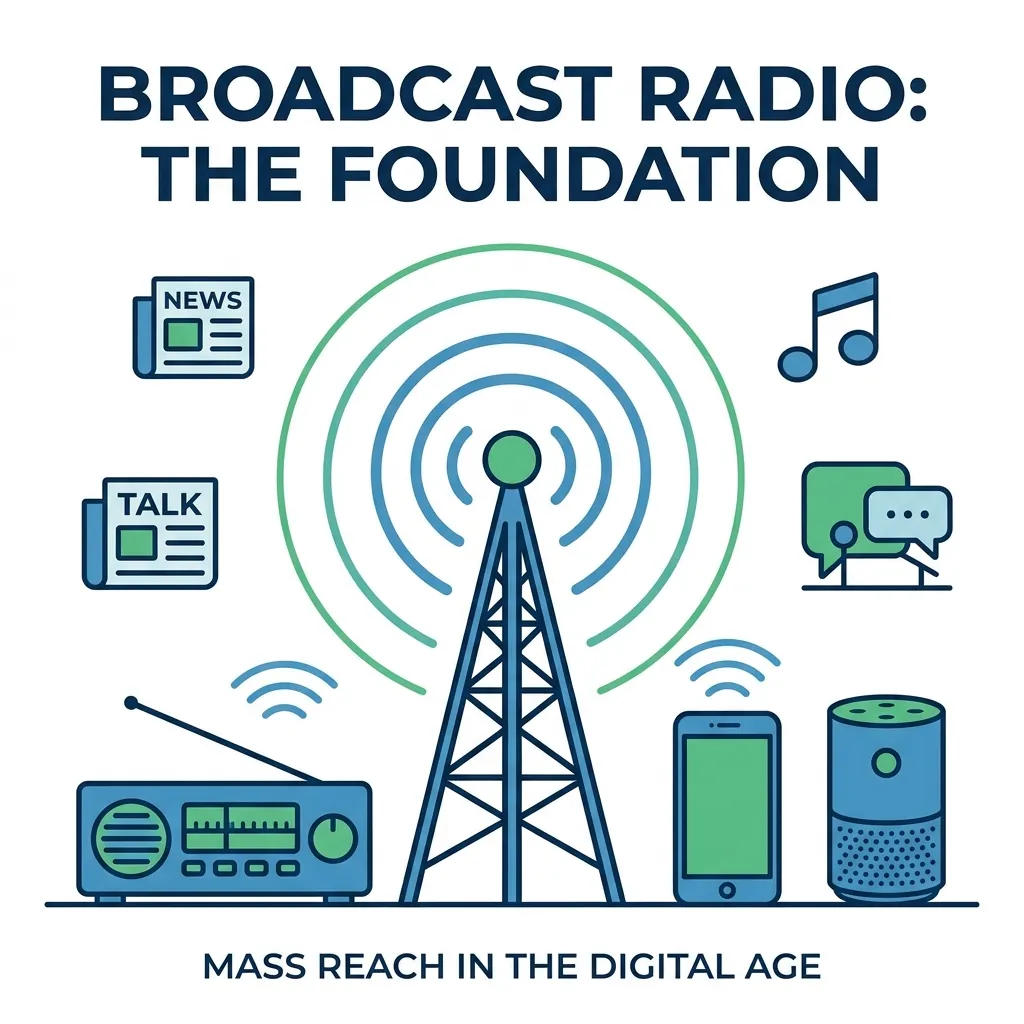
Radio advertising has changed as the broader media environment has evolved.
Many audiences now consume both traditional broadcast media and digital content. As a result, marketers can connect radio campaigns with online experiences.
For example, a radio advertisement can encourage listeners to search a brand name, visit a website, download an offer, or follow a social media account.
This makes radio particularly useful as an awareness channel within an integrated campaign.
The key is to maintain consistency. The message listeners hear on the radio should match what they discover when they search for the brand online.
Conclusion
Traditional radio advertising continues to offer businesses a practical way to reach audiences through repeated, locally relevant audio communication. While digital marketing provides advanced targeting and measurement capabilities, radio remains valuable for awareness, familiarity, and broad local exposure.
A successful campaign starts with the right audience and station, followed by a simple message, professional production, strategic frequency, and a memorable call to action. Businesses should also connect their radio campaigns with their websites and other marketing channels to create a consistent customer journey.
By combining traditional radio advertising with thoughtful planning, creative storytelling, integrated marketing, and reliable measurement, businesses can turn radio from a simple awareness channel into a meaningful part of their overall marketing strategy.
Frequently Asked Questions
1. What is traditional radio advertising?
Traditional radio advertising is the promotion of products, services, brands, or events through commercials and other sponsored messages broadcast on conventional radio stations.
2. Is traditional radio advertising still effective?
Yes. Radio can still be useful for businesses seeking local reach, repeated exposure, brand awareness, and access to audiences who regularly listen while commuting or performing daily activities.
3. What types of businesses use radio advertising?
Restaurants, retailers, automobile dealers, healthcare providers, real estate companies, financial businesses, educational institutions, professional services, and many local businesses can use radio advertising.
4. How long should a radio commercial be?
Common radio commercial lengths include 15, 30, and 60 seconds. The appropriate length depends on the message, budget, campaign objective, and station requirements.
5. How often should a radio advertisement run?
There is no universal frequency. The appropriate schedule depends on the campaign objective, audience size, budget, market, and desired level of repetition.
6. What makes a radio commercial effective?
An effective radio commercial usually has a strong opening, one clear message, memorable branding, engaging audio, and an easy-to-follow call to action.
7. Can small businesses afford radio advertising?
Many small businesses can use radio by focusing on specific geographic markets, relevant stations, selected time periods, and carefully controlled campaign frequency.
8. How can businesses target audiences with radio advertising?
Businesses can target audiences by selecting stations, programs, time periods, and geographic markets that align with the characteristics and listening habits of their ideal customers.
9. How do you measure radio advertising results?
Businesses can measure results using campaign-specific phone numbers, landing pages, promotional codes, website traffic, customer surveys, store traffic, and changes in branded search activity.
10. What are the main advantages of radio advertising?
Major advantages include local reach, repeated exposure, audio storytelling, screen-free consumption, flexible scheduling, and the ability to build brand familiarity.
11. Can radio advertising work with digital marketing?
Yes. Radio can generate awareness while search, websites, social media, email, and other digital channels provide additional opportunities for research, engagement, and conversion.
12. What is the biggest mistake in radio advertising?
One of the biggest mistakes is creating a complicated commercial with too many messages. A focused advertisement with clear branding and a simple call to action is usually easier for listeners to remember.








[…] detailed breakdown of what makes a traditional advertising campaign explains how storytelling fits into broader campaign structure, since emotional ads often work best […]