Traditional outdoor advertising has been putting brands in front of people for well over a century, and it hasn’t slowed down. While digital channels get most of the marketing conversation today, billboards, transit ads, and bus shelters still deliver something screens struggle to replicate: unavoidable, repeated visibility in the physical spaces people move through every day.
This guide is the pillar resource for everything related to traditional outdoor advertising — also known as out-of-home (OOH) advertising. Below, we’ll cover what traditional outdoor advertising actually is, the core formats it includes, how it compares to digital and DOOH alternatives, and how to plan a campaign that uses these channels effectively. Throughout, you’ll also find links to deeper, format-specific guides covering strategy, transit advertising, bus advertising, bus shelters, real-world examples, and how traditional outdoor stacks up against digital advertising specifically.
Think of this page as the map, and each linked cluster guide as a detailed route through one specific part of the territory. If you’re planning your first outdoor campaign, start here for the full picture, then follow the links into whichever format matches your budget, audience, and objective. If you’re already familiar with the basics and looking for something specific — bus shelter creative specs, a direct comparison against digital advertising, or real campaign examples — the sections below will point you toward the right dedicated guide.
What Is Traditional Outdoor Advertising?
Traditional outdoor advertising refers to any printed, static advertising placed in public spaces to reach people while they’re outside their homes — billboards, posters, transit wraps, and bus shelter displays are the clearest examples. Unlike digital out-of-home (DOOH), which uses screens capable of rotating multiple messages, traditional OOH displays a single fixed creative for the full duration of a placement, often giving a brand 100% share of voice on that particular structure.
This format has stayed relevant for a simple reason: it reaches people in moments no ad blocker, skip button, or muted tab can interrupt. A billboard on a daily commute route, or a poster inside a bus shelter someone waits at every morning, earns repeated exposure simply through the routines of everyday life.
The Core Formats: 5 Types of Traditional Outdoor Advertising
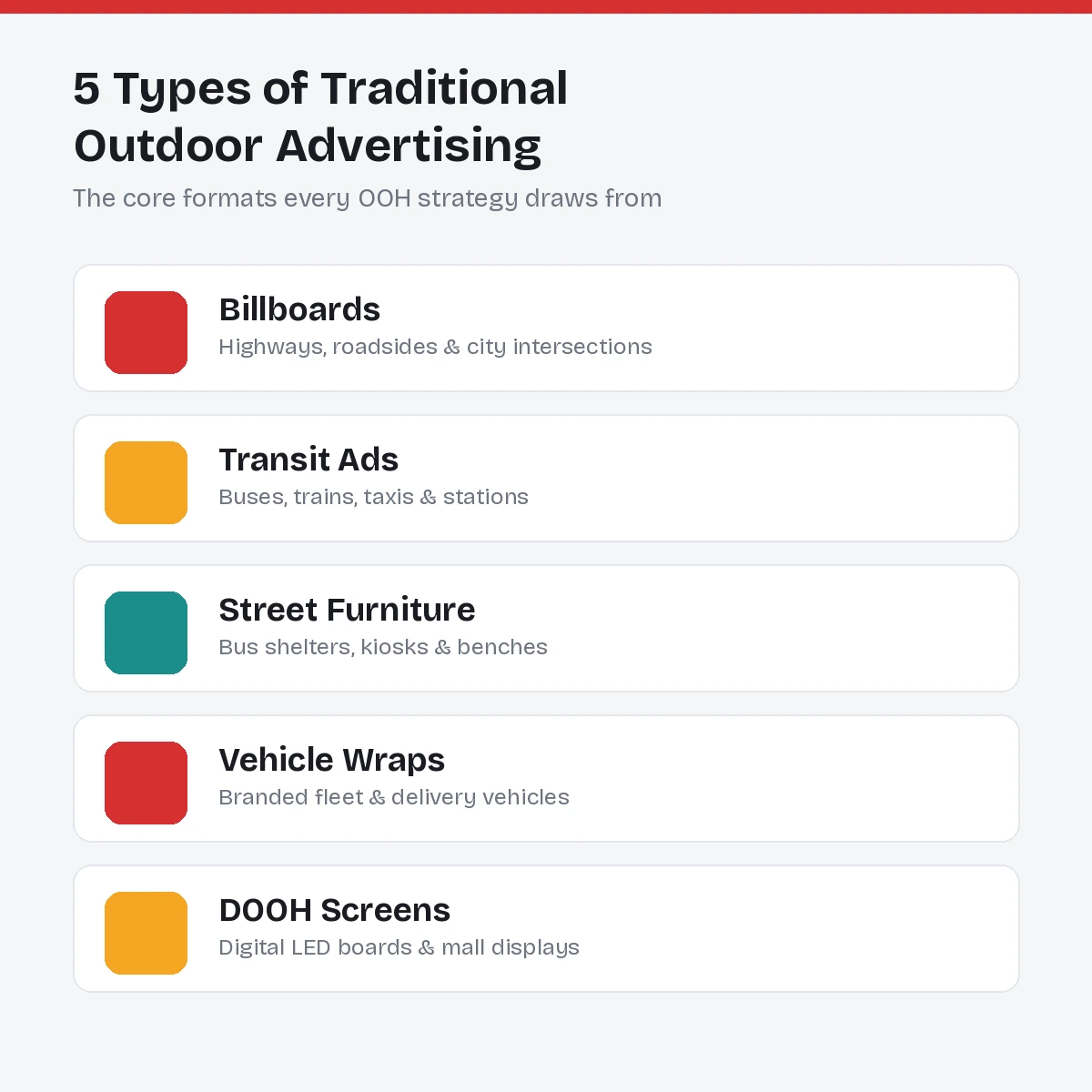
Billboards remain the most recognizable form of OOH — large-format static displays on highways, arterial roads, and busy intersections, built for broad visibility and strong recall through scale and repetition. For a deeper dive into planning, sizing, and messaging for this specific format, see our dedicated billboard advertising guide.
Transit advertising places ads on or inside buses, trains, taxis, and stations, reaching commuters who see the same message daily along fixed routes. A full breakdown of this format — including bus wraps, station posters, and platform displays — is covered in our companion guide on Traditional Transit Advertising, along with format-specific pieces on Traditional Bus Advertising and Bus Shelter Advertising as those go live on the site.
Street furniture advertising covers bus shelters, kiosks, and benches — smaller-format placements embedded directly into pedestrian environments, ideal for hyper-local reach.
Vehicle wraps turn branded fleet and delivery vehicles into moving billboards, extending a brand’s visibility across an entire city rather than a single fixed location. Our vehicle wrap marketing guide covers design and cost considerations for this format in detail.
DOOH (Digital Out-of-Home) screens are the digital evolution of traditional OOH — LED billboards and mall or airport screens that rotate creative and support time-of-day or weather-triggered messaging. We’ll compare this format to traditional static OOH more closely later in this guide, and a dedicated DOOH Advertising guide is coming soon with platform and buying specifics.
Why Traditional Outdoor Advertising Still Works
Skepticism about traditional advertising formats tends to fade quickly once the numbers are examined. Billboards and transit ads deliver continuous, unskippable visibility that digital placements — subject to ad blockers, banner blindness, and shrinking attention spans — increasingly struggle to match. A well-placed static ad doesn’t need a click to register; it works purely through repeated, ambient exposure over weeks or months.
There’s also a trust dimension. Physical placements signal a level of investment and permanence that purely digital campaigns don’t always convey, which is part of why so many established brands still treat a strong outdoor presence as a mark of credibility rather than an old-fashioned afterthought. Our guide on why billboard advertising still works goes deeper into the data behind this staying power.
Traditional OOH vs DOOH vs Digital Advertising
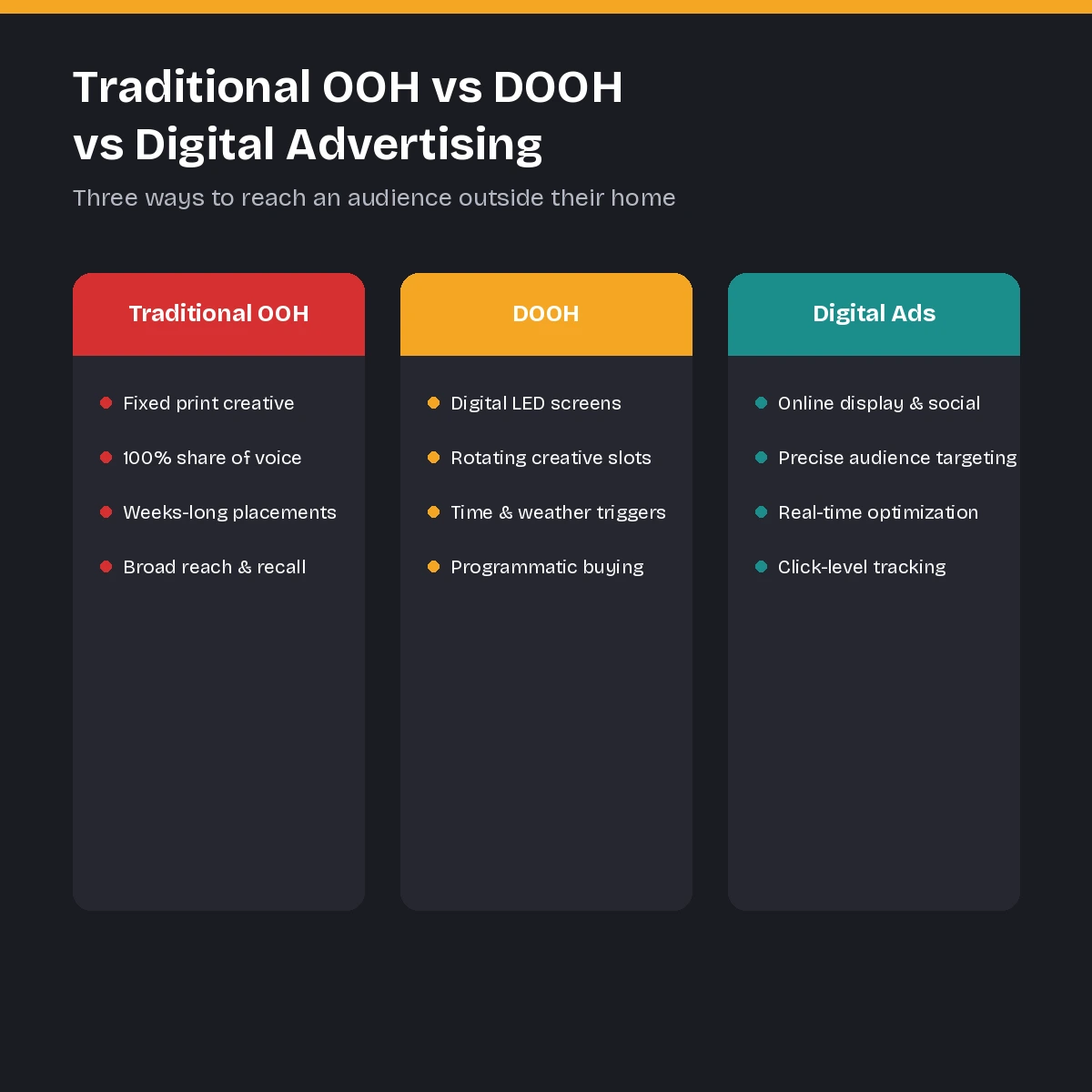
Traditional OOH runs on fixed print creative with 100% share of voice for the length of the placement — you’re paying for guaranteed, uninterrupted visibility rather than a click-through rate.
DOOH brings digital flexibility into the same physical spaces: LED screens can rotate several advertisers’ creative, adjust messaging by time of day, and increasingly support programmatic buying similar to online display advertising.
Digital advertising (social, search, and display) offers the most granular targeting and real-time performance tracking, but lacks the physical, ambient presence that makes outdoor formats memorable in a different way.
Rather than treating these as competitors, most effective campaigns in 2026 sequence them together — a billboard or transit campaign building broad awareness, paired with a trackable digital or DOOH layer for measurable follow-through. Understanding how outdoor formats fit alongside the full spread of digital marketing channels helps clarify where OOH earns its place in a broader media plan rather than being treated as an isolated, old-fashioned line item. A closer comparison of these approaches — including which fits which campaign goal — will be covered in a dedicated Traditional Outdoor Advertising vs Digital Advertising guide linked from this pillar page once published.
Transit and Street Furniture Advertising in Practice
Transit and street furniture formats earn their keep through frequency rather than scale. A commuter who sees the same bus wrap or bus shelter ad every day for a month absorbs far more repeated exposure than a single billboard glimpsed once during a highway drive. This makes these formats especially effective for local and regional brands trying to build familiarity within a specific city or route network.
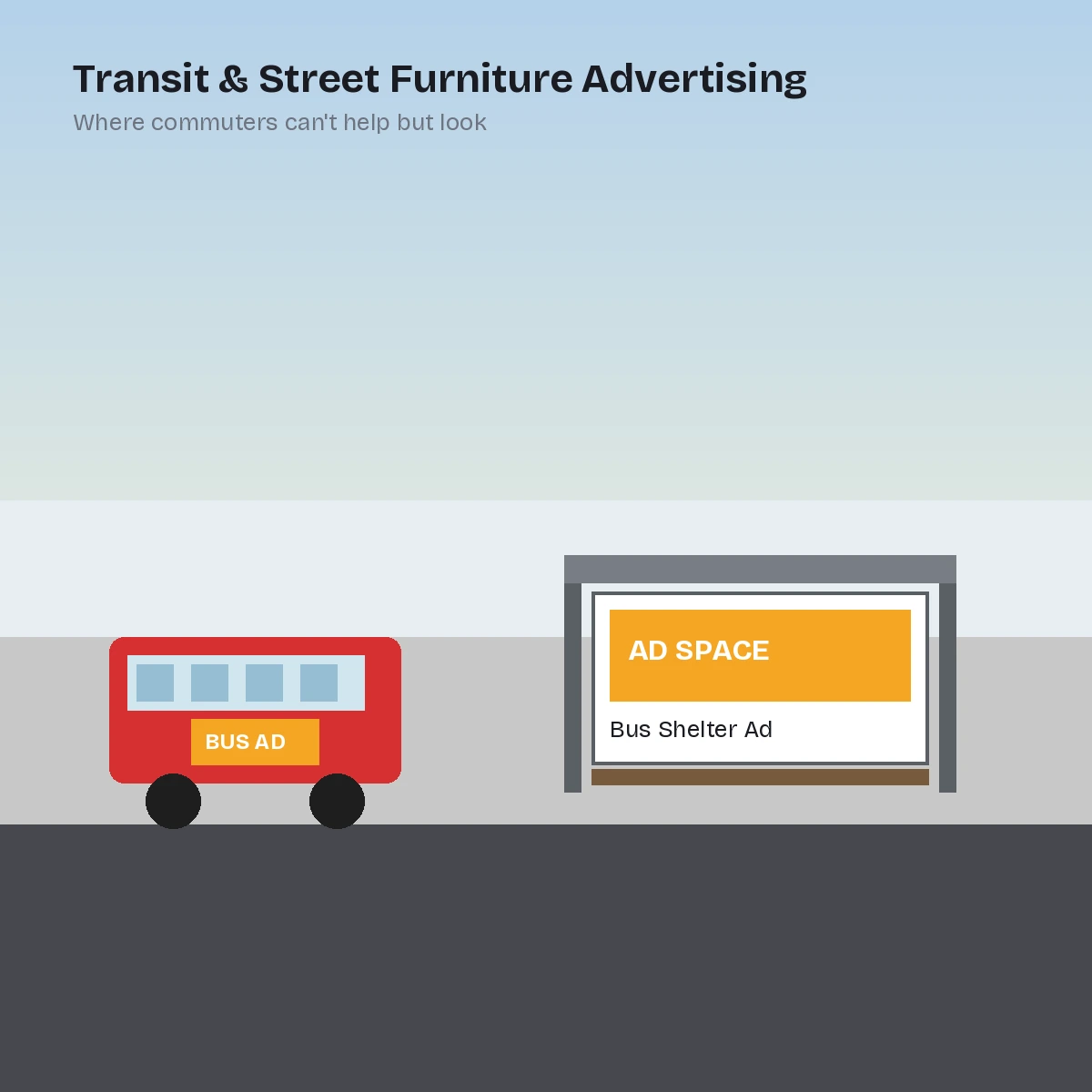
Bus shelters in particular combine outdoor advertising with a captive audience — people waiting for a bus have little else to look at, which is part of why this specific format consistently performs well for local retail, education, and service-based advertisers. This kind of “forced dwell time” is unique among outdoor formats; a billboard is glimpsed for a second or two at highway speed, while a bus shelter ad might be looked at, on and off, for several minutes at a stretch. Dedicated guides on Traditional Bus Advertising and Bus Shelter Advertising will cover creative and placement specifics for these formats as part of this content cluster.
Planning a Traditional Outdoor Advertising Campaign
- Define your objective clearly. Awareness, local footfall, and brand credibility are common OOH goals — trying to force a direct-response objective onto a format built for exposure usually leads to disappointment.
- Choose formats that match your audience’s routine. Commuter-heavy audiences respond well to transit and billboard placements along known routes; hyper-local audiences may respond better to street furniture near specific neighborhoods.
- Design for a glance, not a read. Outdoor ads are typically seen for a few seconds at most — a single clear message and minimal text almost always outperforms a cluttered, detail-heavy design.
- Plan placement duration realistically. Traditional OOH placements typically run for weeks or months; budget and creative planning should reflect that timeline rather than a short digital campaign cycle.
- Pair with a trackable layer where possible. A unique promo code, dedicated landing page, or a parallel digital campaign helps translate ambient outdoor exposure into measurable response data.
- Budget for production, not just placement. Print, installation, and design costs for outdoor formats are often underestimated relative to the media buy itself, and cutting corners here tends to show up immediately in how professional the final creative looks in a public space.
Real-World Examples and Outdoor Advertising Success Stories
Looking at how established brands have used outdoor formats successfully is often more instructive than theory alone. From iconic highway billboards that became cultural touchstones to hyper-local bus shelter campaigns that drove measurable foot traffic for small businesses, the pattern that repeats across successful outdoor campaigns is simplicity: one clear message, strong visual contrast, and placement that matches where the target audience actually spends time. A dedicated Outdoor Advertising Examples guide will walk through specific campaigns and what made each one work, as part of this content cluster.
Measuring the Impact of Traditional Outdoor Campaigns
One of the most persistent myths about traditional outdoor advertising is that it can’t be measured at all. While it’s true that OOH doesn’t offer the click-level precision of digital ads, several reliable measurement approaches exist. Geo-lift studies compare foot traffic or sales in markets with an active outdoor campaign against similar markets without one, isolating the campaign’s actual impact. Brand lift surveys, run before and after a campaign, can capture shifts in awareness and recall directly tied to a specific placement.
More tactically, unique promo codes, dedicated landing page URLs, and call-tracking numbers printed on outdoor creative give a direct, if partial, view into response driven specifically by the physical ad. None of these methods replace the granular tracking available in digital advertising, but together they give marketing teams enough signal to judge whether an outdoor investment is earning its budget, rather than relying purely on gut feeling or industry folklore about “brand awareness.” Even a simple before-and-after comparison of branded search volume in a campaign’s target market can offer a rough, low-cost signal worth tracking alongside these more formal methods.
Common Mistakes in Traditional Outdoor Advertising
- Cramming too much text or detail into a format meant to be read in seconds
- Choosing placements based on cost alone rather than audience route and behavior
- Treating outdoor advertising as a stand-alone channel instead of pairing it with a trackable digital layer
- Ignoring the creative differences between billboard, transit, and street furniture formats and reusing one design across all three
- Underestimating how long a placement needs to run before it produces meaningful recall
How Traditional Outdoor Advertising Fits an Integrated Strategy
Outdoor advertising rarely works best in isolation. Many of the strongest campaigns pair a broad OOH presence with retargeting or search campaigns aimed at people already primed by having seen the physical ad. This kind of sequencing — physical exposure first, trackable digital follow-up second — tends to outperform either channel run alone, since the outdoor placement builds the initial familiarity that makes the digital touch convert at a higher rate.
Thinking about color and design choices for outdoor creative is also worth doing deliberately rather than as an afterthought. This guide to the emotional power of color in marketing is a useful reference when designing billboard or transit creative, since color contrast and psychological association matter even more in a format viewed for only a few seconds at a glance.
Conclusion
Traditional outdoor advertising has earned its staying power by doing something digital channels still can’t fully replicate: delivering unavoidable, repeated visibility in the physical spaces people move through every single day. Billboards, transit ads, street furniture, and vehicle wraps each serve slightly different purposes, but they share the same underlying strength — ambient, hard-to-ignore exposure that builds familiarity over time rather than chasing an immediate click.
Used well — with a clear objective, format choices that match audience routine, and simple, glance-friendly creative — traditional outdoor advertising remains one of the most reliable ways to build broad brand awareness in 2026. Explore the cluster guides linked throughout this page for deeper coverage of transit advertising, bus advertising, bus shelter placements, real-world examples, DOOH, and how traditional outdoor stacks up directly against digital advertising.
None of this requires choosing outdoor advertising instead of digital, or treating it as a nostalgic alternative to more measurable channels. The brands getting the most out of traditional outdoor in 2026 are the ones treating it as one deliberate layer in a broader media strategy — valued for exactly what it does well, and paired thoughtfully with the channels that cover what it doesn’t.
Frequently Asked Questions About Traditional Outdoor Advertising
1. What Is Traditional Outdoor Advertising?
Traditional outdoor advertising refers to static, printed advertisements placed in public spaces, including billboards, transit wraps, and bus shelter displays, that show fixed creative throughout the placement period.
2. Is Traditional Outdoor Advertising Still Effective in 2026?
Yes. Traditional outdoor advertising can remain effective because it provides repeated exposure in physical environments and does not depend on users clicking, scrolling, or interacting with digital screens.
3. What’s the Difference Between Traditional OOH and DOOH?
Traditional OOH uses fixed, printed creative for the duration of a placement, while DOOH uses digital screens that can display multiple messages and update content dynamically.
4. What Are the Main Types of Traditional Outdoor Advertising?
The main formats include billboards, transit advertising, street furniture such as bus shelters and kiosks, and vehicle wraps.
5. How Long Do Traditional Outdoor Advertising Placements Typically Run?
Placements commonly run for several weeks to several months because traditional outdoor advertising relies on repeated exposure over time to build awareness and brand recall.
6. Is Transit Advertising More Effective Than Billboards?
Neither format is universally more effective. Billboards can provide broad visibility along high-traffic routes, while transit advertising can generate repeated exposure among commuters who regularly travel through the same areas.
7. Can Traditional Outdoor Advertising Be Tracked?
Direct tracking is more limited than with digital advertising, but marketers can use unique promo codes, dedicated landing pages, QR codes, surveys, or coordinated digital campaigns to measure response and impact.
8. What Makes Outdoor Advertising Creative Effective?
Simple, high-contrast designs with one clear message tend to work well because people often see outdoor advertisements for only a few seconds while walking, driving, or traveling.
9. Are Bus Shelter Ads Worth the Investment for Small Businesses?
Bus shelter advertising can be useful for local businesses because it provides repeated, location-specific exposure to pedestrians, commuters, and nearby residents. Its value depends on audience fit, location, frequency, and placement cost.
10. How Does Traditional Outdoor Advertising Compare to Digital Advertising?
Traditional outdoor advertising provides broad physical visibility and repeated exposure, while digital advertising offers more precise targeting and detailed performance tracking. Many brands combine both approaches.
11. What Industries Benefit Most From Traditional Outdoor Advertising?
Local retail, real estate, education, automotive, restaurants, and consumer brands seeking broad local or regional awareness can benefit from traditional outdoor advertising.
12. Should Traditional Outdoor Advertising Be Combined With Digital Campaigns?
Yes. Combining outdoor advertising with trackable digital channels can extend campaign reach while providing additional ways to measure audience response and conversions.