
Traditional TV advertising has been one of the most recognizable forms of mass-market advertising for decades. Before digital advertising, social media, streaming platforms, and programmatic campaigns became major parts of the marketing landscape, businesses relied heavily on television to reach large audiences.
Even as digital marketing continues to grow, traditional TV advertising remains relevant for many businesses. Television can combine video, sound, storytelling, and brand recognition in a way that can create strong awareness among viewers.
From national brands to local businesses, traditional television advertising can be used to promote products, services, events, locations, and special offers.
However, traditional TV advertising is not the same for every business. A small local restaurant may need a different strategy from a national consumer brand. A real estate company may focus on property visibility, while an automotive dealership may emphasize vehicle offers and promotions.
Understanding how traditional TV advertising works can help businesses determine whether television is appropriate for their marketing goals and how it can complement other advertising channels.
This guide explains traditional TV advertising, its types, costs, benefits, limitations, production process, examples, measurement methods, and how it compares with other traditional and digital advertising channels.
What Is Traditional TV Advertising?
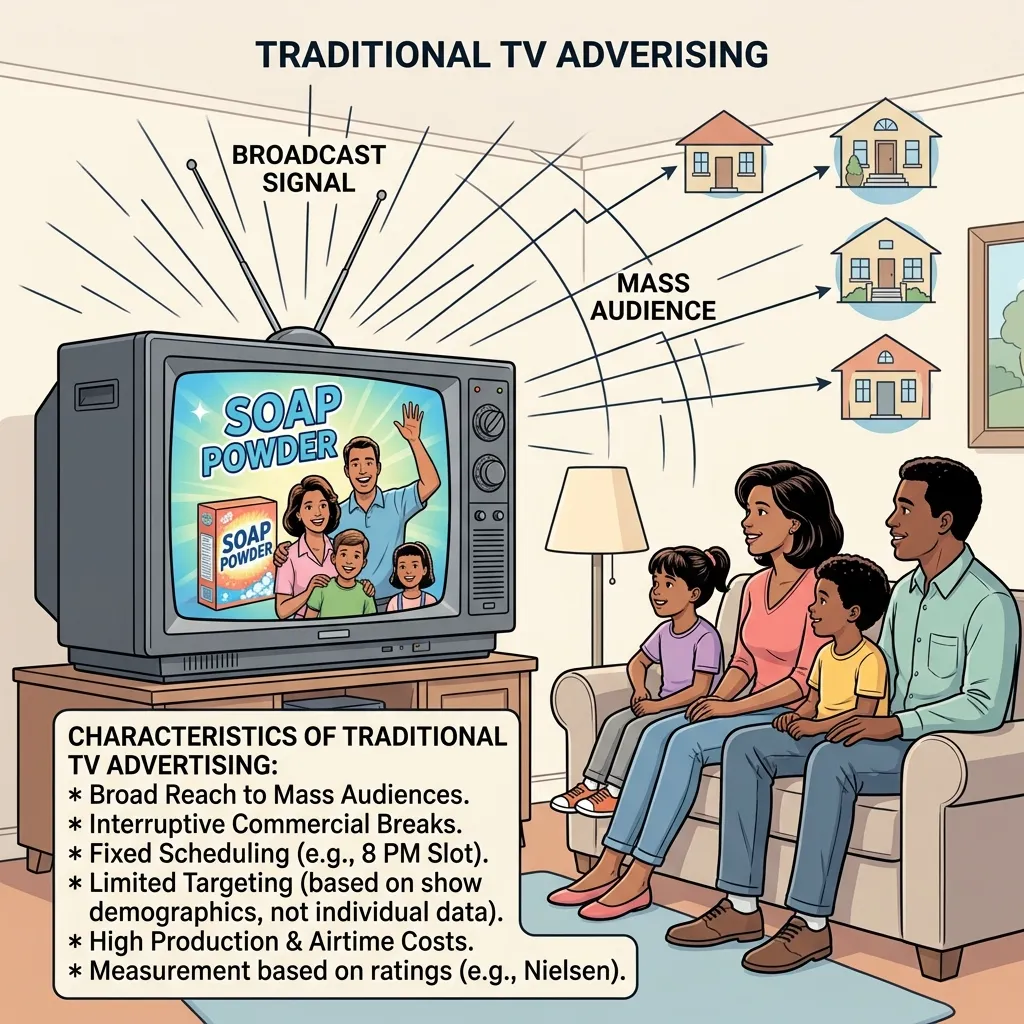
Traditional TV advertising is a form of paid advertising where businesses purchase television airtime to broadcast commercials or promotional messages to viewers.
It generally refers to conventional television advertising delivered through broadcast or cable television rather than primarily through internet-based connected TV or streaming advertising.
A traditional TV advertisement can include:
- Video footage
- Voiceovers
- Music
- Actors
- Product demonstrations
- Animation
- Graphics
- Testimonials
- Brand messages
- Promotional offers
- Calls to action
The main purpose is usually to reach a defined television audience and communicate a memorable message.
Businesses can use traditional TV advertising for:
- Brand awareness
- Product launches
- Service promotion
- Local business promotion
- Event promotion
- Seasonal campaigns
- Sales promotions
- Reputation building
- Customer education
The campaign can be local, regional, or national depending on the advertiser’s goals and available budget.See more TV Advertising by Industry
How Traditional TV Advertising Works
Traditional television advertising involves several stages, from planning the campaign to measuring the results.
Define the Advertising Objective
The first step is deciding what the business wants to achieve.
Possible objectives include:
- Increasing brand awareness
- Generating leads
- Increasing sales
- Promoting a product
- Driving store visits
- Promoting an event
- Building brand recognition
A clear objective helps determine the message, audience, creative format, and media strategy.
Identify the Target Audience
Businesses need to understand who they want to reach.
Audience considerations can include:
- Age
- Location
- Household characteristics
- Interests
- Purchasing behavior
- Lifestyle
- Customer needs
The more clearly the audience is defined, the easier it becomes to choose appropriate programming and advertising opportunities.
Develop the Commercial
The next step is creating the television advertisement.
This can involve:
- Research
- Concept development
- Scriptwriting
- Storyboarding
- Production
- Filming
- Voiceover
- Editing
- Graphics
- Final delivery
Purchase Television Airtime
Once the commercial is ready, the advertiser purchases television advertising placements.
Depending on the campaign, placements may be purchased through:
- Local television stations
- Regional broadcasters
- National networks
- Cable channels
- Media agencies
Broadcast the Advertisement
The commercial is then broadcast according to the agreed media schedule.
Measure Campaign Performance
After or during the campaign, businesses evaluate results using available metrics and business outcomes.
These may include:
- Reach
- Frequency
- Website traffic
- Phone calls
- Leads
- Sales
- Branded searches
- Store visits
- Campaign-specific responses
Why Traditional TV Advertising Still Matters
Traditional TV advertising continues to have several characteristics that can make it useful for certain businesses.
Mass Audience Reach
Television can reach a large number of people through established broadcast and cable programming.
This can be valuable for businesses that need broad awareness.
Strong Audio and Visual Impact
TV combines:
- Moving images
- Sound
- Voice
- Music
- Text
- Storytelling
This allows advertisers to communicate through multiple sensory elements.
Brand Building
Television can help brands build recognition through repeated exposure.
A consistent commercial can reinforce:
- Brand name
- Logo
- Product
- Slogan
- Brand personality
Storytelling Opportunities
A television commercial can communicate a story in a relatively short period.
This can be especially useful for brands that want to create emotional connections with audiences.
Local Market Visibility
Traditional television can also be useful for local businesses that want to establish recognition within a specific geographic market.
Types of Traditional TV Advertising
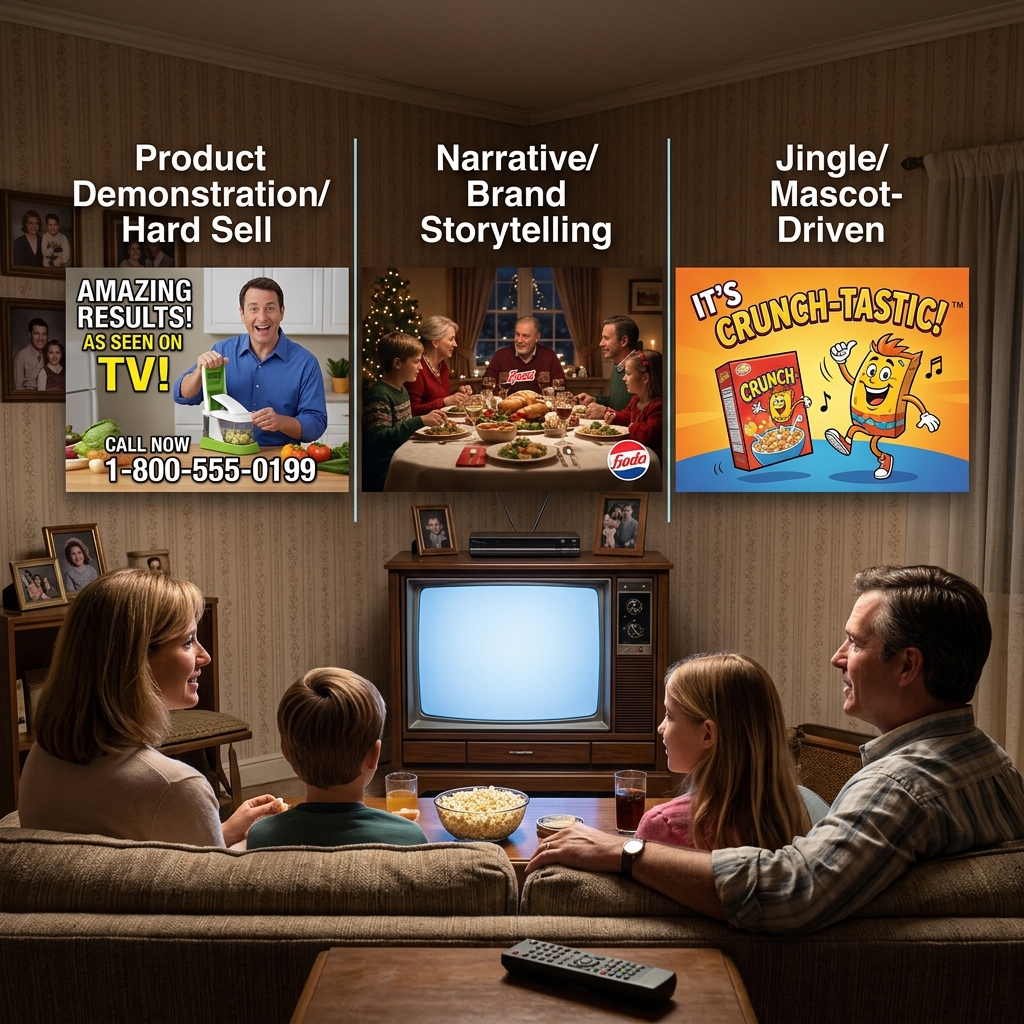
Traditional television advertising can take several forms.
Standard TV Commercials
Standard commercials are short advertisements broadcast during television programming.
They may focus on:
- Products
- Services
- Offers
- Brand awareness
- Events
Local TV Commercials
Local businesses can purchase advertising inventory from television stations serving a particular market.
This can be useful for businesses such as:
- Restaurants
- Car dealerships
- Law firms
- Real estate agencies
- Healthcare providers
- Retail stores
Network Television Advertising
Larger brands may advertise through national television networks to reach audiences across multiple geographic markets.
Cable Television Advertising
Cable channels can provide opportunities to reach audiences associated with particular programming interests.
Sponsorship Advertising
Businesses may sponsor television programs, segments, or special events.
Infomercials
Longer-form television advertisements can provide more time to explain a product, service, demonstration, or offer.
Traditional TV Advertising for Small Business
Small businesses often assume that television advertising is only suitable for large corporations.
That is not always the case.
Local television advertising can allow smaller businesses to target audiences within a specific geographic area.
For a detailed guide, see Traditional TV Advertising for Small Business.
Why Small Businesses Use TV Advertising
A local business may use television to:
- Increase local awareness
- Promote a new location
- Advertise seasonal offers
- Introduce a new service
- Build credibility
- Promote events
- Increase store visits
Examples of Small Business TV Advertising
A restaurant could advertise a new menu.
A local dealership could promote a sales event.
A healthcare provider could introduce a new service.
A real estate agency could promote a new development.
A law firm could build awareness within its service area.
Tips for Small Business TV Advertising
Small businesses should avoid trying to compete with national brands purely through production scale.
Instead, focus on:
- Local relevance
- Clear messaging
- Strong branding
- Specific offers
- Geographic targeting
- Memorable calls to action
Traditional TV Advertising Cost
The cost of traditional TV advertising varies considerably.
For a detailed breakdown, see Traditional TV Advertising Cost.
Factors That Influence TV Advertising Cost
Several factors can affect total campaign cost.
Market Size
Advertising in a large national market can cost substantially more than advertising in a smaller local market.
Audience Size
Placements reaching larger audiences may command higher prices.
Programming
The type and popularity of programming can affect advertising costs.
Time of Day
Different television dayparts can have different audience sizes and advertising rates.
Frequency
Running an advertisement repeatedly increases total media expenditure.
Commercial Production
The cost of creating the commercial is separate from the cost of purchasing airtime.
Production costs may include:
- Scriptwriting
- Actors
- Equipment
- Locations
- Studio costs
- Editing
- Voiceover
- Music
- Graphics
Creating a TV Advertising Budget
Businesses should consider both:
Production Cost + Media Cost + Campaign Management Cost
A realistic budget should also account for campaign duration and frequency.
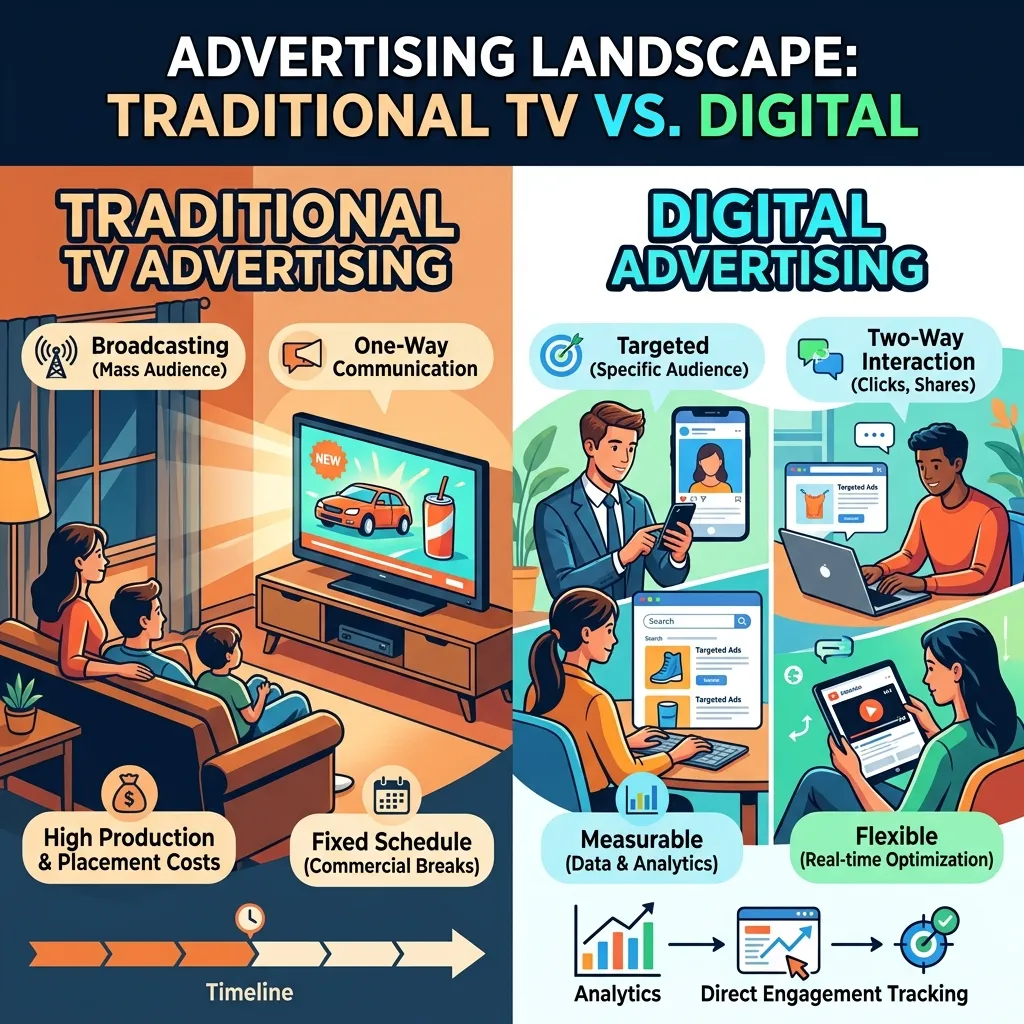
Traditional TV Advertising vs Digital Advertising
Traditional television and digital advertising have different strengths.
For a detailed comparison, see Traditional TV Advertising vs Digital Advertising.
Audience Reach
Traditional TV can provide broad mass-market exposure.
Digital advertising can offer more granular targeting based on audience characteristics and online behavior.
Targeting
Digital platforms often provide more detailed targeting options.
Traditional TV targeting can be based more heavily on:
- Geography
- Programming
- Time slots
- Audience characteristics
Measurement
Digital advertising often provides detailed digital performance data.
Traditional TV measurement can involve broader metrics such as:
- Reach
- Frequency
- Estimated audience
- Brand awareness
- Website response
- Sales impact
Creative Experience
TV offers strong audiovisual storytelling.
Digital advertising offers a wide range of formats including:
- Search ads
- Display ads
- Social ads
- Video ads
- Native advertising
Best Use Cases
Traditional TV can be particularly useful for:
- Mass awareness
- Brand building
- Local market visibility
- Large-scale campaigns
Digital advertising can be particularly useful for:
- Precise targeting
- Lead generation
- Direct response
- Retargeting
- Conversion optimization
The two channels can also work together.
Traditional Radio Advertising
Radio is another traditional advertising medium that businesses can use alongside television.
For a dedicated guide, see Traditional Radio Advertising.
TV vs Radio Advertising
TV provides:
- Visual storytelling
- Audio
- Motion
- Demonstrations
Radio primarily relies on:
- Voice
- Music
- Sound effects
- Spoken messaging
Radio can be useful when a business wants to communicate through audio while audiences are driving, working, or engaging in other activities.
Combining TV and Radio
Businesses can use consistent messaging across both channels.
For example:
TV: Shows the product and brand.
Radio: Reinforces the message through sound and repetition.
This can create broader media exposure.
Traditional Local TV Advertising
Local TV advertising focuses on reaching audiences within a specific geographic television market.
For more information, see Traditional Local TV Advertising.
Who Can Benefit From Local TV Advertising?
Potential users include:
- Restaurants
- Retail stores
- Local service providers
- Healthcare organizations
- Law firms
- Real estate businesses
- Automotive dealerships
- Educational institutions
Benefits of Local TV Advertising
Geographic Relevance
Local businesses can focus their messaging on people in their service area.
Community Awareness
Local television can help businesses establish recognition within their communities.
Local Offers
Businesses can promote:
- Grand openings
- Seasonal promotions
- Events
- Sales
- New services
Local TV Advertising Strategy
A local campaign should make the business location easy to remember.
Include:
- Business name
- Location
- Website
- Phone number
- Clear CTA
Traditional TV Advertising Examples
Real-world advertising examples can help businesses understand how different strategies work.
For more examples, see Traditional TV Advertising Examples.
Product Launch Example
A consumer brand launches a new product through a visually engaging commercial.
The advertisement introduces the product, highlights its primary benefit, and ends with a clear CTA.
Restaurant Example
A restaurant showcases its signature dishes, restaurant environment, and limited-time promotion.
The commercial ends with the restaurant location and website.
Automotive Example
A dealership promotes a new vehicle model and a seasonal sales event.
The advertisement highlights the vehicle and provides a simple offer.
Healthcare Example
A healthcare organization introduces a new service and explains how customers can learn more or schedule an appointment.
Insurance Example
An insurance company uses a relatable scenario to explain the importance of protection and introduce its brand.
Local Retail Example
A retail store promotes a special weekend sale and provides its location and website.
Traditional TV Commercial Production
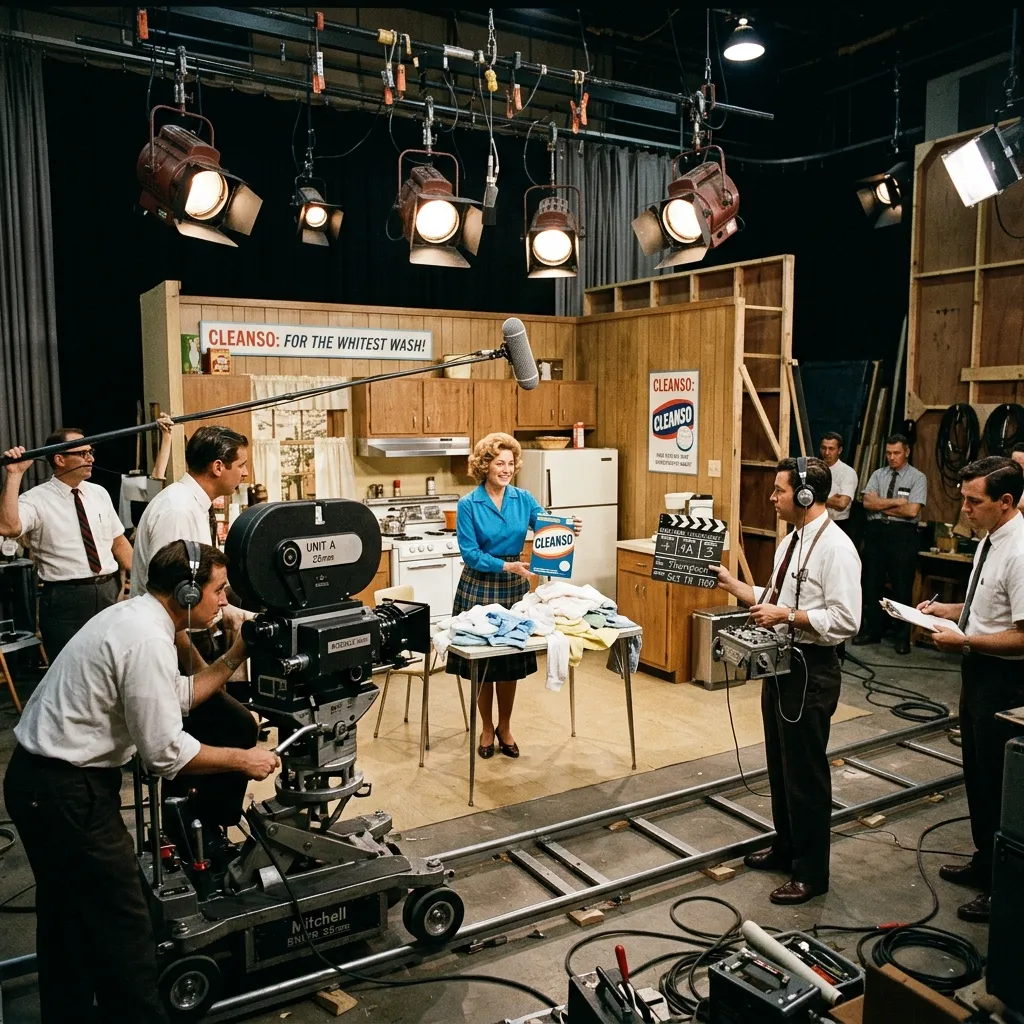
Producing a traditional TV commercial requires planning, creative development, production, and post-production.
For a detailed guide, see Traditional TV Commercial Production.
Step 1: Research
Start by understanding:
- Target audience
- Competitors
- Market
- Customer needs
- Campaign objective
Step 2: Develop the Concept
Create a central idea that communicates the brand message.
Step 3: Write the Script
The script should determine:
- Dialogue
- Voiceover
- Scene descriptions
- Product messaging
- CTA
Step 4: Create a Storyboard
A storyboard provides a visual plan for the commercial.
Step 5: Production
Production may involve:
- Camera operators
- Directors
- Actors
- Locations
- Lighting
- Audio
- Equipment
Step 6: Post-Production
Post-production may include:
- Video editing
- Sound editing
- Music
- Graphics
- Voiceover
- Color correction
- Final formatting
Step 7: Review and Approval
Before broadcasting, the business should review:
- Branding
- Accuracy
- Claims
- Contact information
- CTA
- Final presentation
Traditional Cinema Advertising
Cinema advertising is another traditional visual advertising format.
For a dedicated comparison and strategy, see Traditional Cinema Advertising.
How Cinema Advertising Differs From TV
Cinema advertising is typically shown to audiences before or around movie screenings.
It can offer:
- Large-screen presentation
- High-quality audiovisual experience
- Captive audience environment
TV advertising can reach viewers across a broader range of programming and viewing situations.
When Cinema Advertising Can Work
Cinema advertising can be useful for:
- Entertainment brands
- Restaurants near cinemas
- Retail businesses
- Local services
- Product launches
- Lifestyle brands
Businesses should select cinema placements based on their target audience and geographic objectives.
Traditional Transit Advertising
Transit advertising uses transportation environments to display promotional messages.
For more information, see Traditional Transit Advertising.
Common Transit Advertising Formats
Transit advertising can include:
- Bus advertising
- Bus shelter advertising
- Train advertising
- Subway advertising
- Transit station advertising
TV vs Transit Advertising
TV offers audiovisual storytelling.
Transit advertising relies heavily on:
- Visual design
- Short messages
- Repetition
- Geographic exposure
A business may use both channels to reinforce brand awareness.
Traditional Print Advertising Strategies
Print advertising includes newspapers, magazines, brochures, flyers, direct mail, and other physical formats.
For a dedicated strategy guide, see Traditional Print Advertising Strategies.
TV vs Print Advertising
TV provides:
- Video
- Sound
- Motion
- Storytelling
Print provides:
- Detailed written information
- Physical materials
- Long-form messaging
- Visual layouts
Combining TV and Print
A campaign could introduce a product through TV and provide additional details through brochures, magazines, newspapers, or direct mail.
This can help create consistency across traditional media channels.
Advantages of Traditional TV Advertising
Traditional television advertising can provide several advantages.
Large-Scale Exposure
Television can reach large audiences.
Strong Brand Visibility
Video and sound can make advertisements memorable.
Emotional Impact
Storytelling can help brands communicate emotion.
Professional Brand Image
A well-produced TV commercial can contribute to a professional brand image.
Local Market Opportunities
Local television can help businesses reach geographic markets.
Multi-Sensory Communication
TV combines several communication formats in a single advertisement.
Disadvantages of Traditional TV Advertising
Traditional TV advertising also has limitations.
High Costs
Production and media placement can require significant investment.
Limited Direct Targeting
Traditional television generally offers less granular targeting than many digital platforms.
Measurement Challenges
Attribution can be more complicated than with some digital advertising channels.
Ad Avoidance
Viewers may change channels, leave the room, mute the television, or otherwise avoid advertisements.
Production Requirements
High-quality TV advertising can require significant planning and resources.
How to Measure Traditional TV Advertising
Measuring TV performance requires a combination of media metrics and business outcomes.
Reach
Reach measures the number or proportion of people exposed to an advertisement or campaign.
Frequency
Frequency indicates how often an audience is exposed to the campaign.
Website Traffic
Businesses can monitor website traffic during and after campaigns.
Branded Search
An increase in searches for a brand can provide an indication of increased awareness.
Phone Calls
Businesses can track inbound calls associated with campaign periods.
Leads
Lead volume can be compared before, during, and after the campaign.
Sales
Sales data can help determine whether the campaign contributed to business growth.
QR Codes and Dedicated URLs
Businesses can use:
- QR codes
- Dedicated landing pages
- Campaign-specific URLs
- Promotional codes
These approaches can make response tracking easier.
How to Build a Traditional TV Advertising Strategy
A strong campaign starts with planning.
Define Your Goal
Decide what the campaign needs to accomplish.
Identify Your Audience
Determine who should see the advertisement.
Select the Market
Choose whether the campaign should be:
- Local
- Regional
- National
Develop the Message
Focus on one central value proposition.
Create the Commercial
Produce a commercial that communicates the message clearly.
Select Media Placements
Choose television stations, networks, programs, and time slots that align with the audience.
Determine Frequency
Decide how often the advertisement should be shown.
Coordinate Other Channels
Connect the TV campaign with:
- Website
- Search marketing
- Social media
- Radio
Measure Results
Track both media exposure and business outcomes.
Traditional TV Advertising and Digital Marketing Integration
Traditional TV does not have to operate independently from digital marketing.
A coordinated campaign can create a customer journey such as:
TV Advertisement → Brand Awareness → Online Search → Website Visit → Lead → Conversion
TV and Search Marketing
Viewers may search for a brand after seeing a commercial.
Businesses can make this easier by using:
- Memorable brand names
- Simple URLs
- Clear offers
- Search-friendly campaign messaging
TV and Social Media
Businesses can extend television campaigns through social media content.
For example:
- Behind-the-scenes videos
- Short commercial clips
- Customer discussions
- Campaign hashtags
- Social promotions
TV and Email Marketing
Television can introduce a brand while email marketing nurtures people who have already interacted with the business.
Traditional TV Advertising Compliance
Businesses should review advertising claims carefully before broadcasting commercials.
Advertising should be truthful and should not mislead consumers.
The FTC’s Advertising and Marketing Basics provides guidance on advertising and marketing practices, including principles concerning truthful and non-deceptive advertising.
Businesses can also review the FTC Advertising FAQs for Small Business for additional information about advertising claims and substantiation.
Depending on the industry and location, additional requirements may apply.
Businesses should therefore review applicable laws, regulations, industry rules, and broadcaster requirements before launching a campaign.
Common Traditional TV Advertising Mistakes
Unclear Message
If viewers cannot understand the main point quickly, the commercial may be ineffective.
Too Much Information
Trying to communicate too many ideas can reduce message retention.
Weak Branding
The brand should be recognizable throughout the commercial.
Poor CTA
Viewers should understand what action they should take.
Wrong Audience
Even a high-quality commercial may underperform if it reaches the wrong audience.
Poor Media Placement
Advertising during programming that does not align with the target audience can reduce efficiency.
Ignoring Other Channels
TV campaigns can be more useful when coordinated with digital and other traditional marketing channels.
Traditional TV Advertising Best Practices
Keep the Core Message Simple
Focus on one primary idea.
Make the Brand Memorable
Use consistent:
- Logo
- Colors
- Visual identity
- Brand voice
- Slogan
Use Strong Visuals
Show the product, service, environment, or customer experience whenever possible.
Use Audio Strategically
Music, dialogue, voiceover, and sound effects should support the message rather than distract from it.
Include a Clear CTA
Tell viewers what to do next.
Repeat Key Information
Important information such as brand name, website, phone number, or offer may need to appear more than once.
Test Different Creative Concepts
Businesses can compare different messages and creative approaches where practical.
Is Traditional TV Advertising Right for Your Business?
Traditional TV advertising may be worth considering when a business needs broad awareness, strong visual storytelling, or local market visibility.
Before investing, ask:
- Who is my target audience?
- How large is my target market?
- What is my advertising objective?
- Can TV reach my audience effectively?
- What is my available budget?
- How will I measure results?
- Can I integrate TV with digital marketing?
- Does my product or service benefit from visual storytelling?
If the answers support television, a well-planned campaign may be worth testing.
Final Thoughts
Traditional TV advertising remains an important part of the broader advertising landscape.
It offers businesses the ability to combine video, sound, storytelling, and brand messaging to reach audiences through television programming.
While traditional TV may not provide the same level of digital targeting and immediate performance data as many online advertising platforms, it can still play an important role in brand awareness, local visibility, product promotion, and large-scale marketing campaigns.
The most effective approach is not necessarily to choose traditional TV advertising or digital advertising exclusively.
Businesses can combine television with search marketing, social media, websites, email, radio, print, and other channels to create a connected customer journey.
Whether you are a small business looking for local exposure or a larger company building national brand awareness, the key is to define a clear objective, understand your audience, develop a memorable message, choose appropriate media placements, and measure meaningful business results.
Frequently Asked Questions About Traditional TV Advertising
What is traditional TV advertising?
Traditional TV advertising is paid advertising delivered through conventional television broadcast or cable channels. It typically uses video, audio, storytelling, graphics, and calls to action to promote a product, service, brand, or offer.
Is traditional TV advertising still effective?
Traditional TV advertising can still be effective for businesses seeking broad awareness, local visibility, brand recognition, and audiovisual storytelling. Results depend on factors such as audience, creative quality, media placement, frequency, and campaign objectives.
How much does traditional TV advertising cost?
The cost varies depending on market size, audience, programming, time slot, frequency, campaign duration, and commercial production expenses. Local campaigns can have different costs from regional or national campaigns.
Can small businesses use traditional TV advertising?
Yes. Small businesses can use local television advertising to reach audiences within a specific geographic area. Restaurants, retailers, law firms, dealerships, healthcare providers, and other local businesses may consider local TV campaigns.
What is the difference between traditional TV and digital advertising?
Traditional TV generally provides broad audiovisual reach through television programming, while digital advertising often provides more detailed targeting, tracking, and optimization options. Businesses can also combine both channels.
What are the main types of traditional TV advertising?
Common types include standard TV commercials, local TV advertising, network advertising, cable advertising, sponsorships, and longer-form advertising such as infomercials.
How long should a traditional TV commercial be?
Commercial length depends on the campaign, budget, media placement, and communication objective. Shorter commercials are useful for focused messages, while longer formats can provide more space for storytelling and explanation.
How do you measure TV advertising results?
Businesses can evaluate reach, frequency, website traffic, branded searches, phone calls, leads, sales, QR-code scans, dedicated URLs, promotional codes, and other campaign-specific responses.
Can TV advertising work with SEO and digital marketing?
Yes. A TV advertisement can increase brand awareness and encourage viewers to search for the brand online. Search, social media, websites, email, and other digital channels can then support the customer journey.
What makes a good traditional TV advertisement?
A strong TV advertisement usually has a clear objective, defined target audience, memorable opening, simple message, strong branding, engaging visuals, appropriate audio, credible claims, and a clear call to action.









[…] Businesses can learn more about the broader concept through this traditional TV advertising complete guide. […]
[…] interested in the fundamentals can also explore this traditional TV advertising complete guide for a broader […]
[…] For broader information about television advertising, see the complete guide to traditional TV advertising. […]
[…] at once and allows for more frequent repetition, which is covered in detail in this guide to traditional TV advertising. Cinema advertising, on the other hand, trades reach for attention quality — a smaller audience, […]
[…] To see how print fits into a broader offline strategy, explore our guide on why traditional advertising still works, or compare it with traditional TV advertising. […]