

Traditional TV advertising remains a powerful way for small businesses to reach local audiences, build brand recognition, and create memorable connections with potential customers. While digital advertising offers precise targeting and flexible budgets, television provides something equally valuable: broad visibility and strong visual impact.
For a small business, traditional TV advertising can be particularly useful when the goal is to establish credibility within a local market, promote a new product or service, or reach households that may not respond to online advertising.
The key is not simply buying television airtime. Successful traditional TV advertising for small business requires choosing the right audience, creating a focused commercial, selecting suitable programs, managing costs, and measuring results.
What Is Traditional TV Advertising for Small Business?
Traditional TV advertising for small business refers to promoting a company’s products, services, or brand through conventional television channels rather than relying exclusively on digital or streaming advertising.
A business typically creates a television commercial and pays a television station or network to broadcast it during selected programs or time periods.
Common examples include:
- Local restaurant commercials
- Retail store advertisements
- Healthcare service commercials
- Real estate advertisements
- Automotive dealership ads
- Educational institution promotions
- Home service advertisements
- Local event promotions
- Seasonal sales campaigns
Unlike many digital advertisements that users can scroll past instantly, television commercials use sight, sound, motion, and storytelling to communicate a message.
For small businesses, this combination can help turn a relatively simple offer into a memorable brand experience.
Why TV Advertising Still Matters for Small Businesses
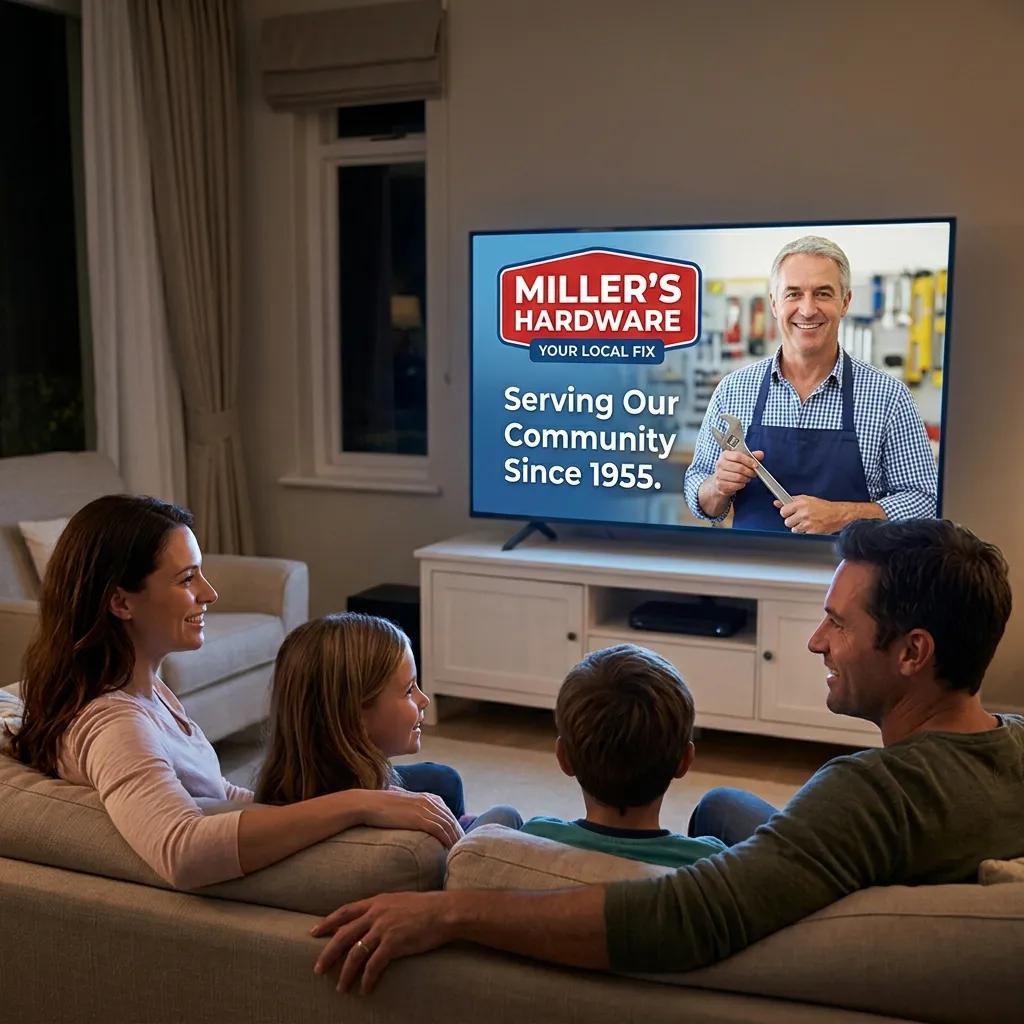
Small businesses often compete against larger companies with bigger digital marketing budgets. Television can provide an opportunity to establish a strong presence within a specific geographic market.
A well-planned TV campaign can help a business:
- Increase local brand awareness
- Reach a broad household audience
- Build credibility
- Promote special offers
- Introduce new products or services
- Strengthen brand recognition
- Support other marketing channels
- Generate website visits and phone calls
Television can also reinforce other advertising efforts. Someone may see a business on TV and later recognize the same brand when encountering its website, social media page, storefront, or printed advertisement.
Benefits of Traditional TV Advertising for Small Business
1. Builds Local Brand Awareness
Local awareness is especially important for businesses that serve a defined geographic area.
A restaurant, dental clinic, furniture store, construction company, or local retailer does not necessarily need to reach an international audience. It needs to become recognizable among potential customers in its service area.
Local television advertising can put a business in front of households within that market repeatedly.
Repeated exposure can make a brand easier to recognize when customers eventually need the product or service.
2. Reaches a Broad Audience
Television can reach different demographic groups within a household.
Depending on the selected channel and program, businesses can reach audiences based on factors such as:
- Age
- Location
- Household characteristics
- Interests
- Viewing habits
- Program preferences
This broad reach can be useful for businesses whose products appeal to multiple customer groups.
3. Creates Strong Visual Impact
One of the major strengths of TV advertising is its ability to combine multiple forms of communication.
A commercial can use:
- Video
- Voice
- Music
- Graphics
- Demonstrations
- Brand colors
- Storytelling
- On-screen offers
For example, a restaurant can show its food being prepared, customers enjoying the experience, and a limited-time offer within a short commercial.
That experience is difficult to reproduce through a simple text advertisement.
4. Increases Perceived Credibility
Being featured on television can create a perception of legitimacy and professionalism.
For a small business competing with established companies, this perception can be valuable.
A professional commercial can communicate that the company is established, active, and serious about serving its customers.
However, credibility ultimately depends on the quality and authenticity of the advertisement. A poorly produced commercial may have the opposite effect.
5. Supports Promotional Campaigns
Traditional TV advertising can be particularly effective for time-sensitive promotions.
Businesses can advertise:
- Seasonal discounts
- Grand openings
- Holiday sales
- New product launches
- Special events
- Limited-time offers
- Membership promotions
- Service packages
A clear offer combined with a deadline can encourage viewers to take action.
6. Strengthens Brand Recall
Television allows businesses to develop recurring creative elements.
A company might consistently use:
- The same slogan
- A recognizable spokesperson
- A memorable sound
- A distinctive visual style
- A recurring character
- A consistent brand message
Over time, these elements can strengthen brand recall.
How Traditional TV Advertising Works for a Small Business

A typical campaign follows several stages.
Step 1: Define the Advertising Objective
Start by deciding what the campaign needs to accomplish.
Possible objectives include:
- Increasing awareness
- Generating leads
- Driving store visits
- Increasing phone calls
- Promoting a new product
- Increasing sales
- Supporting a special promotion
A campaign with a clear objective is easier to plan and measure.
Step 2: Identify the Target Audience
Determine who is most likely to purchase the product or service.
Consider:
- Location
- Age group
- Household profile
- Income level
- Customer needs
- Buying behavior
- Viewing habits
For a local business, geographic targeting is often particularly important.
A company should avoid paying to reach large numbers of viewers who are outside its service area.
Step 3: Set the Budget
Small businesses should establish a realistic advertising budget before producing or purchasing airtime.
The overall budget may include:
- Commercial production
- Scriptwriting
- Video production
- Voice-over
- Editing
- Media placement
- Airtime
- Creative revisions
- Tracking and measurement
The cheapest campaign is not always the best campaign. At the same time, a small business should not spend heavily on production while leaving too little budget for actual media exposure.
Step 4: Create the Commercial
The commercial should communicate one central message.
A basic structure can include:
Problem → Solution → Benefit → Offer → Call to Action
For example, a home service company could begin by showing a common household problem, introduce its service as the solution, highlight a customer benefit, present an introductory offer, and finish with a phone number or website.
Step 5: Choose the Right Programs
Program selection matters because the audience watching the program should match the business’s target market.
Consider:
- Audience demographics
- Program popularity
- Local relevance
- Broadcast schedule
- Frequency
- Cost
- Competitive advertising
- Seasonal viewing patterns
A smaller business may benefit more from strategically selected local programming than from trying to compete for the most expensive national placements.
Step 6: Schedule the Campaign
Frequency is important.
Showing an advertisement once may create awareness, but repeated exposure can improve recognition.
Businesses should consider a schedule that balances:
- Reach
- Frequency
- Budget
- Campaign duration
- Audience availability
Step 7: Track the Results
The campaign should have measurable indicators.
Useful metrics include:
- Website traffic
- Phone calls
- Coupon redemptions
- Store visits
- Branded searches
- Lead volume
- Sales
- Campaign response rate
For example, a business can use a dedicated landing page or promotional code that appears only in the television commercial.
How Much Does Traditional TV Advertising Cost for a Small Business?
The cost of traditional TV advertising varies significantly.
Major cost factors include:
| Cost Factor | Why It Matters |
|---|---|
| Production | Determines the cost of creating the commercial |
| Airtime | Changes based on station, program, and schedule |
| Audience size | Larger audiences can command higher rates |
| Geographic market | Larger markets generally cost more |
| Time of day | High-demand viewing periods may cost more |
| Frequency | More placements increase total campaign cost |
| Commercial length | Longer advertisements may require different pricing |
| Campaign duration | Longer campaigns require a larger overall budget |
Small businesses should therefore think about total campaign cost, not simply the price of one commercial placement.
A lower-cost placement that reaches the right customers repeatedly may provide more value than an expensive placement with a large but poorly matched audience.
Traditional TV Advertising vs Digital Advertising for Small Businesses
TV and digital advertising serve different purposes.
| Factor | Traditional TV Advertising | Digital Advertising |
|---|---|---|
| Reach | Broad | Highly targetable |
| Visual impact | Very strong | Strong |
| Local awareness | Strong | Strong |
| Audience targeting | Moderate to strong depending on placement | Highly precise |
| Real-time optimization | Limited | Strong |
| Direct measurement | More challenging | Usually easier |
| Brand storytelling | Excellent | Excellent |
| Budget flexibility | Can require larger commitments | Often more flexible |
| Frequency | Scheduled | Highly adjustable |
This does not mean a small business must choose only one.
In many cases, TV can create awareness while digital channels capture and convert interested customers.
How to Create an Effective TV Commercial for a Small Business
A small-business commercial does not need to look like a Hollywood production.
It needs to be clear, relevant, and memorable.
Keep the Message Simple
Avoid trying to explain everything about the business.
Choose one primary message.
For example:
“Get 20% off your first service this month.”
A focused message is easier for viewers to understand and remember.
Show the Product or Service
Whenever possible, demonstrate what customers are buying.
A restaurant can show its food.
A furniture store can show its products inside a room.
A fitness center can show its facilities.
A home service company can show the service being performed.
Make the Brand Visible
Do not wait until the final second to reveal the company.
The brand name, logo, or product should appear naturally throughout the commercial.
Include a Clear Call to Action
Tell viewers exactly what to do next.
Examples include:
- Visit our store
- Call today
- Book an appointment
- Visit our website
- Use this promotional code
- Claim your offer
A commercial without a clear next step can create awareness without generating measurable action.
Local TV Advertising Strategies for Small Businesses
Local television can be especially useful when the business depends on customers within a particular area.
Focus on the Local Community
Use local references when appropriate.
Mention:
- The service area
- Local events
- Nearby communities
- Local customer needs
- Regional promotions
This can make the commercial feel more relevant.
Promote Location-Based Offers
A business can create an offer specifically for TV viewers.
For example:
“Mention TV10 when you visit and receive 10% off.”
This provides both an incentive and a way to track responses.
Use Local Testimonials
Real customer experiences can add credibility.
A short testimonial can explain:
- What problem the customer had
- Why they selected the business
- What result they experienced
Authentic testimonials can be more persuasive than generic claims.
Common Mistakes Small Businesses Should Avoid
1. Spending Too Much on Production
A massive production budget does not automatically produce better results.
The message, audience, offer, and distribution strategy matter just as much.
2. Trying to Say Too Much
Too many messages can confuse viewers.
Focus on one primary benefit and one action.
3. Ignoring Frequency
A single exposure may not be enough to build meaningful awareness.
Campaign frequency should be considered alongside reach.
4. Choosing Programs Only Because They Are Popular
The largest audience is not necessarily the most valuable audience.
A small business should prioritize relevance.
5. Forgetting the Call to Action
Always give viewers a clear next step.
6. Failing to Track Results
Without tracking, it becomes difficult to determine whether TV advertising is contributing to business growth.
7. Using the Same Commercial Forever
Customer expectations and market conditions change.
Businesses should periodically review and refresh their creative approach.
How to Measure Traditional TV Advertising Results
Measuring TV advertising can be more challenging than measuring some digital campaigns, but it is still possible.
Use Dedicated URLs
Create a landing page that is promoted only through the TV campaign.
For example, the commercial could direct viewers to a simple campaign-specific web address.
Use Promotional Codes
A unique promotional code can help identify customers who responded to the commercial.
Track Phone Calls
Use a dedicated phone number or call-tracking system where appropriate.
Monitor Branded Search Activity
An increase in searches for the company’s name after a campaign begins can provide another indication of increased awareness.
Compare Sales Before and After the Campaign
Compare relevant sales or lead data across periods while considering other factors that could affect performance.
Ask Customers How They Heard About the Business
A simple question during checkout, booking, or lead intake can reveal whether television contributed to the customer’s decision.
How Small Businesses Can Maximize Their TV Advertising Budget
A limited budget does not necessarily mean TV advertising is impossible.
Businesses can improve efficiency by:
- Targeting a specific geographic market.
- Choosing programs that match the target audience.
- Negotiating appropriate media packages.
- Reusing core creative assets when practical.
- Testing different offers.
- Tracking response with unique codes or URLs.
- Focusing on frequency rather than one-off exposure.
- Combining TV with digital channels.
- Reviewing performance regularly.
- Investing more heavily in placements that produce meaningful results.
The objective should be to maximize relevant exposure, not simply maximize the number of viewers.
Combining Traditional TV Advertising With Digital Marketing
Traditional TV advertising does not have to operate independently.
A small business can build an integrated campaign around the same message.
For example:
TV commercial → Website → Social media → Retargeting → Conversion
A viewer may first discover the company through television. Later, that person may search for the business online, visit its website, or encounter a related digital advertisement.
Consistent branding across these channels can reinforce recognition.
This approach can be especially useful for small businesses that want the broad awareness of television alongside the measurement capabilities of digital marketing.
Is Traditional TV Advertising Worth It for a Small Business?

Traditional TV advertising can be worthwhile when the business has:
- A defined local market
- A product or service with broad appeal
- Enough margin to support customer acquisition
- A clear advertising objective
- A compelling commercial
- A measurable offer
- A realistic campaign budget
It may be less suitable when a business serves an extremely narrow audience or has a very limited budget with no ability to track campaign performance.
The right question is not simply, “Is TV advertising expensive?”
Instead, ask:
Can television reach enough of the right potential customers at a cost that makes business sense?
That calculation should guide the decision.
A Simple Traditional TV Advertising Plan for Small Businesses
A small business can use the following framework to build its first campaign:
| Stage | Action |
|---|---|
| Goal | Define the campaign objective |
| Audience | Identify the ideal local customer |
| Message | Choose one core benefit |
| Offer | Create a compelling reason to respond |
| Creative | Produce a clear commercial |
| Media | Select relevant local programs |
| Schedule | Determine campaign frequency and duration |
| Tracking | Set up codes, URLs, calls, or other tracking |
| Launch | Begin the campaign |
| Review | Analyze awareness and response |
| Optimize | Adjust placements, messaging, or offers |
This process helps prevent TV advertising from becoming a purely awareness-focused expense without measurable business objectives.
Final Thoughts
Traditional TV advertising for small business can still be a valuable marketing channel when it is planned around the right audience, message, budget, and measurement system.
Television provides strong visual storytelling, broad reach, and the opportunity to establish credibility within a local market. However, simply purchasing airtime does not guarantee results.
Small businesses should begin with a clear objective, understand their target customers, create a concise commercial, choose relevant programming, maintain sufficient frequency, and track customer responses.
The strongest approach is often to use television as part of a broader marketing strategy. TV can create awareness and trust, while websites, search, social media, email, and other channels can help convert that awareness into measurable customer action.
When every element works together, traditional TV advertising can become more than a brand-awareness tactic—it can become a practical part of a small business growth strategy.
Frequently Asked Questions
What is traditional TV advertising for small business?
Traditional TV advertising for small business involves promoting products, services, or brands through conventional television broadcasts. Small businesses can use local stations and targeted programming to reach potential customers within a specific market.
Is TV advertising effective for small businesses?
TV advertising can be effective for small businesses when the campaign reaches a relevant audience, communicates a clear message, uses appropriate frequency, and includes measurable goals.
How much does TV advertising cost for a small business?
Costs vary based on production, geographic market, station, program, time slot, audience size, commercial length, and campaign frequency. There is no single price that applies to every small business.
Is local TV advertising better for small businesses?
Local TV advertising can be particularly useful for businesses that depend on customers within a specific geographic area. It can reduce wasted exposure compared with campaigns designed for a much broader market.
What should a small business include in a TV commercial?
A strong commercial should generally include the brand, a clear customer benefit, relevant visuals, a compelling offer when appropriate, and a clear call to action.
How long should a small-business TV commercial be?
The appropriate commercial length depends on the campaign, budget, message, and available media placements. The most important consideration is whether viewers can understand and remember the core message.
How can a small business measure TV advertising?
Businesses can measure TV campaigns using dedicated landing pages, promotional codes, phone numbers, customer surveys, website traffic, branded search activity, lead volume, store visits, and sales data.
Can TV advertising work with a small budget?
It can, particularly when a business focuses on a defined geographic area and carefully selects relevant placements. Budget efficiency depends on reaching the right audience rather than simply purchasing the largest possible audience.
Should small businesses use TV and digital advertising together?
Yes. TV can build awareness and brand recognition, while digital channels can help capture, retarget, and convert interested customers. Combining both can create a more connected customer journey.
What are the biggest TV advertising mistakes for small businesses?
Common mistakes include unclear messaging, weak calls to action, poor audience selection, insufficient frequency, excessive production spending, and failing to measure campaign results.
Is traditional TV advertising still relevant today?
Yes. Although media consumption has changed, television can still provide broad reach, visual storytelling, and local brand exposure. Its value depends on the target audience and campaign strategy.
What is the best TV advertising strategy for a small business?
The best strategy starts with a defined objective and audience, followed by a focused commercial, relevant program selection, appropriate frequency, a realistic budget, and reliable performance tracking.









[…] small organizations specifically, this guide to traditional TV advertising for small businesses provides additional […]