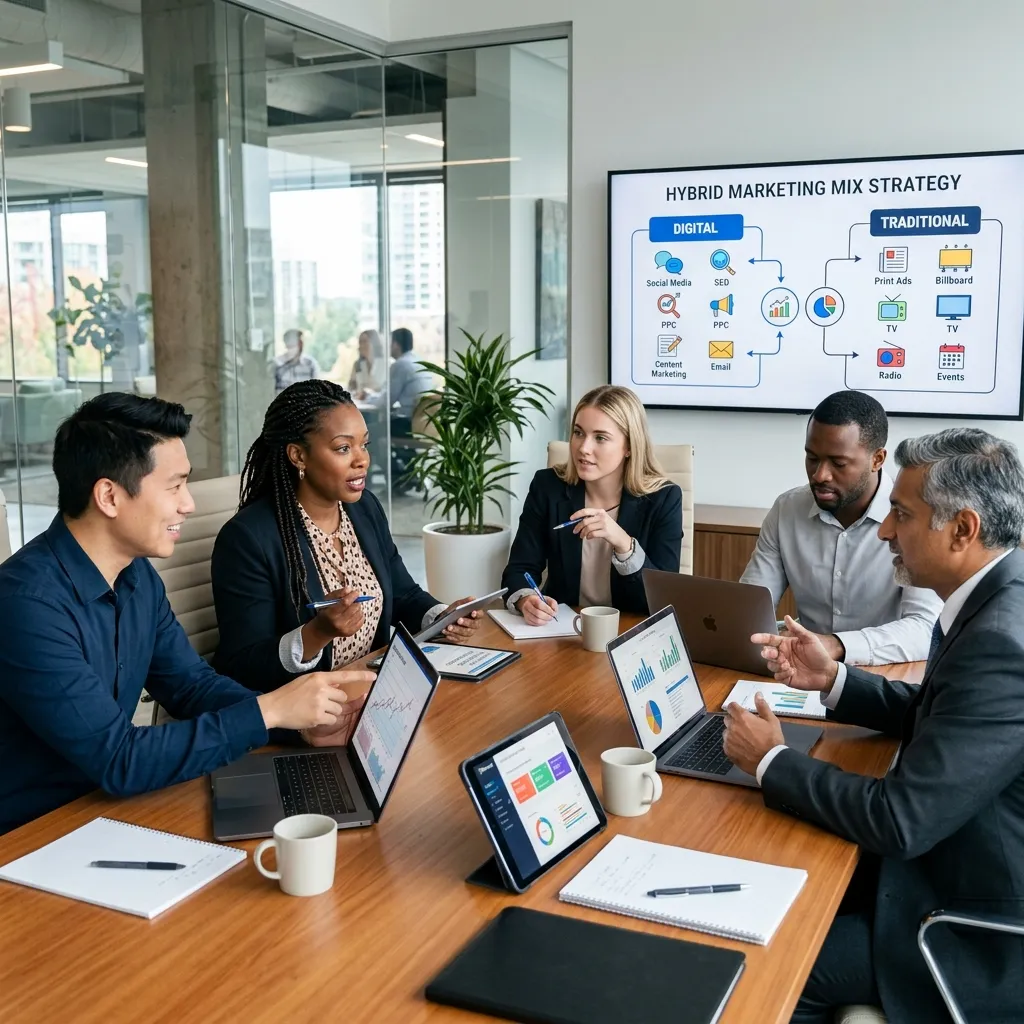
A hybrid marketing mix strategy combines the traditional 4 Ps framework—Product, Price, Place, and Promotion—with digital marketing channels like SEO, social media, and content marketing. This integrated marketing mix approach helps businesses reach diverse audiences, maximize ROI, and build lasting brand authority across every customer touchpoint.
Most businesses already understand the 4 Ps. Product, Price, Place, Promotion—the foundational framework taught in every marketing class and applied in every boardroom. What fewer businesses grasp is how dramatically those four pillars need to evolve when offline and online channels are running simultaneously.
A hybrid marketing mix strategy doesn’t discard the classic model. It extends it. Digital feedback reshapes product decisions. Dynamic pricing algorithms challenge static price lists. Omnichannel distribution blurs the line between physical and digital storefronts. And promotion—once a clean division between advertising and PR—now spans social media campaigns, influencer partnerships, QR-coded print ads, and retargeted digital display all working in concert.
The brands growing fastest today aren’t the ones that picked a side between traditional and digital. They’re the ones that figured out how to make both sides amplify each other. This guide explains exactly how to do that—from the foundational concepts through to implementation, real-world examples, and the key challenges you’ll need to navigate.
By the end, you’ll have a clear, actionable framework for building a hybrid marketing mix strategy that drives measurable growth.
What Is a Hybrid Marketing Mix Strategy?
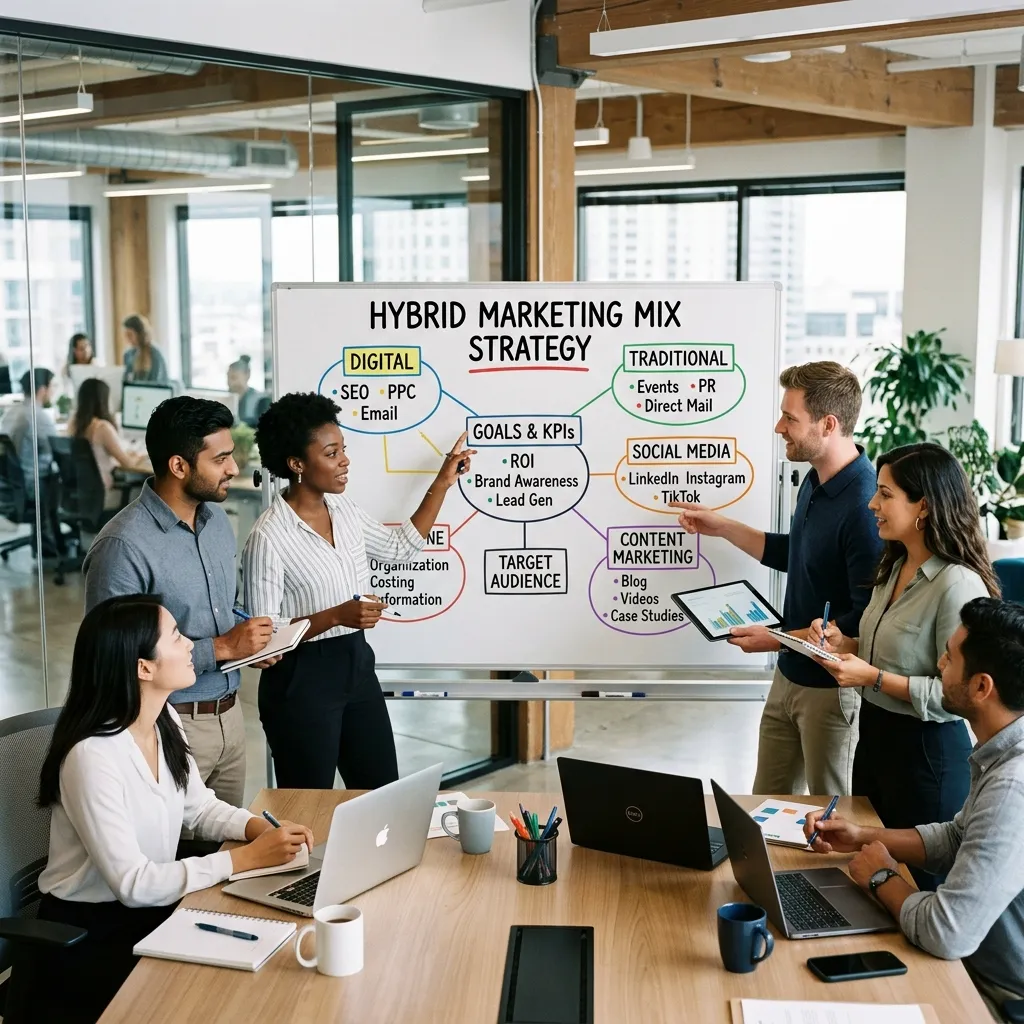 A hybrid marketing mix strategy is an integrated promotional framework that combines traditional marketing principles—such as the 4 Ps—with digital marketing channels and tactics to create a unified, customer-centric approach. Rather than treating print ads, TV campaigns, and digital platforms as separate budget lines with separate goals, the hybrid model unifies every effort under shared objectives and consistent brand messaging.
The “mix” component is critical here. Traditional marketing’s 4 Ps—Product, Price, Place, and Promotion—were designed for a world where businesses controlled the conversation. Digital marketing shifted power to the consumer. A hybrid marketing mix strategy acknowledges both realities and builds a framework flexible enough to operate in both.
To understand the full hybrid marketing strategy definition and how it applies across modern business contexts, it’s worth examining how each component of the traditional mix transforms when digital channels are layered in.
Understanding the Core Concepts Behind the Hybrid Model
How does the traditional 4 Ps marketing mix still apply today?
The 4 Ps remain relevant precisely because they force strategic clarity. Before any channel is chosen, businesses must define what they’re selling, at what price, through which distribution channels, and with what promotional message. These decisions form the strategic spine that every hybrid marketing mix initiative hangs from.
- Product: What problem does the product solve, and how does digital feedback—reviews, support tickets, social listening—improve it over time?
- Price: Does the pricing strategy account for both in-store and e-commerce price expectations?
- Place: Are products available where customers actually shop, both physically and digitally?
- Promotion: Does promotional messaging remain consistent whether a customer encounters a billboard or a social media ad?
What does the digital marketing mix add to the equation?
The digital marketing mix extends each of the four traditional Ps with capabilities that didn’t exist until recently. E-commerce opens new distribution channels. SEO makes brand discovery organic and compounding. Social media creates two-way brand conversations. Content marketing educates buyers at every stage of the funnel.
For a detailed comparison of how these two worlds stack up, the analysis of digital vs. traditional marketing clarifies where each approach is strongest—and where each falls short without the other.
What makes a hybrid marketing model distinct from multichannel marketing?
Multichannel marketing means being present on multiple channels. The hybrid marketing model means designing those channels to actively reinforce each other. The distinction is significant. A business running independent Facebook ads and independent TV commercials is multichannel. A business where the TV commercial drives viewers to a branded hashtag, which feeds retargeting data back into social ad campaigns, is operating a true hybrid marketing model.
The synergy between traditional and digital approaches is what turns separate tactics into a system. According to Nielsen (2024), consumers interact with brands across an average of six distinct touchpoints before making a purchase. A hybrid model ensures the brand is present—and consistent—at every one of those moments.
The Four Pillars of a Successful Hybrid Marketing Mix Strategy
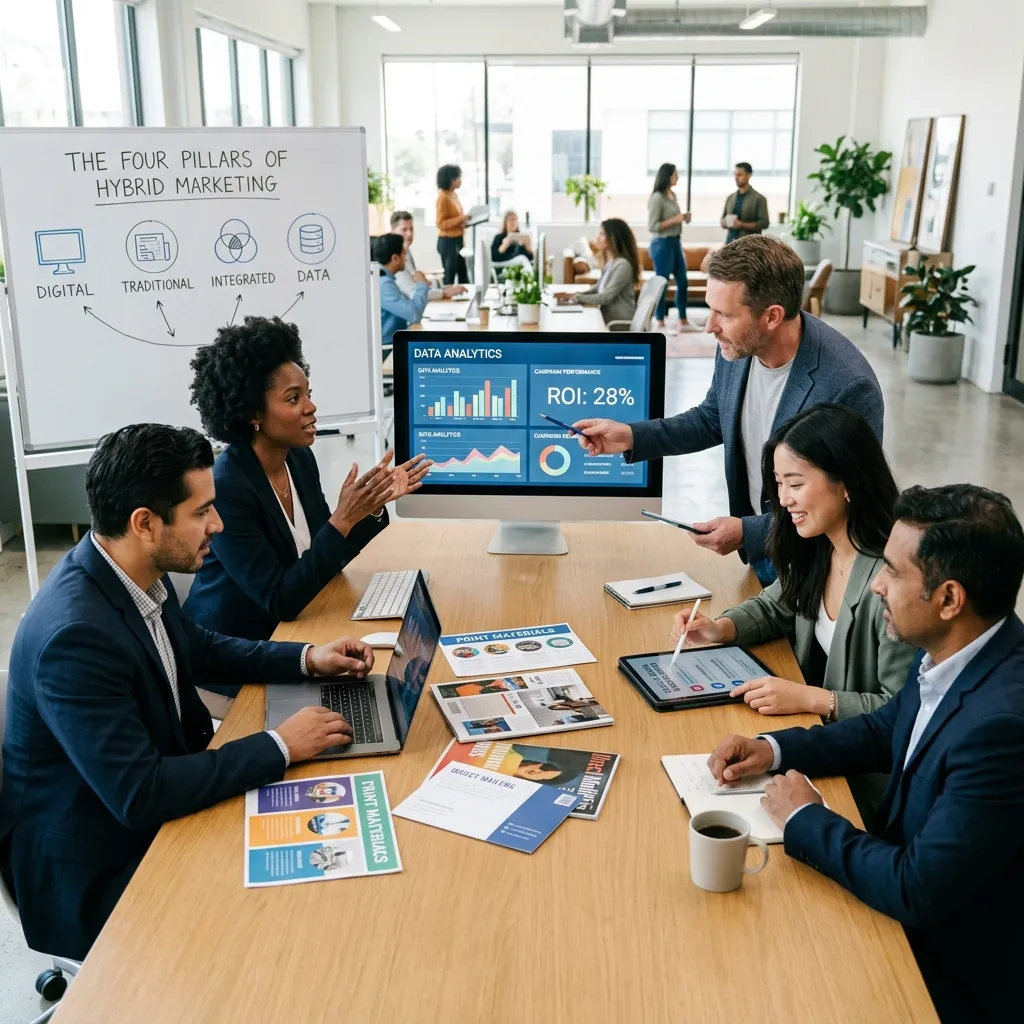
Pillar 1: Integration of channels for a seamless customer journey
Channel integration is the operational foundation of any hybrid marketing mix strategy. Online and offline touchpoints must share the same visual identity, tone of voice, and core offer. When messaging feels disconnected between a print brochure and a website landing page, cognitive friction slows purchasing decisions.
Practical integration examples include:
- QR codes on print ads that direct readers to campaign-specific landing pages, connecting offline impressions to trackable online conversions
- Social media campaigns linked to in-store promotions, where a branded hashtag unlocks an in-store discount
- Direct mail geo-fencing pairings, where physical catalogs are mailed to specific postal codes while digital ads simultaneously reach mobile devices in those same locations
Each of these tactics turns a single-channel impression into a multi-touchpoint brand experience. Explore the full hybrid marketing channel complete guide for a deeper breakdown of how different channel combinations perform across the customer journey.
Pillar 2: Data-driven decision making across all channels
Traditional marketing has historically struggled with measurement. Digital marketing made attribution easy—but only for digital channels. A hybrid marketing mix strategy solves this by embedding digital tracking mechanisms into offline efforts.
Unique promo codes on direct mail pieces, custom vanity URLs on billboards, and dedicated phone numbers in radio spots all connect offline exposure to digital conversion events. Feed that data into a centralized CRM, and marketing teams gain a complete picture of what’s driving results.
This matters for three reasons:
- Personalization: Knowing which channels drove which customers allows for increasingly tailored follow-up messaging
- ROI measurement: Leaders can evaluate exactly which traditional efforts are justifying their budgets
- Reallocation speed: When data shows one channel outperforming another, budgets can shift quickly—a capability that purely traditional teams often lack
According to Forrester Research (2024), agencies and marketing teams using unified marketing measurement tools improve campaign effectiveness by up to 30%.
Pillar 3: A customer-centric approach across every touchpoint
Modern buyers don’t experience marketing as “offline” or “online.” They experience it as a single, continuous brand relationship. A prospect might encounter a sponsored industry event (traditional), search for the brand on Google (digital), receive a follow-up email (digital), and finally convert after seeing a retargeted display ad (digital). The brand that delivered a seamless, consistent experience across all of those moments wins.
Building that experience requires understanding where customers spend their time—and designing touchpoints to meet them there. Customer journey mapping, audience persona development, and regular review of behavioral data all feed this process. Consistency in brand messaging isn’t just a visual exercise; it extends to tone, offer clarity, and the emotional impression the brand leaves at each stage.
Pillar 4: Adaptability and agility in a changing market
Markets shift. Algorithms change. Consumer preferences evolve faster than annual strategy reviews can accommodate. A hybrid marketing mix strategy is inherently more resilient than a single-channel approach because when one channel underperforms, others continue to generate results.
This diversification protects against volatility. Digital-only brands are vulnerable to algorithm changes on Meta or Google. Traditional-only brands can’t respond to a viral moment or a competitor’s social media push. Hybrid strategies build in the flexibility to test new channels, pause underperforming ones, and reallocate resources based on real-time data.
How to Build Your Own Hybrid Marketing Mix Strategy

Step 1: Define your target audience with demographic and behavioral precision
Effective hybrid marketing mix development starts with knowing exactly who you’re trying to reach—and where they consume information. A 58-year-old CFO who reads trade publications requires a different channel mix than a 32-year-old e-commerce shopper scrolling Instagram during their commute.
Build buyer personas that capture:
- Demographics (age, location, income, job title)
- Psychographics (values, priorities, lifestyle)
- Media consumption habits (which platforms, how often, and for what purpose)
- Purchase decision drivers (trust signals, peer recommendations, price sensitivity)
Step 2: Set clear, SMART objectives for integrated campaigns
Objectives determine which channel blend will deliver the strongest return. Define goals that are Specific, Measurable, Achievable, Relevant, and Time-bound—both for short-term campaign performance and longer-term brand growth.
Examples of SMART hybrid marketing objectives:
- Increase website traffic by 35% over 90 days through a combined direct mail and PPC campaign
- Generate 500 qualified leads per month from an integrated content marketing and trade show strategy
- Achieve 20% year-over-year growth in brand recall within a target geographic market
Step 3: Build your integrated marketing mix across all 4 Ps
Product: Use digital feedback—customer reviews, social listening, support data—to inform product development and positioning. Online communities often surface product improvement ideas faster than formal research cycles.
Price: Dynamic pricing strategies for e-commerce don’t always translate directly to in-store shelf pricing. A hybrid approach acknowledges these differences and creates logical, transparent pricing frameworks that work across both environments. For a broader look at how digital and traditional strategies compare across pricing and other variables, this comparison of digital vs. traditional marketing approaches provides useful context.
Place: Omnichannel distribution means customers can discover, purchase, and receive products through whatever combination of physical and digital channels they prefer. This requires inventory systems, logistics, and customer service infrastructure that work seamlessly across both storefronts.
Promotion: Blending advertising, PR, content marketing, and social media under a single promotional strategy is where the hybrid marketing mix strategy becomes most visible to the customer. A PR campaign that secures editorial coverage in a respected publication generates both credibility and—if the publication includes a backlink—measurable SEO authority. An outdoor billboard that includes a QR code converts a passive impression into an active digital interaction.
For more on building this promotional layer effectively, the resources on what is hybrid marketing strategy and digital vs. traditional marketing provide detailed channel-by-channel guidance.
Step 4: Allocate budget strategically, not proportionally
There is no universal ratio between traditional and digital spending. Budget allocation should follow business goals, not arbitrary percentages. Businesses pursuing mass brand awareness should weight spend toward broadcast and outdoor. Businesses prioritizing lead generation should allocate more toward PPC, email, and gated content.
One practical rule: reserve 15–20% of the total marketing budget for testing and experimentation. As channel performance data accumulates, shift resources toward the combinations that generate the strongest ROI.
Step 5: Implement with the right tools and monitor the right KPIs
The technology that makes a hybrid marketing mix strategy functional includes:
- CRM platforms (HubSpot, Salesforce) that track leads from both offline and online sources
- Marketing automation tools that deliver personalized, timely communications without requiring manual effort
- Unified analytics dashboards that pull digital and offline data into one view
Key performance indicators for an integrated marketing mix should span both channel types:
|
Channel Type |
KPIs to Track |
|---|---|
|
Digital |
CTR, CPA, conversion rate, organic traffic |
|
Traditional |
Promo code redemptions, vanity URL visits, call tracking |
|
Integrated |
Total ROAS, brand recall uplift, cross-channel attribution |
Real-World Case Studies: Hybrid Marketing Strategy in Action

How Coca-Cola’s “Share a Coke” campaign proved the hybrid model
Coca-Cola’s “Share a Coke” initiative is one of the most widely cited hybrid marketing strategy examples for good reason. The company printed popular consumer names on physical bottles—a traditional product-marketing tactic—and paired it with a digital campaign encouraging buyers to photograph their personalized bottles and share them with a branded hashtag.
The physical product drove digital engagement. The digital engagement amplified the physical product’s reach far beyond what any traditional distribution campaign could have achieved alone. Sales increased across every market where the campaign ran.
How a regional retailer used geo-fencing to connect offline and online
A regional furniture retailer deployed a hybrid marketing mix strategy by mailing high-quality printed catalogs to targeted postal codes. Simultaneously, the retailer used geo-fencing technology to serve Facebook and Instagram advertisements to mobile devices located within those exact postal codes.
Consumers received both a physical catalog and a digital ad within the same window. The dual exposure built familiarity and trust—and drove measurable foot traffic into physical showrooms. The campaign demonstrated the multiplier effect of a coordinated hybrid marketing channel approach: the whole significantly outperformed the sum of either part.
Challenges of the Hybrid Marketing Mix—and How to Overcome Them
Siloed departments: Traditional PR teams and digital SEO teams often operate independently, with different KPIs and limited cross-functional communication. The solution is unified teams with shared performance goals and integrated reporting that makes both offline and online contributions visible to everyone.
Data fragmentation: Merging offline coupon redemptions with digital tracking pixels is technically complex. Investing in a CRM platform that acts as a single source of truth resolves most attribution challenges before they undermine campaign reporting.
Measuring attribution: Connecting a billboard impression to a website conversion requires creative data infrastructure—QR codes, vanity URLs, unique phone numbers. Establishing these mechanisms before launch is far easier than retrofitting them after a campaign is live.
Brand consistency: The more channels a brand occupies, the greater the risk of inconsistent messaging. A clear brand style guide—governing visual identity, tone, and core offer—must be established before any hybrid campaign launches.
The Future of the Hybrid Marketing Mix: AI, Personalization, and Emerging Technology
Augmented Reality already allows consumers to point smartphone cameras at physical magazine advertisements to trigger interactive 3D product experiences. Connected TV blends the mass reach of traditional television with household-level digital targeting. According to Nielsen’s 2024 consumer research, buyers increasingly expect personalized, cross-channel experiences regardless of whether they encounter a brand online or offline.
Artificial intelligence is accelerating this convergence. AI-powered tools now enable real-time audience segmentation, predictive analytics, and automated personalization at a scale that was impossible a decade ago. Brands that integrate these capabilities into their hybrid marketing mix strategy will be able to serve the right message—through the right channel, offline or online—at precisely the right moment. McKinsey’s research on consumer decision journeys reinforces why this cross-channel presence increasingly determines which brands win at the moment of purchase.
Hyper-personalization will be the defining characteristic of the next evolution. Customers will expect physical and digital touchpoints to feel like continuations of the same conversation—not separate brand interactions happening on different teams’ budgets.
Conclusion
The hybrid marketing mix strategy represents the most complete answer available to a fundamental challenge: customers don’t live in just one channel, so marketing can’t either. The brands that build systems where traditional and digital efforts reinforce each other will consistently outperform those treating the two as competing priorities.
Start by auditing your current channel mix. Identify the gaps between offline and online efforts—where messaging diverges, where data doesn’t flow, where teams aren’t collaborating. Those gaps are your most immediate opportunities. Close them, and the compounding effect of a truly integrated marketing mix will follow.
Frequently Asked Questions
1. What is a hybrid marketing mix strategy in simple terms?
A hybrid marketing mix strategy is a promotional framework that applies the traditional 4 Ps—Product, Price, Place, and Promotion—while integrating both offline (traditional) and online (digital) marketing channels into one coordinated system. The goal is to reach customers consistently across every touchpoint, physical and digital.
2. How does a hybrid marketing strategy differ from a purely digital strategy?
A hybrid marketing strategy includes traditional offline channels such as print, TV, direct mail, and events alongside digital platforms. A purely digital strategy operates only online. The hybrid model builds broader brand trust, reaches demographics that are less active online, and creates physical touchpoints that digital-only strategies cannot replicate.
3. What are the key components of an integrated marketing mix?
An integrated marketing mix applies the 4 Ps across both traditional and digital channels. Product decisions incorporate digital feedback. Pricing accounts for both online and offline purchase environments. Place encompasses both physical stores and e-commerce. Promotion blends advertising, PR, content marketing, and social media into a unified campaign.
4. How do you measure the ROI of traditional channels in a hybrid strategy?
Track offline performance by embedding digital mechanisms into traditional materials—unique QR codes, custom vanity URLs, dedicated promo codes, and trackable phone numbers. Feed that data into a centralized CRM so offline conversions are attributed accurately alongside digital results.
5. Is a hybrid marketing strategy suitable for small businesses?
Yes. A small business can combine affordable print flyers or community event sponsorships with targeted local Facebook or Google ads. The hybrid model doesn’t require a large budget—it requires strategic integration of whatever channels are being used.
6. What role does content marketing play in a hybrid marketing mix?
Content marketing serves as the educational backbone of the hybrid model. Traditional ads capture attention and direct audiences to the company website, where blogs, guides, and videos build the trust needed to convert a prospect into a customer.
7. How should budget be allocated across a hybrid marketing mix?
There is no fixed ratio. Businesses targeting mass brand awareness typically allocate more toward traditional broadcast and outdoor channels. Businesses prioritizing lead generation allocate more toward PPC, email, and social. Reserve 15–20% of the total budget for channel testing and optimization.
8. What technology is needed to run a hybrid marketing mix strategy?
Core technology requirements include a CRM platform that tracks leads from offline and online sources, marketing automation tools for personalized communications, and a unified analytics dashboard that aggregates data from all channels into one performance view.
9. How does PR fit into a hybrid marketing mix strategy?
PR secures earned media coverage in print and digital publications. When those publications include a digital backlink to the company website, the traditional PR activity generates measurable SEO authority—a direct, trackable digital benefit from an offline marketing effort.
10. How quickly can a business see results from a hybrid marketing mix strategy?
Digital elements like PPC advertising can generate traffic and leads within hours. Traditional elements like PR and direct mail typically require three to six months to build measurable brand authority. The hybrid model balances immediate performance with long-term brand growth simultaneously.