Traditional print advertising — newspapers, magazines, flyers, brochures, and direct mail — is often written off as outdated in a world dominated by screens, yet it continues to deliver measurable results for brands that use it well. Print carries a level of credibility and tangibility that digital ads can’t replicate, and it reaches audiences in a focused, distraction-free format. This guide covers the core traditional print advertising strategies that still work today, the different formats available, how to plan and measure a campaign, and the mistakes that quietly waste print advertising budgets.
It’s tempting to assume that print advertising has been fully replaced by digital channels, but the data tells a more nuanced story. Readers of print publications tend to engage more deeply with the content in front of them, and physical materials like direct mail and flyers have a tangibility that a scrolling feed simply can’t match. Traditional print advertising strategies haven’t disappeared — they’ve evolved to work alongside digital campaigns rather than in competition with them.
This guide breaks down the strategies that make print advertising effective today, from choosing the right publication to designing ads that actually get read. If you’re weighing whether print still belongs in your marketing mix, this comparison of print advertising in the digital age is a useful starting point before diving into the tactics below. Whether your business is a local retailer, a professional services firm, or a B2B brand targeting a specific industry, the fundamentals covered here can help you build a print strategy that earns its place in the budget rather than surviving purely on habit or nostalgia.
Why Print Advertising Still Matters

- Higher perceived credibility. Readers often trust information in a newspaper or established magazine more than an ad appearing in a social feed, since print carries the weight of editorial association.
- Focused attention. A reader flipping through a physical publication isn’t juggling browser tabs or notifications, which increases the likelihood your ad actually gets seen and read.
- Tangibility and longevity. A well-designed flyer or direct mail piece can sit on a counter or fridge for days, continuing to generate impressions long after a digital ad would have disappeared from a feed.
- Strong local relevance. Community newspapers and local magazines remain a trusted source of local news and recommendations, making them effective for businesses targeting a specific area.
- Complements digital campaigns. Print works especially well as part of an integrated approach. This guide to integrating traditional and digital marketing explains how print can reinforce a message a customer later encounters again online.
Core Traditional Print Advertising Strategies
1. Choose the Right Publication for Your Audience
Not all print outlets reach the same audience. A local community newspaper suits a neighborhood business, while a national trade magazine suits a B2B brand targeting a specific industry. Research a publication’s readership demographics and circulation numbers before committing budget, the same way you would evaluate any other traditional marketing platform.
2. Design for Skimmability
Readers often scan a page before deciding whether to read further. Use a bold headline, a clear visual hierarchy, and a single focused message rather than cramming multiple offers into one ad. Simplicity consistently outperforms cluttered design in print.
3. Use a Clear, Trackable Call-to-Action
Every print ad should give the reader an obvious next step — a phone number, a website, a QR code, or a specific in-store offer. Unique promo codes or dedicated landing pages tied to a specific publication make it possible to measure which placements are actually driving results.
4. Leverage Direct Mail for Precision Targeting
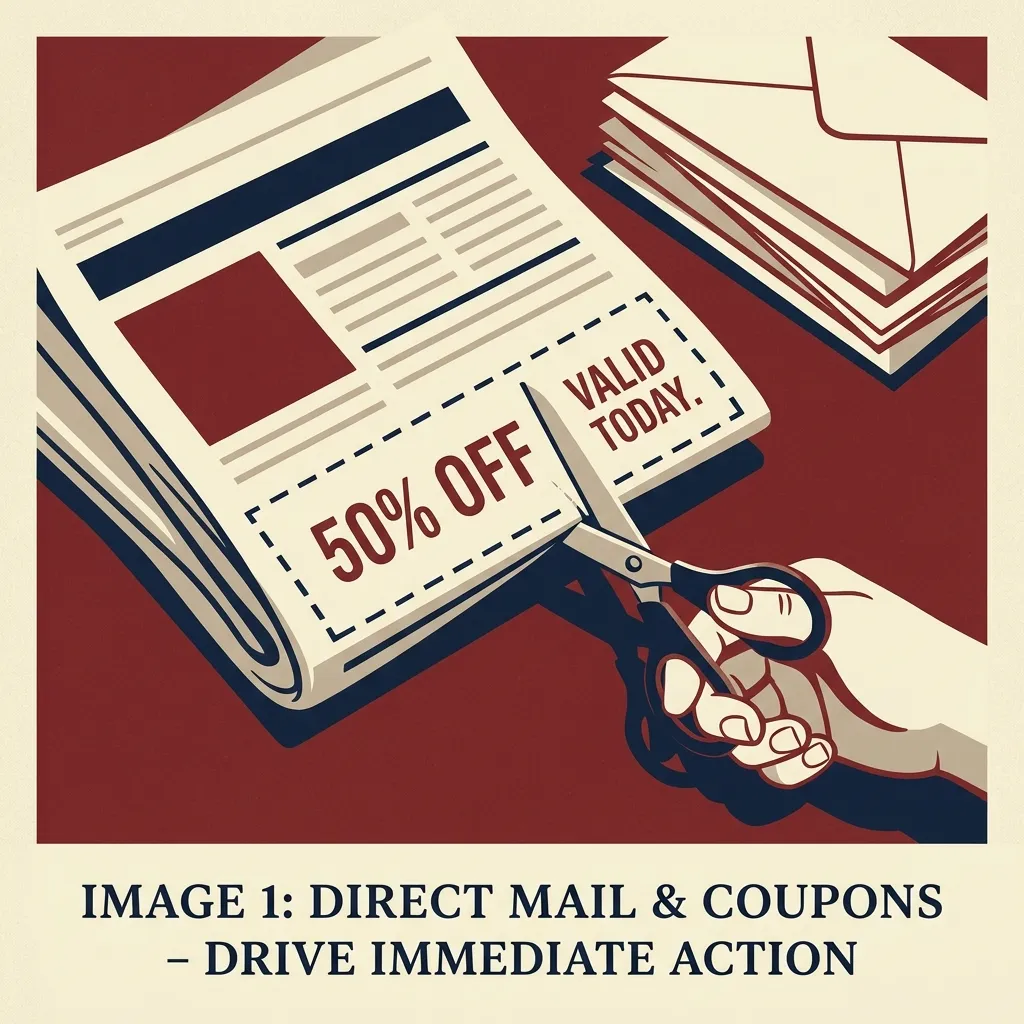
Unlike newspaper or magazine ads, direct mail allows for highly specific targeting down to individual neighborhoods or household types. This guide to direct mail marketing covers how to build a mailing list, design a piece that gets opened, and measure response rates effectively.
5. Repeat the Message Across Multiple Issues
A single print ad rarely generates strong recall on its own. Running the same or a closely related message across several issues of a publication builds the kind of familiarity that drives action, much like frequency does in broadcast advertising.
6. Combine Print With Local PR
Editorial coverage and paid print advertising reinforce each other well. A feature story alongside a paid placement in the same publication builds credibility that a standalone ad can’t achieve on its own. This overview of marketing and PR explains how the two disciplines work together effectively in traditional media.
7. Use Flyers and Brochures for Local, In-Person Reach
Flyers distributed in high-foot-traffic areas or included with in-store purchases remain a low-cost way to drive awareness for local promotions, events, or new product launches, especially when paired with an in-store display.
8. Test Different Formats and Sizes
A full-page ad, a half-page spread, and a small classified listing all serve different purposes and budgets. Testing formats across a few issues can reveal which size and placement generates the strongest response for your specific offer before committing to a larger, longer-term buy.
Measuring Print Advertising Effectiveness
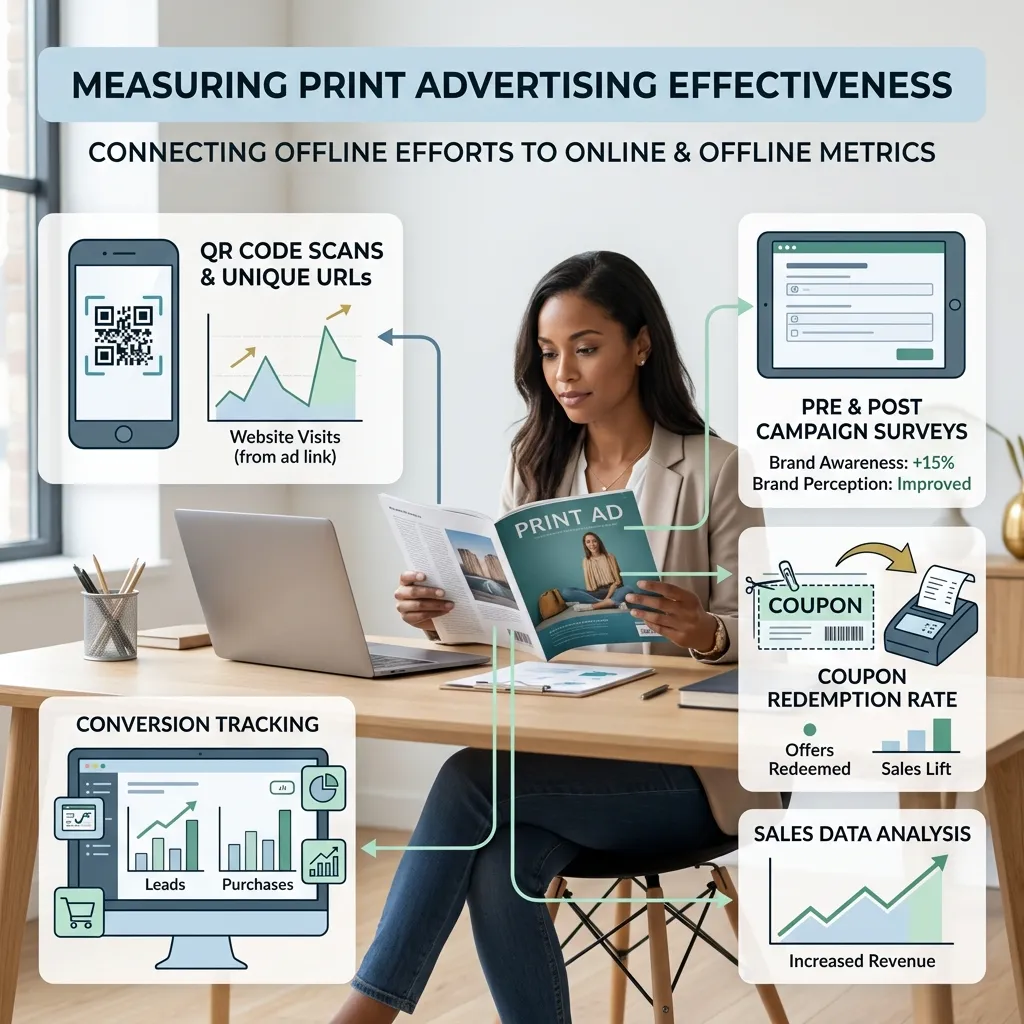
Print advertising is often assumed to be difficult to measure, but several practical methods make it possible to track performance:
- Unique phone numbers or extensions dedicated to a specific publication or ad run.
- Custom URLs or QR codes that route to a landing page built specifically for that print placement.
- Coupon codes redeemable in-store or online, tied to a specific issue or mailing.
- Pre- and post-campaign brand awareness surveys in the target market.
Reviewing broader offline marketing metrics can help set realistic benchmarks for what a successful print campaign should look like before you launch, rather than guessing at performance after the fact.
Print Advertising vs. Digital Advertising
Print and digital advertising serve different purposes within a marketing strategy. Digital offers precise targeting and real-time performance data, while print offers credibility, tangibility, and a distraction-free reading environment that digital struggles to replicate. Rather than viewing them as competitors, most successful campaigns treat them as complementary. This comparison of digital vs. traditional marketing explains how the two approaches often perform best when used together rather than in isolation.
For brands looking to combine the credibility of print with the analytics of digital, pairing a print campaign with parallel consumer behavior research can help ensure the messaging and offer resonate with how the target audience actually makes decisions, both offline and online.
Print Advertising for B2B and Trade Audiences
While much of traditional print advertising is associated with consumer-facing formats like newspapers and flyers, trade publications and industry magazines remain a strong channel for B2B brands. Decision-makers in specialized industries often still read trade journals as part of their professional routine, making a well-placed print ad in the right publication a credible way to reach a niche, high-intent audience that’s harder to target precisely through broad digital channels.
B2B print strategies differ slightly from consumer approaches. Rather than driving immediate transactions, trade publication ads typically focus on building brand familiarity ahead of a longer sales cycle, positioning the company as a recognized name before a prospect ever speaks with a sales representative. Case studies, data-driven headlines, and clear positioning statements tend to perform better in this context than the emotionally driven creative common in consumer print ads. Pairing a trade publication placement with a presence at related trade show marketing events can reinforce the same message to the same professional audience across multiple touchpoints.
Seasonal and Event-Based Print Strategies
Timing plays a significant role in how well a print campaign performs. Aligning ad placements with seasonal shopping periods, local events, or industry conferences increases the relevance of the message to whatever the reader is already thinking about. A retail brand advertising in a newspaper’s holiday shopping guide, for example, benefits from context the ad wouldn’t have if it ran in a random midweek issue months earlier.
Community publications often run special sections tied to local events — back-to-school guides, wedding planning issues, home and garden features — that offer a built-in, highly relevant audience for businesses in related categories. Identifying these recurring editorial calendars ahead of time allows advertisers to plan placements that align naturally with reader interest rather than competing for attention in a general news section.
Print Advertising Formats to Consider
- Newspaper ads — strong for local relevance and time-sensitive offers like sales or events.
- Magazine ads — better suited to brand-building and reaching a specific interest-based or professional audience.
- Direct mail — ideal for precise geographic or demographic targeting with a tangible, personal touch.
- Flyers and brochures — low-cost options for local promotions, events, or in-store information.
- Classified and directory listings — a budget-friendly way to maintain visibility for local service-based businesses.
Common Mistakes in Traditional Print Advertising
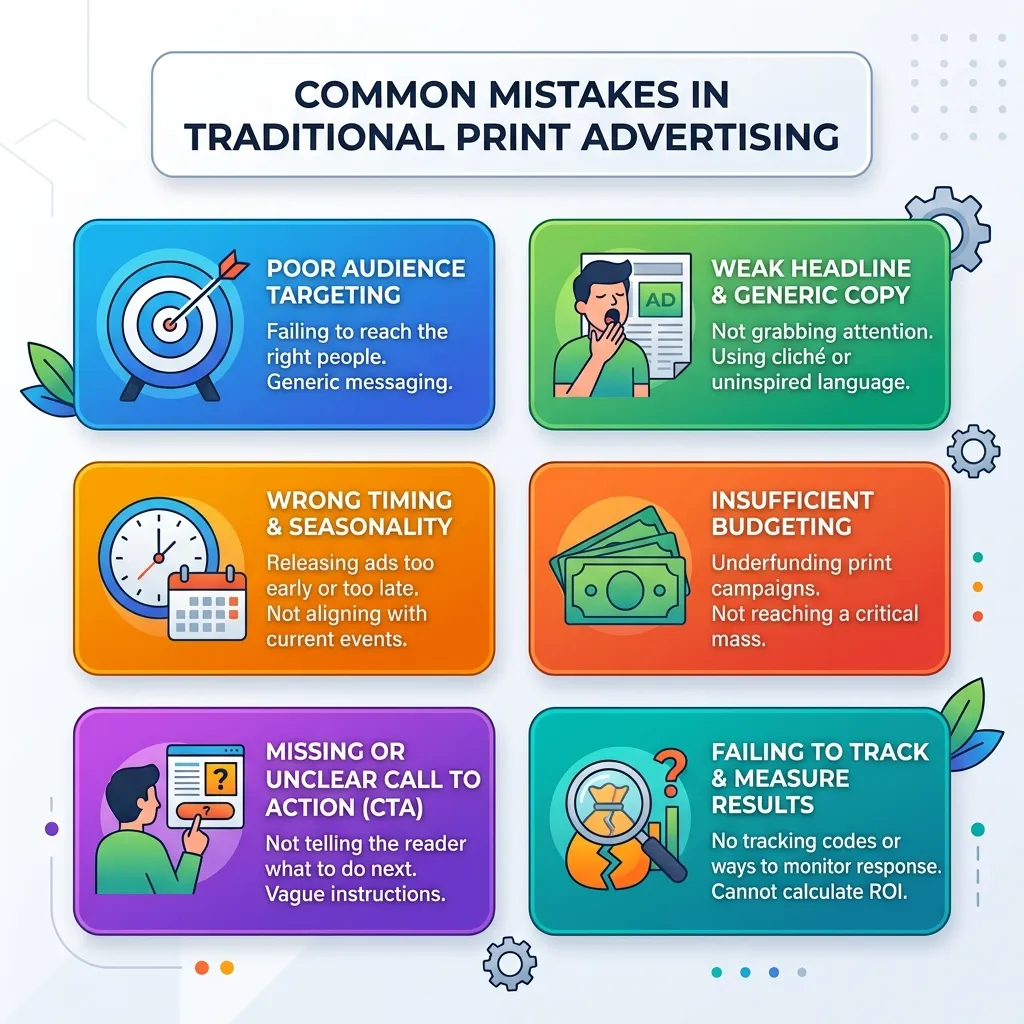
- Running a single ad and expecting immediate results. Print benefits from repetition across multiple issues far more than a one-off placement.
- Ignoring the publication’s actual readership. A beautifully designed ad in the wrong publication still won’t reach the right audience.
- Skipping a trackable call-to-action. Without a unique code, URL, or phone number, it’s nearly impossible to prove which placements are working.
- Overcrowding the design. Trying to fit too many offers or too much text into one ad reduces readability and impact.
- Treating print as disconnected from the rest of the marketing mix. Print performs best when it reinforces a message customers also see through other channels, rather than existing in isolation. This broader look at creative marketing ideas offers useful inspiration for tying a print concept into a wider campaign.
A Simple Example
A local dental practice wanted to attract new patients in a specific suburb. Instead of a single generic newspaper ad, they ran a small, consistent ad across eight consecutive weekly issues of the community paper, paired with a direct mail piece offering a new-patient discount to households in the same zip codes. Each piece included a unique phone extension so the practice could track exactly how many calls came from the newspaper versus the mailer. The repeated exposure combined with the tangible, trackable mail piece drove a steady stream of new patient inquiries at a lower cost than a comparable digital ad spend targeting the same small geographic area.
Conclusion
Traditional print advertising strategies haven’t lost their relevance — they’ve simply become more effective when paired thoughtfully with measurement and digital reinforcement. Choosing the right publication, designing for skimmability, including a trackable call-to-action, and repeating your message across multiple issues are the fundamentals that separate print campaigns that generate real results from ones that quietly disappear into the recycling bin. Treat print as one part of an integrated strategy rather than a standalone tactic, measure it as rigorously as you would any digital channel, and it can continue to deliver the kind of credibility and local relevance that digital advertising still struggles to match. Whether you’re a local business testing your first community newspaper ad or a B2B brand investing in trade publication visibility, the same core discipline applies: know your audience, design for clarity, and give every reader an obvious next step.
Frequently Asked Questions (FAQs)
1. Is traditional print advertising still effective in 2026?
Yes. Print continues to offer strong credibility, focused reader attention, and effective local targeting, especially when paired with digital tracking methods.
2. What are the main types of traditional print advertising?
The main formats include newspaper ads, magazine ads, direct mail, flyers and brochures, and classified or directory listings.
3. How do you measure the success of a print advertising campaign?
Common methods include unique phone numbers, custom URLs or QR codes, coupon codes, and pre- and post-campaign brand awareness surveys.
4. Is direct mail still worth using in a print strategy?
Yes, direct mail remains one of the most precisely targetable print formats, allowing advertisers to reach specific neighborhoods or household types.
5. How many times should a print ad run before expecting results?
Most print advertising strategies benefit from repetition across multiple issues rather than a single placement, since recall builds gradually with repeated exposure.
6. What makes a print ad effective?
A bold headline, clear visual hierarchy, a single focused message, and a clear, trackable call-to-action are the core elements of an effective print ad.
7. Should small businesses use print advertising?
Yes, especially local and community publications, which offer affordable, geographically targeted reach ideal for small business budgets.
8. How does print advertising compare to digital advertising?
Print offers stronger perceived credibility and a distraction-free reading environment, while digital offers more precise targeting and real-time performance data — the two work best together.
9. What’s the biggest mistake businesses make with print advertising?
Running a single ad without repetition or a trackable call-to-action, which makes it difficult to build recall or measure whether the campaign actually worked.
10. Can print advertising work alongside social media or digital campaigns?
Very well. Many brands use print to build credibility and awareness, then reinforce the same message through digital retargeting or social content.
11. Are magazine ads different from newspaper ads?
Yes. Magazines are generally better suited for brand-building and reaching specific interest-based audiences, while newspapers work well for local, time-sensitive offers.
12. How much does traditional print advertising cost?
Costs vary widely based on publication size, circulation, ad size, and placement, but options range from affordable classified listings to larger full-page magazine spreads.
To see how print fits into a broader offline strategy, explore our guide on why traditional advertising still works, or compare it with traditional TV advertising.