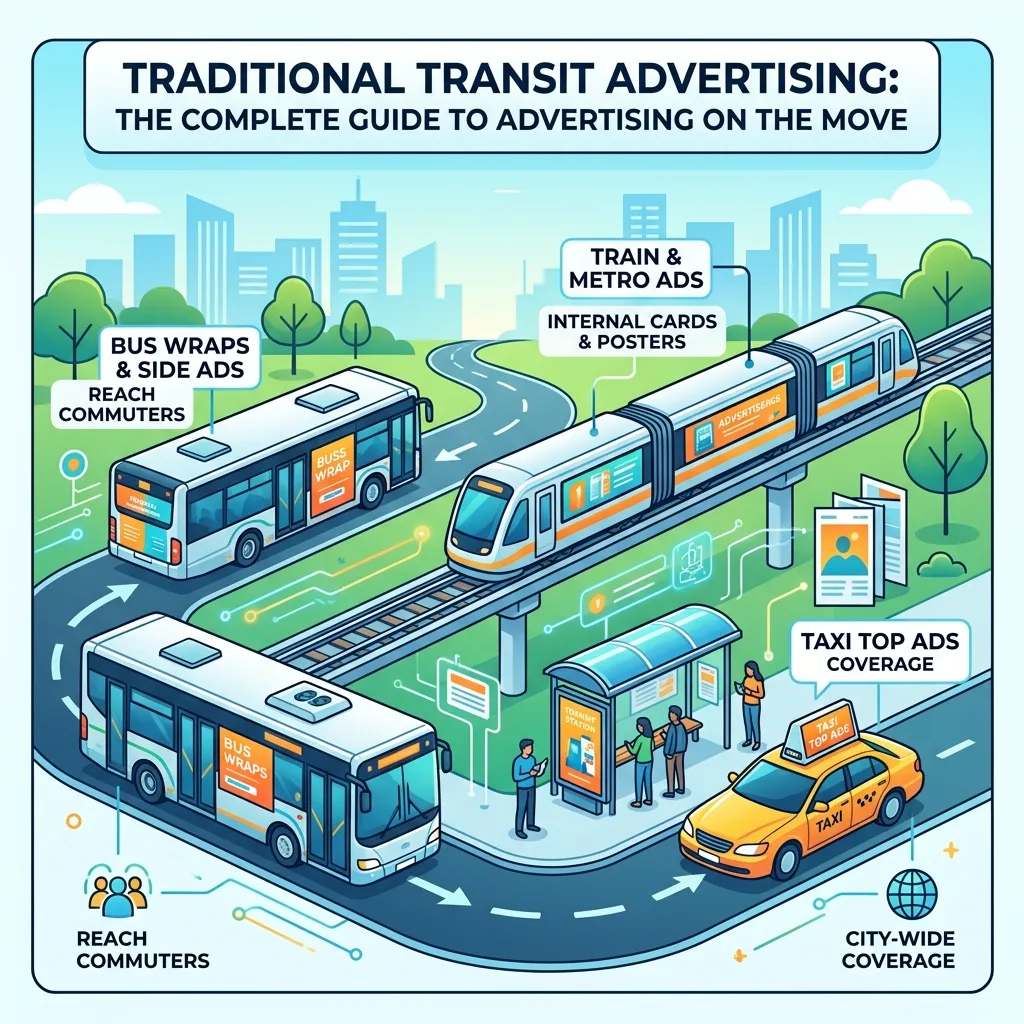
Traditional transit advertising — ads placed on buses, trains, subways, taxis, and at transit stations — puts your brand directly in front of commuters during the parts of their day when they have the most idle attention to spare. Unlike many offline formats that rely on a single, static placement, transit advertising travels through neighborhoods, business districts, and high-traffic corridors, generating repeated impressions across a wide geographic footprint. This guide covers what transit advertising includes, why it remains one of the most cost-efficient traditional formats, the different placement types available, how to plan a campaign, and the mistakes to avoid.
Every day, millions of people spend part of their commute staring out a window, waiting on a platform, or glancing at the vehicle next to them in traffic. Traditional transit advertising turns those in-between moments into brand impressions — often for a fraction of the cost of TV or digital media. It’s one of the oldest forms of outdoor advertising, yet it remains remarkably effective because it reaches people in a mindset that’s hard to replicate elsewhere: relaxed, unhurried, and physically stationary or in transit.
This guide walks through everything you need to know about traditional transit advertising, including how it compares to other outdoor formats like traditional billboard advertising, the different placement options available, and a step-by-step approach to planning a campaign that actually delivers results. Whether you’re a local business considering your first bus shelter poster or a regional brand weighing a full fleet wrap, understanding how the format works — and where it fits alongside your other marketing channels — will help you get more out of every advertising dollar spent.
What Is Traditional Transit Advertising?
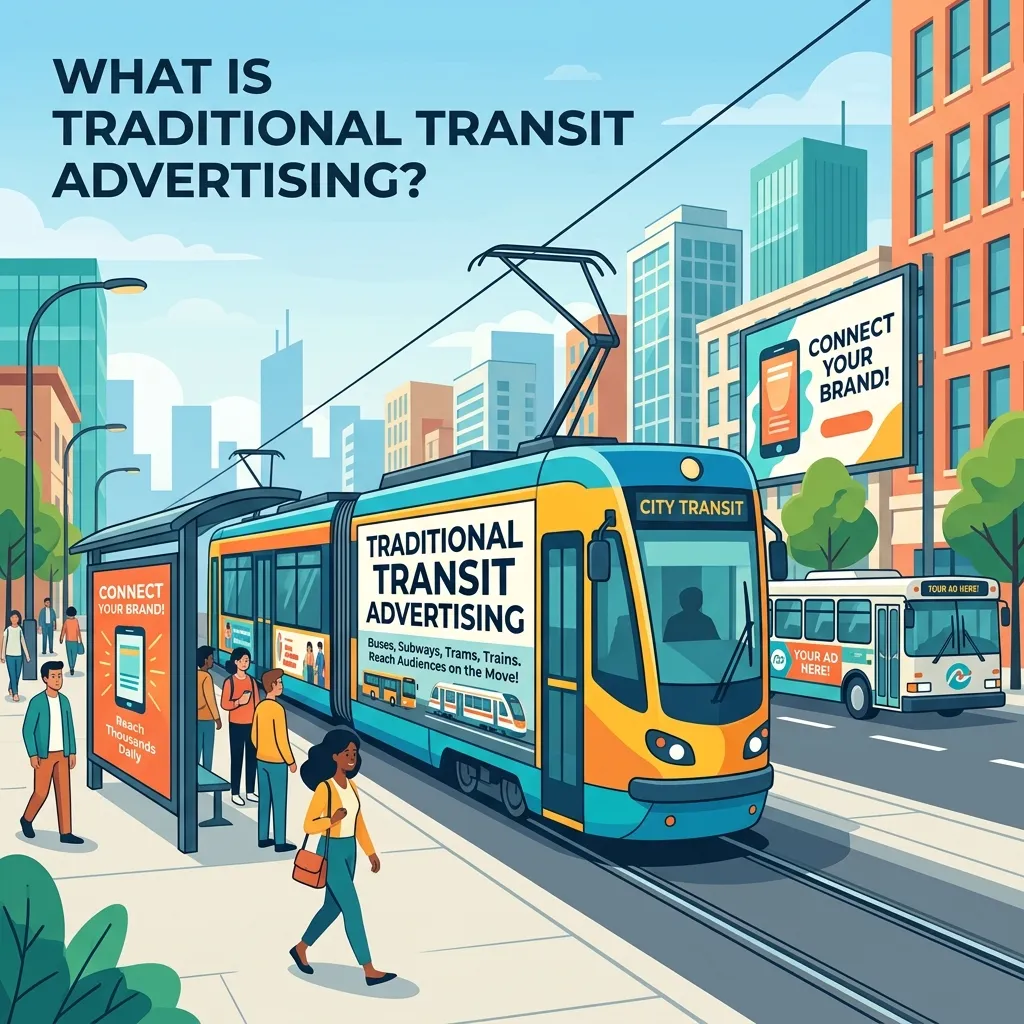
Transit advertising refers to any ad placed on or around public transportation — buses, trains, subways, trams, taxis — as well as the stations, platforms, and shelters that serve them. It’s a subcategory of outdoor advertising and shares many of the same strengths: high visibility, broad geographic reach, and strong cost efficiency compared to broadcast media. Because transit vehicles move through the same routes daily, ads placed on them generate consistent, repeated exposure to the same commuter base over time, building the kind of familiarity that drives brand recall.
Why Transit Advertising Still Works
- Repetition through movement. Unlike a fixed billboard seen once per commute, a bus or train ad might be seen by the same person from multiple angles and distances throughout the day.
- High dwell time at stations. Commuters waiting on a platform or at a bus stop often have several idle minutes with nothing else to look at, making station and shelter ads highly effective.
- Broad, unavoidable exposure. Transit ads reach both riders and the general public who see the vehicles passing by, effectively functioning as a moving billboard.
- Strong local targeting. Routes can be selected to align precisely with a brand’s target neighborhoods, business districts, or demographic clusters.
- Cost efficiency at scale. Compared to national TV or large billboard buys, transit advertising often delivers a lower cost per thousand impressions, especially in dense urban markets.
Transit advertising also complements digital efforts well. Reviewing this comparison of digital vs. traditional marketing benefits helps clarify why brands increasingly treat transit and digital as complementary rather than competing channels, using transit for broad local reach and digital for precise follow-up targeting.
Types of Traditional Transit Advertising
1. Bus Wraps and Bus-Side Ads
Full or partial vehicle wraps turn an entire bus into a moving advertisement, offering maximum visibility as it travels through multiple neighborhoods each day. Bus-side or bus-tail ads offer a more affordable alternative while still capturing strong visibility in traffic.
2. Subway and Train Car Advertising
Interior and exterior train ads reach commuters during long rides, often in dense urban markets where daily ridership numbers are extremely high. Interior ads benefit from a captive audience with limited distractions, similar in spirit to cinema advertising’s attention advantage.
3. Station and Platform Advertising
Posters, digital screens, and branded platform displays take advantage of the significant idle time commuters spend waiting for trains or buses to arrive.
4. Taxi and Rideshare Advertising
Taxi tops, rear-window clings, and in-vehicle screens reach both the passenger inside and pedestrians or drivers who see the vehicle on the road.
5. Transit Shelter Advertising
Bus shelter posters and digital displays combine strong street-level visibility with the same high-dwell-time advantage as station platforms, since waiting passengers have nowhere else to look.
6. Vehicle Wrap Advertising Beyond Public Transit
Many of the same principles apply to branded fleet and delivery vehicles. This guide to vehicle wrap marketing explores how private and commercial vehicles can extend a similar moving-billboard effect beyond public transit systems.
How Transit Advertising Compares to Other Traditional Formats
Transit advertising shares some DNA with billboard advertising — both rely on high-visibility outdoor placements — but transit’s mobility gives it a broader reach across a single route rather than one fixed location. For a deeper look at why static outdoor placements remain effective, why billboard advertising still works offers useful context that applies almost equally to transit’s moving format.
Compared to broadcast formats like local TV advertising, transit advertising tends to be significantly more affordable while still delivering strong, geographically concentrated reach — making it especially attractive for local businesses, regional retailers, and service providers who don’t need national coverage.
How to Plan a Transit Advertising Campaign

Step 1: Define Your Target Geography
Transit advertising’s biggest strength is precise local targeting. Identify the neighborhoods, business districts, or commuter routes where your target audience is most concentrated before selecting vehicles or stations.
Step 2: Choose the Right Placement Type
A full bus wrap suits brands wanting maximum visual impact and broad awareness, while a station poster or shelter ad may better suit a smaller local budget focused on a specific commuter base.
Step 3: Design for a Moving, Glanced-At Format
Unlike a magazine ad or a webpage, transit ads are often seen briefly and from a distance or in motion. Keep messaging short, bold, and legible — a clear headline, a strong visual, and minimal text perform far better than dense copy. Reviewing broader advertising methods and strategies can help ensure your creative approach matches the format’s constraints.
Step 4: Select the Right Duration
Transit contracts are typically sold in multi-week or multi-month blocks. Longer placements build stronger repetition and recall, especially for routes with consistent daily ridership.
Step 5: Integrate With Local Sponsorships and Events
Transit campaigns often perform best when paired with local visibility efforts. This guide to local sponsorship marketing shows how community-level sponsorships can reinforce the same geographic targeting transit advertising already provides.
Step 6: Add a Digital Bridge
Include a QR code, short URL, or memorable phone number so commuters who see the ad can easily continue the interaction online. Pairing transit placements with a PPC advertising campaign targeting the same geographic area can capture demand generated by the offline exposure.
Step 7: Measure Performance
Track unique promo codes, dedicated landing page traffic, and regional sales or foot-traffic lift in areas covered by the campaign. Reviewing offline marketing metrics more broadly can help set realistic benchmarks before the campaign launches.
Regulations and Practical Considerations
Transit advertising operates under rules set by the transit authority or agency that owns the vehicles and stations, which means creative approval processes can take longer than other formats. Most systems have guidelines around content standards, prohibited categories (such as certain alcohol, tobacco, or political messaging), and size or placement specifications for wraps and interior cards. Building extra lead time into a campaign timeline for creative review and approval helps avoid last-minute delays, especially for full vehicle wraps that require physical installation.
Weather and wear are also worth planning for. Exterior wraps and shelter posters are exposed to sun, rain, and general wear from daily use, so materials need to be durable enough to look sharp for the full length of the campaign. Many transit authorities include maintenance and replacement provisions in their advertising contracts, but it’s worth confirming this upfront rather than assuming it’s included.
Finally, consider accessibility and multilingual audiences where relevant. In diverse urban markets, station and platform ads often reach a wide range of language backgrounds, so simple, visual-first creative tends to communicate more effectively across a broad commuter base than text-heavy messaging aimed at a single language group.
The Cost of Transit Advertising
Transit advertising costs depend on several factors:
- Placement type — a full bus wrap costs significantly more than a single station poster.
- Route and ridership volume — high-traffic downtown routes command higher rates than suburban or off-peak routes.
- Campaign duration — longer bookings often come with better per-week rates.
- Production costs — vinyl wraps and digital station displays require more upfront investment than printed posters.
For local businesses, transit advertising is often one of the more accessible traditional formats, with shelter and station ads in particular offering strong visibility at a relatively low entry cost compared to TV or large-format billboards.
Common Mistakes in Transit Advertising
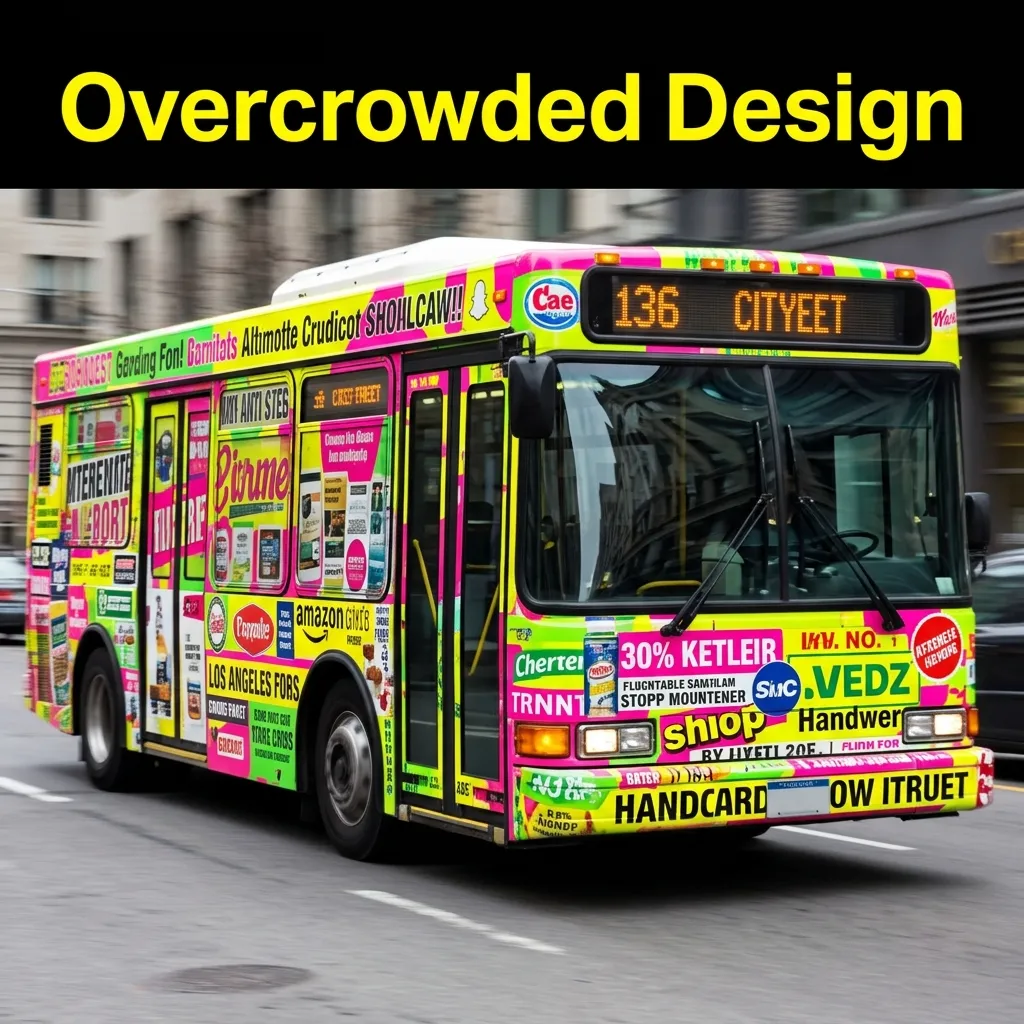
- Overloading the design with text. Commuters and passersby only have a few seconds to absorb the message — simplicity wins.
- Ignoring route relevance. Placing an ad on a route that doesn’t align with the target audience wastes much of the format’s core advantage.
- Skipping a digital call-to-action. Without a QR code or simple next step, transit ads generate awareness but little measurable action.
- Treating it as a standalone tactic. Transit advertising performs best as part of a broader, integrated marketing strategy rather than an isolated placement.
- Underestimating production lead time. Vehicle wraps and station installations require lead time to design, print, and install — last-minute bookings often limit placement options.
A Simple Example
A local fitness studio wanted to boost membership sign-ups ahead of the new year. Instead of relying solely on social media ads, they booked interior subway car ads and shelter posters along routes running through nearby residential neighborhoods, paired with a QR code offering a free trial week. The campaign’s repeated daily exposure to the same commuter base, combined with an easy digital next step, drove a steady stream of trial sign-ups at a lower cost per acquisition than their previous purely digital campaigns — while also raising general brand familiarity across the neighborhood.
Conclusion
Traditional transit advertising remains one of the most cost-efficient ways to build consistent, geographically targeted brand exposure. Its combination of repeated daily visibility, high commuter dwell time, and flexible placement options — from bus wraps to station posters — makes it a strong fit for local and regional brands looking to build awareness without a national media budget. As with any traditional format, the campaigns that perform best are the ones designed specifically for the medium: bold, simple creative, precise route selection, and a clear digital next step for anyone who wants to act on what they saw. Paired thoughtfully with local sponsorships, digital retargeting, and consistent measurement, transit advertising can deliver strong, lasting brand recall at a fraction of the cost of broadcast media.
Frequently Asked Questions (FAQs)
1. What is traditional transit advertising?
It’s advertising placed on or around public transportation, including buses, trains, subways, taxis, and the stations or shelters that serve them.
2. Is transit advertising still effective in 2026?
Yes. Its combination of repeated daily exposure and high commuter dwell time continues to deliver strong recall, especially for local and regional brands.
3. How much does transit advertising cost?
Costs vary based on placement type, route ridership, campaign duration, and production requirements, but options range from affordable station posters to larger full-vehicle wraps.
4. What’s the difference between transit advertising and billboard advertising?
Billboards are fixed in a single location, while transit ads move through multiple neighborhoods and routes, generating broader, repeated exposure across a wider geographic area.
5. What type of businesses benefit most from transit advertising?
Local retailers, restaurants, service providers, healthcare practices, and other businesses targeting a specific city or neighborhood tend to see the strongest results.
6. How long should a transit advertising campaign run?
Most campaigns run in multi-week or multi-month blocks, since longer placements build stronger repetition and recall among the same rider base.
7. Can transit advertising be geographically targeted?
Yes. Advertisers can select specific routes, stations, or vehicle types to align closely with their target neighborhoods or commuter demographics.
8. Should transit ads include a website or QR code?
Yes, including a clear digital next step — a QR code, short URL, or phone number — helps convert offline attention into a measurable online action.
9. How do you measure the success of a transit advertising campaign?
Common methods include unique promo codes, dedicated landing page traffic, QR code scans, and comparing sales or foot traffic across areas the campaign covered.
10. What design principles work best for transit ads?
Bold visuals, short headlines, and minimal text perform best, since most viewers only glance at the ad for a few seconds while it’s in motion or from a distance.
11. Is transit advertising more affordable than TV advertising?
Generally yes, especially for local and regional campaigns, since transit placements can be scoped to specific routes rather than requiring a broad broadcast buy.
12. Does transit advertising work well alongside digital marketing?
Very well. Many brands pair transit placements with digital retargeting or local PPC campaigns to capture demand generated by the offline exposure.
To explore how transit advertising fits into a broader offline strategy, see our guide on why traditional advertising still works, or compare it with traditional billboard advertising.