
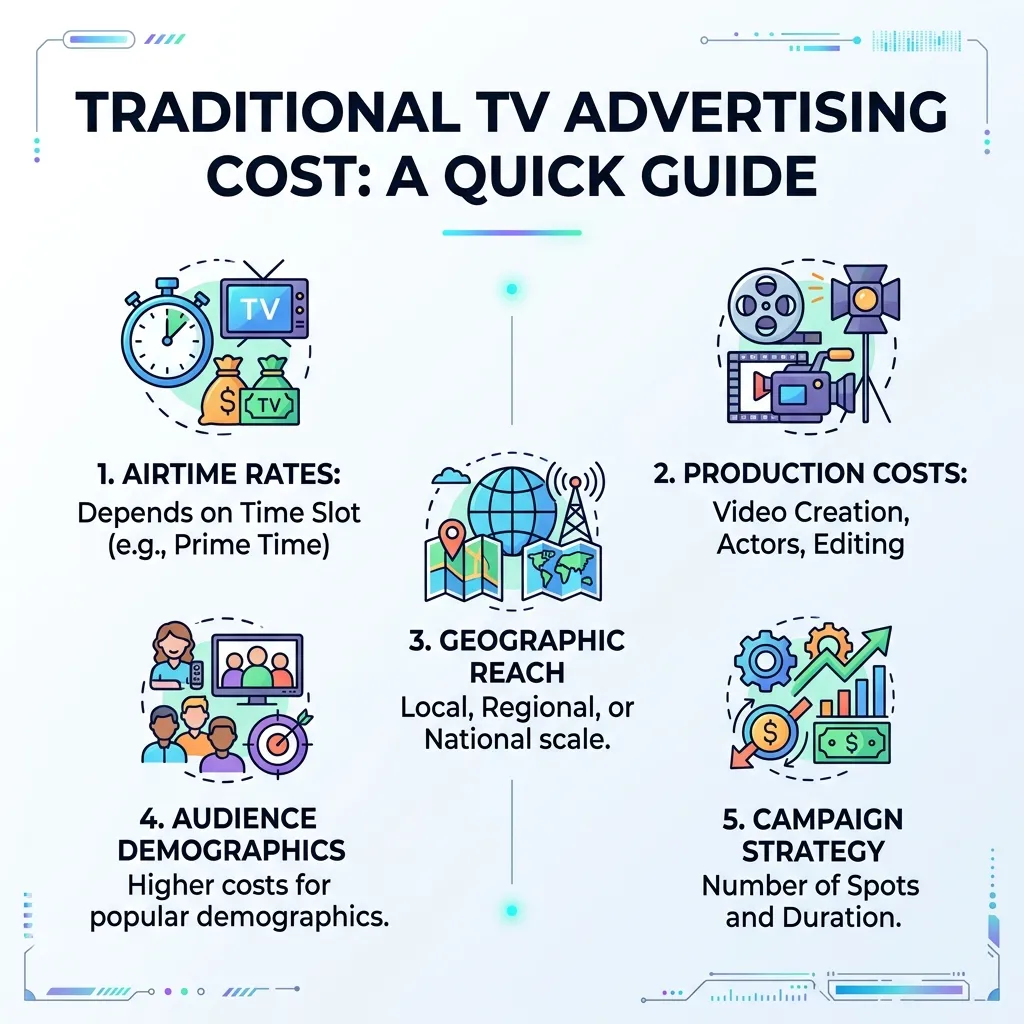
Traditional TV advertising remains a powerful way for businesses to reach a broad audience, build brand recognition, and create memorable campaigns. However, one of the first questions businesses ask before launching a television campaign is: How much does traditional TV advertising cost?
The answer depends on several factors, including the market, channel, program popularity, commercial length, time slot, audience size, production quality, and campaign frequency. A local business may spend considerably less than a national brand, while premium programming can command significantly higher rates.
Understanding these cost factors can help businesses plan a realistic television advertising budget and avoid spending money without a clear strategy.
What Is Traditional TV Advertising?

Traditional TV advertising refers to paid commercial placements on conventional television networks, broadcast stations, and cable channels. Businesses purchase advertising time to present video commercials to viewers during or around television programs.
Unlike digital advertising, where advertisers can often adjust campaigns in real time based on clicks or conversions, traditional television advertising generally involves purchasing scheduled airtime and reaching a defined television audience.
Businesses can learn more about the broader concept through this traditional TV advertising complete guide.
Traditional TV advertising can include:
- Local television commercials
- Regional television campaigns
- National television commercials
- Cable TV advertising
- Broadcast television advertising
- Sponsored programming
- Prime-time commercials
- Daytime advertising
- Sports and entertainment placements
For businesses considering this channel, understanding the cost structure is essential before committing to a campaign.
How Much Does Traditional TV Advertising Cost?
There is no single fixed price for traditional TV advertising. Costs vary widely depending on the market and advertising objectives.
A local television commercial may cost hundreds to several thousand dollars for airtime, while major national placements can cost substantially more. Production costs are separate from media-buying costs and can range from a relatively inexpensive in-house production to a professionally produced commercial costing tens of thousands of dollars or more.
A television advertising budget generally contains several components:
| Cost Component | What It Covers |
|---|---|
| Production | Creating the commercial |
| Airtime | Purchasing television spots |
| Media planning | Selecting channels and placements |
| Creative development | Script, concept, and design |
| Talent | Actors, presenters, or voice-over artists |
| Editing | Post-production and finishing |
| Distribution | Delivering the finished commercial |
| Campaign management | Planning and monitoring the campaign |
Therefore, businesses should calculate the total campaign cost, rather than looking only at the price of an individual TV spot.learn more :TV Ad Guide
Main Factors That Affect Traditional TV Advertising Cost
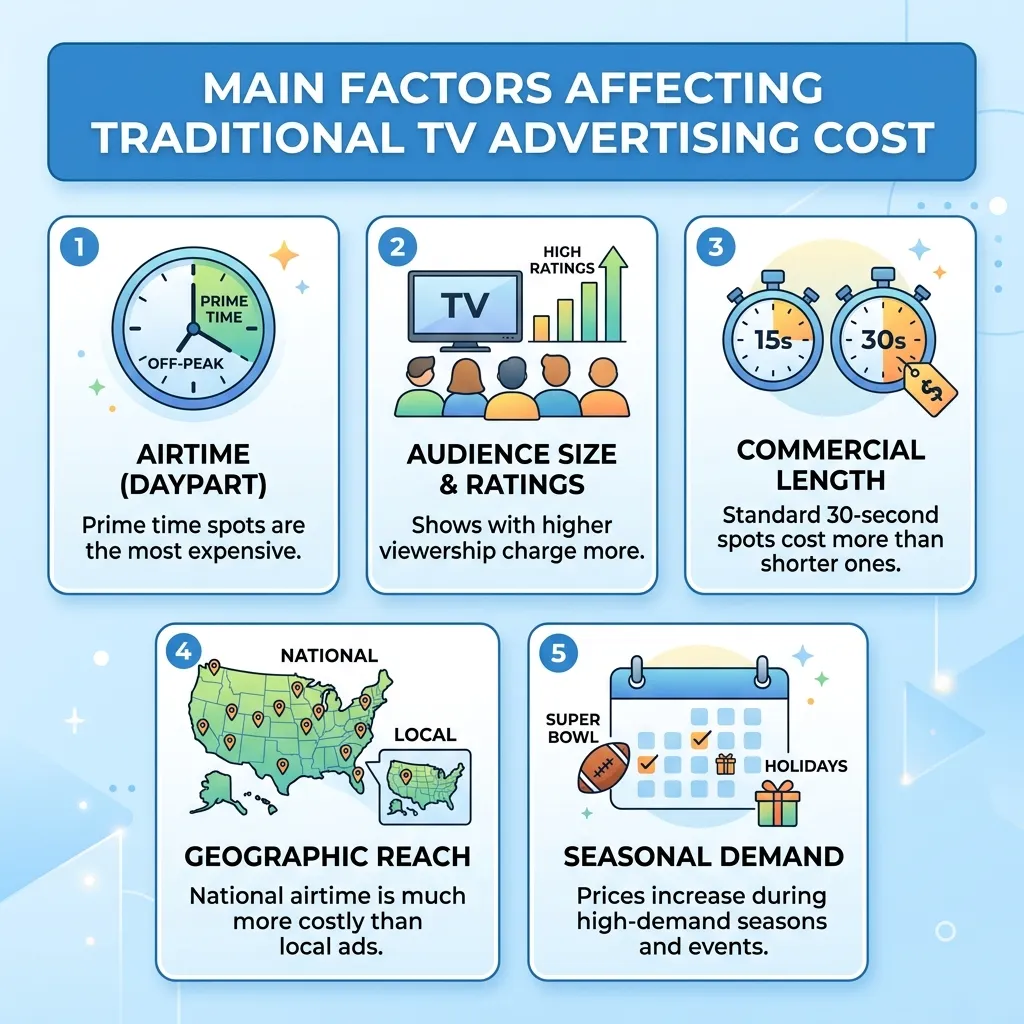
Several factors determine how much a business will pay for traditional television advertising.
1. Geographic Market
Location is one of the biggest factors affecting TV advertising prices.
Advertising in a small local market can be considerably cheaper than purchasing airtime in a large metropolitan market. National campaigns are usually more expensive because they reach a much larger potential audience.
For example, a local restaurant may only need to advertise within its city or surrounding area. A national consumer brand, however, may need television placements across multiple markets.
This geographic targeting can make traditional TV advertising more accessible to small and medium-sized businesses.
2. Television Channel
The channel or network also influences advertising costs.
Channels with larger audiences and stronger demographics typically charge more for commercial placements. A specialized cable channel may offer a more affordable opportunity than a highly popular national network.
Businesses should therefore consider both audience size and audience relevance rather than automatically choosing the most expensive network.
3. Program Popularity
Commercials shown during highly popular programs usually cost more.
A program with millions of viewers provides greater exposure, increasing demand for its available advertising slots. Major sporting events, popular entertainment programs, news programs, and special broadcasts can therefore command premium advertising rates.
A smaller business may achieve better efficiency by choosing a program with a highly relevant audience rather than paying for the largest possible audience.
4. Time Slot
The time of day has a significant effect on traditional TV advertising cost.
Prime-time television generally attracts more viewers and therefore commands higher advertising rates. Early morning, daytime, late-night, and less popular time slots can be less expensive.
Businesses should compare:
- Morning spots
- Daytime spots
- Early evening
- Prime-time spots
- Late-night spots
- Weekend placements
The best option depends on when the target audience is most likely to watch television.
5. Commercial Length
The length of a commercial also affects pricing.
Common commercial lengths include:
- 15 seconds
- 30 seconds
- 60 seconds
- Longer sponsored segments
A 30-second commercial is often used as a standard format because it provides enough time to communicate a message without requiring the budget of a longer spot.
However, a shorter commercial is not automatically better. The right length depends on the complexity of the message and the campaign objective.
6. Frequency
Businesses rarely rely on a single television commercial.
Repeated exposure helps viewers remember a brand and its message. As the number of placements increases, the overall campaign cost also increases.
Instead of purchasing a large number of random spots, businesses should create a media schedule based on:
- Target audience
- Campaign duration
- Frequency
- Program selection
- Budget
- Desired reach
This approach can make the campaign more efficient.
TV Commercial Production Cost
A common mistake is to consider only the cost of airtime.
Before a commercial can be broadcast, businesses usually need to create the advertisement itself. Production expenses can vary considerably depending on the creative concept.
A simple commercial may involve:
- Basic scripting
- One location
- Small production team
- Limited talent
- Simple editing
A larger production may require:
- Professional actors
- Multiple locations
- Specialized equipment
- Cinematography
- Makeup and styling
- Animation
- Advanced visual effects
- Professional voice-over
- Extensive post-production
Businesses should therefore establish a separate production budget before purchasing airtime.
Local vs. National TV Advertising Cost
One of the most important distinctions in television advertising is between local and national campaigns.
Local TV Advertising
Local television advertising focuses on a specific geographic market. It can be suitable for businesses such as:
- Restaurants
- Retail stores
- Healthcare providers
- Automotive dealerships
- Real estate companies
- Local service providers
- Educational institutions
The main advantage is that businesses do not have to pay for exposure in markets they do not serve.
For small businesses, local television can therefore provide a practical way to use traditional media without committing to a national campaign.
National TV Advertising
National TV advertising reaches audiences across a much larger geographic area.
It is generally more expensive because the campaign may involve:
- Larger media purchases
- Multiple networks
- Premium programming
- Higher production budgets
- Broader audience reach
- More frequent placements
National advertising is usually more appropriate for brands with products or services available across multiple regions.
Cable TV Advertising Cost
Cable television can provide businesses with another traditional advertising option.
Cable networks often serve specific audience segments, allowing advertisers to select channels that align with their target customers.
For example, a business may choose a channel focused on:
- News
- Sports
- Food
- Entertainment
- Lifestyle
- Business
- Home improvement
The cost depends on the market, network, time slot, audience, and campaign frequency.
Businesses can also compare cable advertising with broader television strategies by reviewing this guide to traditional TV advertising.
Prime-Time Advertising: Is It Worth the Cost?
Prime-time advertising can provide substantial exposure, but it also tends to be more expensive.
The key question is not simply whether prime time has more viewers. Businesses should determine whether those viewers match their target audience.
For example, paying a premium for a large audience may not make sense if only a small percentage of those viewers are potential customers.
Instead, advertisers should evaluate:
- Who watches the program?
- Does the audience match the customer profile?
- What is the estimated reach?
- How frequently will viewers see the commercial?
- What action should viewers take?
- Can the campaign be measured?
A less expensive time slot with a highly relevant audience can sometimes provide better value than a premium placement.
How to Calculate a Traditional TV Advertising Budget
Businesses can build their budget by separating fixed and variable expenses.
A simple budgeting structure is:
Total TV Advertising Budget = Production Cost + Airtime Cost + Campaign Management Cost + Additional Expenses
For example, a business might allocate its budget across:
- 20–30% for creative production
- 50–70% for media placement
- The remaining budget for planning, testing, measurement, and supporting activities
These percentages are not universal rules. Businesses should adjust them according to their campaign objectives and available resources.
The most important point is to avoid spending the entire budget on production or airtime without leaving resources for measurement and optimization.
How Small Businesses Can Reduce TV Advertising Costs
Traditional television advertising does not always require a massive budget.
Small businesses can control costs by using a focused strategy.
Choose Local Markets
Advertising only where the business operates can reduce unnecessary exposure.
Select Relevant Programs
Instead of purchasing expensive placements solely because they have high ratings, choose programs watched by the target audience.
Start With Shorter Commercials
A concise commercial can communicate a strong message when it is professionally scripted and edited.
Negotiate Media Packages
Depending on the market and broadcaster, advertisers may be able to negotiate packages involving multiple placements.
Use Existing Creative Assets
Businesses that already have professional video assets may be able to reduce production expenses.
Test Before Scaling
Start with a manageable campaign and evaluate performance before committing to a larger media buy.
This approach can help businesses protect their budget while learning which placements generate the strongest response.
Traditional TV Advertising Cost vs. Digital Advertising
Television and digital advertising use different cost structures.
Digital advertising can often be purchased through impressions, clicks, views, or conversions. Television advertising generally focuses more on airtime, reach, audience size, and frequency.
However, the two channels do not necessarily need to compete.
Businesses can integrate television with digital channels to reinforce campaign messages across multiple touchpoints.
For a broader comparison, businesses can explore digital vs. traditional marketing.
A TV commercial might introduce a brand to a broad audience, while digital campaigns can encourage viewers to search for the company, visit its website, sign up for an offer, or make a purchase.
How to Measure TV Advertising ROI
Cost alone does not determine whether a television campaign is successful.
Businesses should evaluate the return generated by their investment.
Useful measurement methods include:
Website Traffic
Monitor whether website traffic increases after commercials air.
Branded Searches
An increase in searches for the company or product name can indicate that viewers are responding to the campaign.
Promo Codes
Unique promotional codes can help connect television exposure with purchases.
Dedicated Landing Pages
A campaign-specific landing page can provide a measurable destination for television viewers.
Phone Calls
Businesses can use dedicated phone numbers to track responses generated by a TV campaign.
Sales Growth
Comparing sales before, during, and after the campaign can provide additional insight.
Businesses interested in broader offline measurement can also review this guide to offline marketing metrics.
Common Mistakes That Increase TV Advertising Costs
Businesses can waste money on television advertising when they fail to plan properly.
Buying Based Only on Audience Size
A huge audience does not automatically mean a valuable audience.
Ignoring Frequency
One commercial may not provide enough exposure to create meaningful awareness.
Spending Too Much on Production
An expensive commercial cannot compensate for poor targeting or weak messaging.
Using a Weak Call to Action
Viewers should understand what they are expected to do after seeing the advertisement.
Failing to Track Results
Without measurement, it becomes difficult to determine whether the campaign generated meaningful business outcomes.
Targeting Everyone
A broad audience may sound attractive, but businesses usually benefit more from reaching people who are likely to become customers.
Is Traditional TV Advertising Worth the Cost?
Traditional TV advertising can still be worthwhile when it is aligned with the right audience, market, message, and budget.
It can provide:
- Broad awareness
- Strong visual storytelling
- Local market exposure
- Repeated brand exposure
- Credibility
- Mass reach
- Opportunities for integrated campaigns
However, television is not automatically the best option for every business.
Companies should compare the expected reach and business value against other marketing channels before making a major investment.
A carefully planned local campaign can be more practical for a small business than an expensive national campaign.
How to Get the Best Value From Traditional TV Advertising
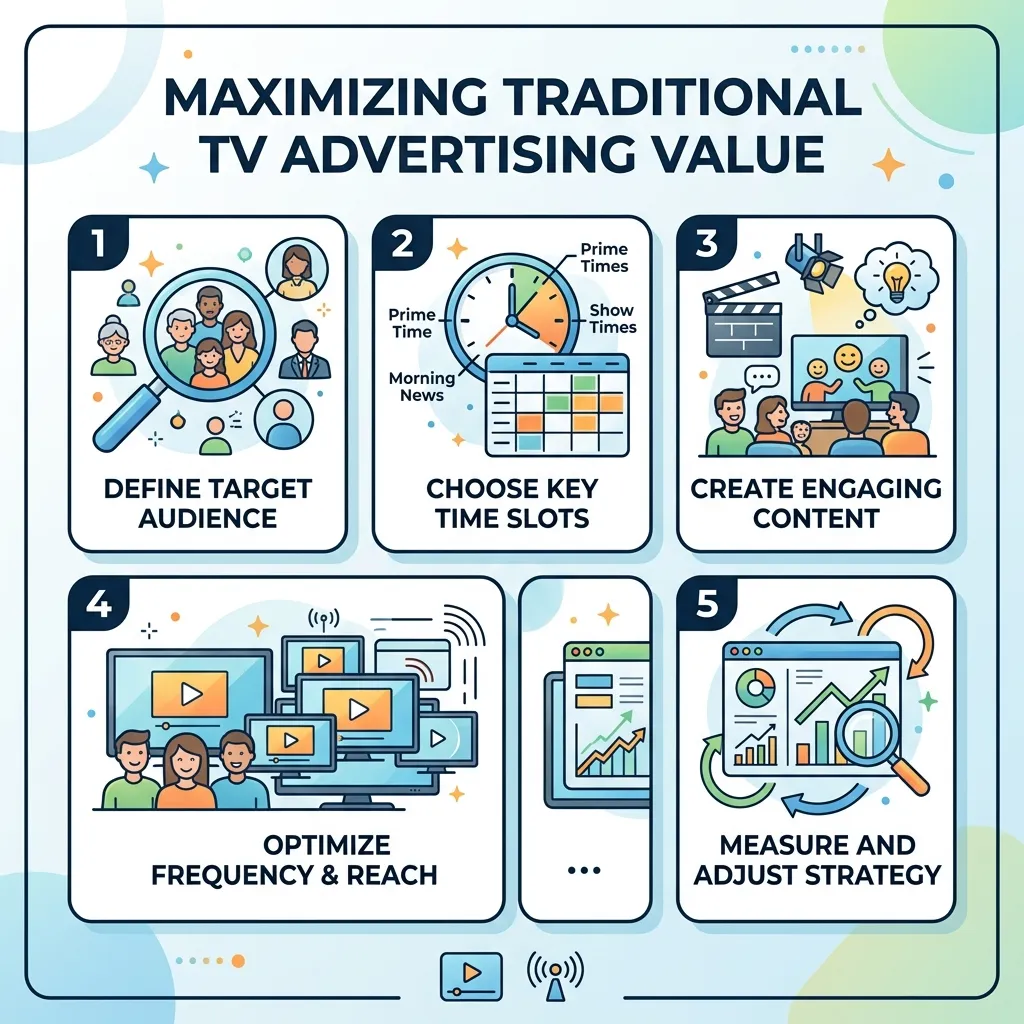
Businesses can improve the value of their investment by combining strategic media buying with strong creative execution.
Start by defining the campaign objective. Is the goal brand awareness, product promotion, store visits, website traffic, lead generation, or sales?
Next, identify the audience and determine where and when they are most likely to watch television.
Then develop a clear commercial with:
- A strong opening
- A simple message
- Memorable branding
- Relevant visuals
- A clear benefit
- A strong call to action
Finally, connect the TV campaign with other marketing channels.
For example, a television commercial can encourage viewers to visit a website, search for a brand, call a business, or use a promotional offer.
Businesses can also explore traditional marketing for small businesses to understand how television can fit into a broader offline strategy.
Final Thoughts
Traditional TV advertising cost depends on much more than the price of a commercial spot. Market size, network, program popularity, time slot, commercial length, frequency, production quality, and campaign objectives all influence the final investment.
For small businesses, local television and carefully selected programming can provide a more manageable entry point. Larger companies may benefit from broader regional or national campaigns.
The most effective approach is not necessarily to buy the most expensive advertising slot. Instead, businesses should focus on reaching the right audience with the right message at the right frequency.
By combining strategic media buying, professional creative development, measurable calls to action, and supporting digital campaigns, businesses can make traditional television advertising a more accountable and valuable part of their overall marketing strategy.
FAQs About Traditional TV Advertising Cost
1. How much does traditional TV advertising cost?
Traditional TV advertising costs vary based on the market, network, program, time slot, commercial length, and frequency. Local campaigns generally require less investment than national campaigns.
2. Is TV advertising expensive for small businesses?
It can be, but small businesses can control costs through local targeting, shorter commercials, selective programming, and smaller media packages.
3. Does commercial length affect TV advertising cost?
Yes. Longer commercials generally require more airtime and can increase media costs.
4. Is local TV advertising cheaper than national TV advertising?
Generally, local campaigns cost less because they target a smaller geographic market and audience.
5. Why is prime-time TV advertising more expensive?
Prime-time programs typically attract larger audiences, which increases demand for available advertising inventory.
6. Does TV commercial production cost include airtime?
No. Production and media placement are normally separate expenses and should be budgeted independently.
7. How can a business reduce TV advertising costs?
Businesses can reduce costs by targeting specific markets, selecting relevant programs, negotiating media packages, and testing campaigns before scaling.
8. How can businesses measure TV advertising ROI?
Website traffic, branded searches, promotional codes, dedicated landing pages, phone calls, and sales changes can help measure campaign performance.
9. Is traditional TV advertising still effective?
It can be effective when the campaign reaches a relevant audience with a compelling message and sufficient frequency.
10. Should small businesses use TV advertising?
TV can be useful for small businesses that serve a local or regional market and have a clear objective, appropriate budget, and measurable campaign strategy.









[…] of thousands for a national campaign with high production values. Our detailed breakdown of TV advertising costs for businesses covers how production costs fit within the broader budget alongside media buying and […]