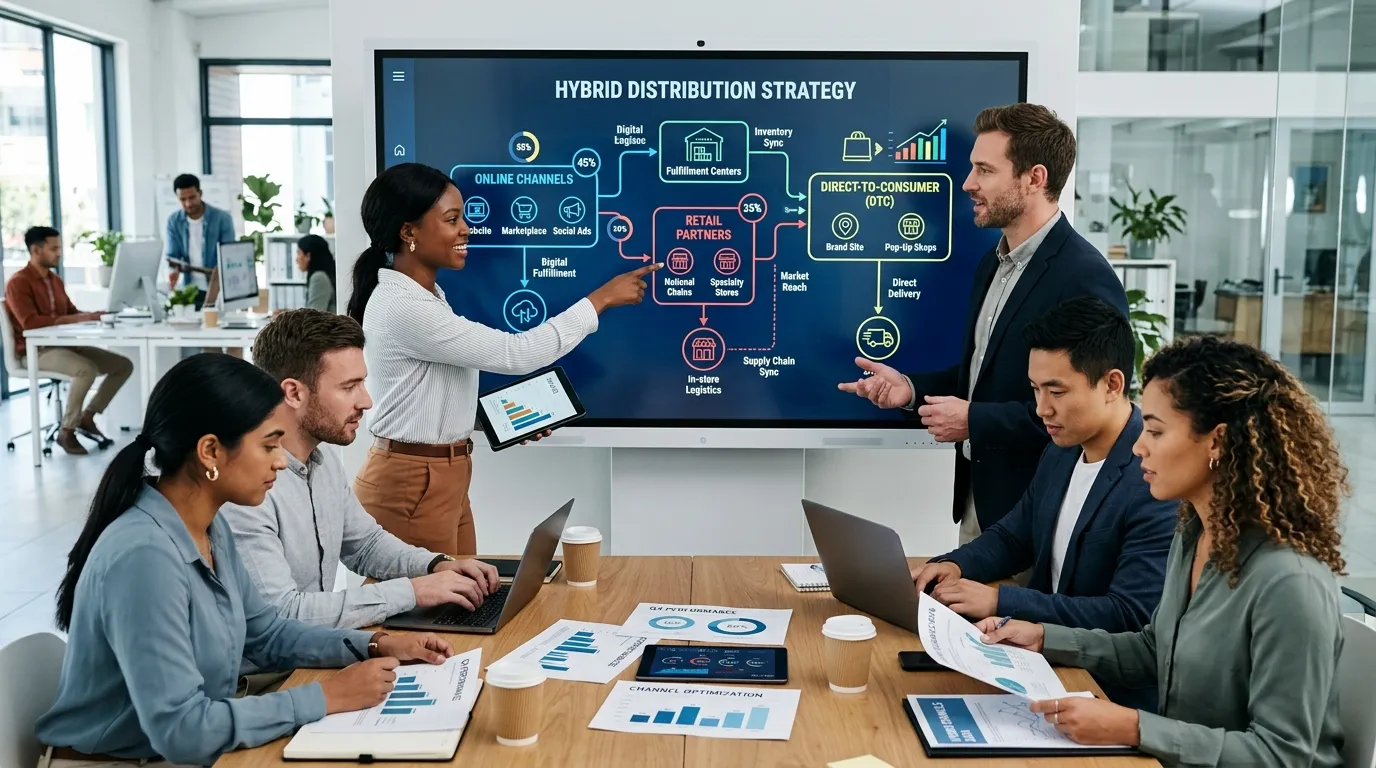
Hybrid distribution channel in marketing combines direct and indirect, online and offline sales routes to reach customers through multiple touchpoints simultaneously.
 A hybrid distribution channel in marketing is a distribution framework that combines multiple types of sales and delivery routes—direct, indirect, digital, physical—under a single, coordinated strategy. Rather than routing all sales through one method, businesses using hybrid distribution allow customers to purchase through whichever channel suits them best, while the company manages all those channels as a unified system.
The distinction from “multi-channel” is important. Multi-channel distribution means being present on multiple platforms. Hybrid distribution means designing those platforms to actively reinforce each other. A brand that sells on its own website, through Amazon, through physical retail partners, and through a direct sales team—while coordinating inventory, pricing, and messaging across all four—is operating a true hybrid distribution channel.
For a broader understanding of how this integrates with overall marketing strategy, our hybrid marketing strategy definition guide provides useful context on the underlying principles.
Traditional vs. Digital Channels: Understanding the Core Divide
Before examining how hybrid distribution works, it helps to understand what each side of the equation contributes—and where each falls short on its own.
What Do Traditional Distribution Channels Offer?
Traditional distribution channels—physical retail, wholesale partnerships, direct sales teams, catalogs, and in-store promotions—excel at building tangible trust and serving customers who prefer face-to-face or hands-on purchasing experiences.
Physical retail provides immediate product access. Wholesale distribution creates broad geographic coverage without requiring the brand to manage multiple storefronts. Direct sales teams can handle complex, high-value B2B transactions that require relationship-building over time. These channels build credibility that digital-only brands often struggle to replicate.
The limitation is reach and measurement. Traditional channels are geographically constrained, operationally expensive to scale, and difficult to track with precision.
What Do Digital Distribution Channels Add?
Digital channels—e-commerce platforms, online marketplaces, social commerce, direct-to-consumer websites, and digital resellers—solve the problems that traditional channels create. They scale globally without proportional cost increases, generate precise performance data, and allow customers to purchase at any time from any location.
However, digital-only distribution creates its own vulnerabilities: algorithm dependency, rising customer acquisition costs, and limited ability to serve customers who want a physical product experience before purchasing.
How Does Hybrid Distribution Bridge the Gap?
The hybrid distribution channel in marketing combines both models to eliminate each set of weaknesses. Traditional channels fill demand among customers who prefer physical touchpoints. Digital channels capture those who prefer online convenience. Together, they expand total addressable market and create a more resilient revenue base.
According to Nielsen’s 2024 consumer research, buyers interact with brands across an average of six distinct touchpoints before making a purchase. A hybrid distribution channel ensures the brand is present—and consistent—at every one of those moments.
What Are the Benefits of a Hybrid Distribution Channel in Marketing?

How Does Hybrid Distribution Increase Market Reach and Customer Access?
Every distribution channel you add extends your potential customer base. A software company that sells only through its own website may miss the enterprise buyers who prefer procurement through established reseller partnerships. A food brand that sells only through grocery chains misses the direct-to-consumer customers who want a subscription experience.
Hybrid distribution closes these gaps. By operating across direct and indirect channels simultaneously, businesses can serve different customer segments with the channel they prefer—without forcing any segment to compromise.
How Does a Hybrid Marketing Strategy Improve Customer Experience and Engagement?
Customers form opinions about brands based on every interaction they have. A disjointed distribution experience—where pricing differs between the website and the store, or where the online channel doesn’t honor promotions from the physical channel—destroys trust quickly.
A well-executed hybrid distribution channel creates consistency. Customers who research online and purchase in-store encounter the same value proposition. Those who start in-store and complete their purchase online face no friction. The seamless experience across every channel is what drives loyalty.
What Efficiency and Cost Optimization Benefits Does Hybrid Distribution Deliver?
Hybrid distribution allows companies to optimize each channel for what it does best. High-volume, low-complexity sales go through automated digital channels where the cost per transaction is lowest. Complex, high-value sales go through direct teams where human relationship-building justifies the investment. Mid-market volume goes through wholesale or retail partners who handle logistics efficiently.
This segmentation reduces cost-per-acquisition across the board and prevents any single channel from bearing a disproportionate share of operational overhead.
Why Does Hybrid Distribution Offer Greater Flexibility and Adaptability?
Single-channel businesses are fragile. A retailer that sells only through one major platform is entirely dependent on that platform’s policies, fees, and algorithms. A brand that sells only through physical retail is exposed to shifts in foot traffic, real estate costs, and supply chain disruptions.
Hybrid distribution diversifies that risk. When one channel underperforms, others continue generating revenue. This resilience is particularly valuable during market disruptions, where businesses with multiple active distribution routes consistently outperform those that depend on a single path to market.
How Does Hybrid Distribution Create Data Collection and Personalization Opportunities?
Each distribution channel generates data about customer behavior, preferences, and purchasing patterns. Combining data from physical point-of-sale systems, e-commerce platforms, wholesale order histories, and direct sales CRMs creates a far richer picture than any single channel can provide.
That combined data set enables meaningful personalization—targeting the right customers with the right offers through the channels they actually prefer. According to Forrester Research (2024), organizations that use unified marketing measurement tools improve campaign effectiveness by up to 30%.
What Are the Key Components of a Successful Hybrid Distribution Strategy?
How Do You Select the Right Channels for a Hybrid Distribution Model?
Channel selection should follow customer behavior, not internal preference. Map where your customers currently discover, evaluate, and purchase products. Then identify the gaps—channels where demand exists but your brand has no presence. Prioritize channels that serve high-value customer segments or where competitors are capturing demand you’re leaving behind.
The hybrid marketing mix strategy guide offers a detailed framework for evaluating channel options within the broader context of a 4 Ps approach.
Why Is Seamless Channel Integration Critical in an Omnichannel Distribution Strategy?
The omnichannel distribution strategy is the operational backbone of hybrid distribution. Inventory systems, pricing engines, loyalty programs, and customer service functions must operate consistently across every channel. A customer who adds an item to their online cart should be able to pick it up in-store. A wholesale partner should access the same product information as your direct sales team.
Without back-end integration, channels become silos—and silos create friction that drives customers away.
How Do You Maintain Consistent Brand Messaging Across All Distribution Touchpoints?
Brand consistency in a hybrid distribution channel is a non-negotiable. Product positioning, pricing rationale, promotional messaging, and visual identity must remain aligned whether a customer encounters the brand through a retail partner, a social commerce post, or a direct sales call.
Establish a clear brand style guide before expanding into any new channel. Inconsistency signals disorganization—and customers notice.
What Technology and Tools Support Hybrid Distribution Channel Implementation?
Three technology categories are essential:
- CRM platforms (HubSpot, Salesforce) that track customer interactions across every channel into a single source of truth
- E-commerce and inventory management platforms that synchronize stock levels, pricing, and order fulfillment across digital and physical channels
- Analytics dashboards that aggregate performance data from all distribution routes into one view, enabling channel-by-channel comparison and rapid reallocation decisions
Why Does Team Training Matter in a Hybrid Distribution Channel Strategy?
Technology is only as effective as the people operating it. Sales teams need to understand how to work alongside digital channels rather than compete with them. Customer service teams need visibility into transactions from every channel to resolve issues quickly. Marketing teams need to align campaign timing and messaging with channel-specific promotions.
Cross-functional training and clear internal accountability for each channel are what turn a hybrid distribution strategy from a plan into a functioning system.
How Do You Build a Hybrid Distribution Channel Strategy in 6 Steps?

Step 1: Define Your Target Audience and Their Purchasing Journey
Start with the customer. Map every touchpoint they encounter from first awareness to post-purchase. Identify which channels they use at each stage—where they discover products, where they evaluate options, where they actually buy, and how they prefer to receive support afterward. This journey map determines which channels deserve investment.
Step 2: Identify and Evaluate Potential Channels
Audit your current channel mix and compare it against your customer journey map. Where does your brand appear? Where is it absent? Evaluate potential new channels based on three factors: audience fit, operational feasibility, and competitive density. Channels where your target customers are active but your competitors have limited presence represent the highest-priority opportunities.
Step 3: Map Out the Customer Experience Across Channels
Design the cross-channel experience before you build it. Document how a customer who starts on your website might complete a purchase in-store. Map how a wholesale partner’s customer can escalate to your direct support team. Plan how a social commerce buyer should be able to access your loyalty program. The goal is zero friction at every channel transition point.
For further guidance on how this fits within a broader hybrid marketing channel strategy, the complete channel guide provides additional detail on execution.
Step 4: Implement Technology and Infrastructure
Once the experience is mapped, build the infrastructure to support it. This means integrating your e-commerce platform with your physical point-of-sale system, connecting your wholesale ordering system to your central inventory database, and ensuring your CRM captures transactions from every channel. The investment pays off in operational efficiency and the data quality required for ongoing optimization.
Step 5: Establish Metrics and KPIs for Success
Define success metrics for each channel individually and for the hybrid system as a whole. Channel-level metrics include conversion rate, average order value, and cost per acquisition. System-level metrics include total revenue per customer, cross-channel attribution, and customer lifetime value. According to McKinsey’s research on consumer decision journeys, brands that measure cross-channel behavior consistently make better resource allocation decisions than those tracking channels in isolation.
Step 6: Iterate and Optimize Based on Performance Data
A hybrid distribution channel is never finished. Review channel performance data quarterly. Test new configurations—product bundles, pricing structures, channel-exclusive promotions—on a rolling basis. When one channel shows declining performance, investigate the cause before reallocating budget away from it. The goal is a system that continuously improves, not one that simply runs.
What Are the Biggest Challenges of a Hybrid Distribution Channel—and How Do You Overcome Them?
How Do You Manage Channel Conflict in a Hybrid Distribution Strategy?
Channel conflict occurs when two distribution routes compete for the same customer—typically when a brand’s direct-to-consumer pricing undercuts its wholesale partners, or when a digital channel cannibalizes a retail partner’s sales. Left unmanaged, this erodes partner relationships and undermines the hybrid model.
The solution is a clear channel segmentation strategy. Define which customer segments each channel serves. Use channel-exclusive products, bundles, or pricing tiers to reduce direct overlap. Communicate the rationale to all partners transparently.
How Do You Maintain Brand Consistency Across a Multi-Channel Marketing Approach?
The more channels you operate, the greater the risk of messaging drift. Different teams, different partners, different platforms all create opportunities for inconsistency. Centralize brand governance with a single owner responsible for approving all channel-specific creative and messaging. Conduct regular audits of how the brand appears across every active channel.
How Do You Solve Data Management and Silo Problems in Hybrid Distribution?
Data silos emerge when channel data lives in separate, disconnected systems. The website analytics platform doesn’t talk to the wholesale order management system, which doesn’t connect to the in-store POS. The result is incomplete attribution and poor decision-making.
Invest in a CRM that functions as a true central data hub. Map every customer interaction—regardless of channel—back to a unified customer profile. Establishing this infrastructure early prevents costly data migration projects later.
How Do You Allocate Resources and Budget Across a Hybrid Distribution Channel?
Budget allocation across multiple channels is both a financial and a political challenge. Different channel owners will advocate for their own priorities. Base allocation decisions on performance data rather than internal advocacy. Reserve 15–20% of the total marketing and distribution budget for testing new configurations, and shift resources toward the combinations that consistently deliver the strongest ROI.
Real-World Examples: Companies Successfully Leveraging a Hybrid Distribution Strategy

Coca-Cola’s “Share a Coke” Campaign is one of the most frequently cited examples of hybrid distribution and marketing working in concert. Personalized bottles—a traditional physical product-marketing tactic—drove digital engagement when consumers photographed and shared their bottles online. The physical distribution channel fueled the digital campaign. The digital campaign accelerated physical product sales. Sales increased across every market where the campaign ran.
Nike operates one of the most sophisticated hybrid distribution channel strategies in consumer goods. The brand sells through its own direct-to-consumer website and physical Nike stores, through wholesale retail partners like Foot Locker, through third-party e-commerce platforms, and through a direct app ecosystem. Each channel serves a different segment of the customer base. Critically, Nike has progressively pulled back from wholesale partners that didn’t deliver the brand experience they required—demonstrating that a hybrid distribution channel strategy also means managing which channels to include with as much discipline as how to run them.