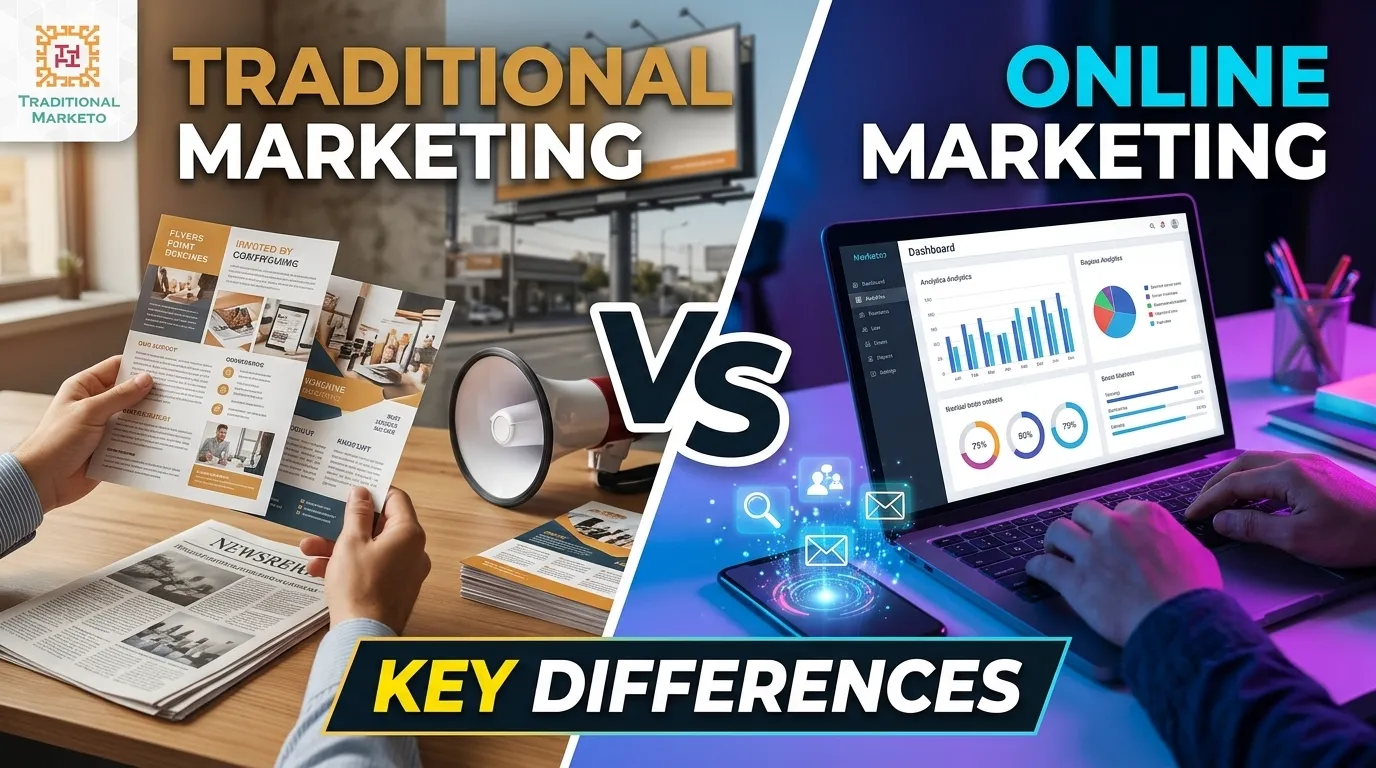
Marketing plays an important role in helping businesses reach customers, build brand awareness, and increase sales. Over the years, marketing methods have changed significantly because of technological developments and changing consumer behavior. Traditional marketing has been used for decades through newspapers, television, radio, magazines, and billboards. On the other hand, online marketing has become increasingly popular because businesses can connect with their audiences through websites, social media, search engines, and email.
Traditional Marketing vs Online Marketing is an important topic for businesses that want to choose the right promotional methods. Both approaches have unique benefits, limitations, and purposes. While traditional marketing helps businesses reach audiences through established media channels, online marketing provides more targeted communication, measurable results, and flexible advertising opportunities. In this guide, we will explore different marketing strategies, advertising methods, costs, advantages, disadvantages, and effectiveness to help you understand which approach is more suitable for your business.
Traditional Marketing vs Digital Marketing
Traditional marketing and digital marketing are two major approaches businesses use to promote their products and services. Although both aim to attract customers and generate sales, they use different communication channels and promotional techniques. Traditional marketing refers to advertising through offline channels such as television, radio, newspapers, magazines, brochures, direct mail, and outdoor billboards. These methods allow companies to reach large audiences, particularly people who regularly consume traditional media.
Digital marketing, however, uses internet-based platforms to communicate with potential customers. Businesses promote their products through search engines, social media, websites, email campaigns, online videos, and paid advertisements.
When discussing Traditional Marketing vs Online Marketing, one major difference is how businesses interact with their audiences. Traditional marketing generally uses one-way communication, where companies deliver advertising messages to consumers. Digital marketing supports two-way communication, allowing customers to comment, share opinions, ask questions, and interact directly with brands. For example, a company might advertise a new product through television commercials while using Facebook and Google Ads to reach people interested in that particular product. Both methods can work together to create a stronger marketing campaign.
Online Marketing Strategies
Online marketing strategies help businesses attract potential customers, develop relationships, and increase revenue through digital platforms. These strategies are especially valuable because companies can reach audiences beyond their local geographical areas. Search engine optimization (SEO) is one of the most important online marketing strategies. It involves improving website content, structure, and technical performance so that search engines can understand and rank web pages. A well-optimized website can attract organic visitors who are already searching for relevant products or services.
Social media marketing is another effective strategy. Platforms such as Facebook, Instagram, LinkedIn, TikTok, and Pinterest allow businesses to share content, promote products, and communicate with customers. Companies can also use paid social media campaigns to reach specific audiences. Email marketing helps businesses maintain relationships with existing customers and encourage repeat purchases. By sending useful information, product updates, newsletters, and promotional offers, companies can keep their audiences engaged. Businesses interested in this approach can explore our guide to e-commerce email marketing for more insights.
Content marketing is equally important because it focuses on providing useful and informative content. Blog posts, videos, tutorials, and infographics help businesses establish credibility and attract potential customers. These strategies demonstrate how Traditional Marketing vs Online Marketing differs in terms of audience targeting, communication, and campaign measurement. Businesses can combine multiple online strategies to achieve better marketing results.
Traditional Advertising Methods
 Traditional advertising methods have been used by businesses for many years to communicate with customers through offline media. Even though online advertising has become increasingly popular, traditional advertising remains relevant in many industries. Television advertising is one of the most recognizable traditional advertising methods. Businesses create commercials that appear during television programs, news broadcasts, and entertainment shows. Television advertisements combine visuals, sound, and storytelling to create memorable brand messages.
Radio advertising is another established method. Companies broadcast short promotional messages during radio programs to reach listeners. It can be particularly useful for local businesses that want to connect with people in specific geographical areas. Newspaper and magazine advertising allow businesses to publish promotional content in printed publications. These advertisements can target readers based on their interests, locations, or publication preferences.
Billboards and outdoor advertisements are commonly placed along busy roads, shopping areas, public transportation locations, and commercial districts. Their main advantage is repeated exposure to people who regularly travel through those areas. Direct mail marketing involves sending printed promotional materials, catalogs, discount offers, and business information directly to customers. The comparison of Traditional Marketing vs Online Marketing shows that traditional advertising can still create strong brand recognition. For example, businesses looking to increase visibility among television audiences can learn more from this article about the benefits of television advertising for businesses.
Digital Marketing Advantages and Disadvantages
Digital marketing offers several advantages that make it attractive to businesses of different sizes. One of its biggest benefits is audience targeting. Companies can reach people based on their interests, age groups, geographical locations, online behavior, and other relevant characteristics. Another advantage is measurable performance. Businesses can use analytics tools to monitor website traffic, clicks, conversions, customer engagement, and advertising performance. This information helps marketers understand which campaigns are working and where improvements are needed.
Digital marketing also offers flexibility. Companies can modify advertisements, update website content, change campaign budgets, and test different marketing messages without printing new materials or producing another television commercial. However, digital marketing also has some disadvantages. Online competition is extremely high, making it difficult for businesses to stand out. Search engine algorithms and social media platforms frequently change, which can affect marketing performance.
Privacy concerns, advertising fatigue, negative online reviews, and the need for continuous content creation are other challenges. When evaluating Traditional Marketing vs Online Marketing, businesses should understand that digital marketing is not automatically successful. It requires proper planning, relevant content, consistent effort, and a clear understanding of customer behavior.
Difference Between Traditional and Online Marketing
The main difference between traditional and online marketing is the communication channel used to reach customers. Traditional marketing relies on offline platforms, whereas online marketing uses internet-based channels. Audience targeting is another important difference. Traditional advertising often reaches a broad audience within a particular geographical area. Online marketing provides more advanced targeting options, allowing companies to focus on specific customer groups.
Communication also differs between the two approaches. Traditional advertisements generally deliver messages without immediate interaction. Online platforms allow customers to respond, ask questions, share feedback, and communicate directly with businesses. Measurement is another significant factor. Traditional marketing performance can be difficult to measure accurately. Businesses may use surveys, promotional codes, customer feedback, or sales comparisons to estimate campaign results. Online marketing provides access to analytics and tracking tools that help measure customer interactions and conversions.
Geographical reach also matters. A local newspaper advertisement may primarily reach readers in a particular region, while a website or social media campaign can reach potential customers internationally. In the discussion of Traditional Marketing vs Online Marketing, it is important to remember that neither approach is universally better. The right choice depends on the business model, target audience, marketing objectives, and available resources.
Traditional Marketing Techniques
 Traditional marketing techniques continue to help businesses build relationships with customers through physical and offline communication channels. These techniques are particularly useful for companies targeting local communities or audiences that prefer traditional media. Print marketing is a common technique that includes distributing flyers, brochures, posters, catalogs, and business cards. These materials provide customers with physical information about products, services, prices, and special offers.
Event marketing is another effective traditional technique. Businesses participate in trade shows, exhibitions, conferences, community events, and promotional activities to introduce their brands and connect with potential customers. Telemarketing involves contacting potential customers through telephone calls to explain products, provide information, and promote services. When used responsibly, it can support customer communication and sales activities.
Public relations is also an important part of traditional marketing. Companies use press releases, media coverage, sponsorships, and community engagement to establish a positive public image. Businesses can also use promotional merchandise, such as branded pens, calendars, notebooks, and shopping bags, to increase brand recognition. Although Traditional Marketing vs Online Marketing is often presented as a competition, traditional techniques can complement digital campaigns. For example, a company can distribute brochures at an event while encouraging customers to visit its website or follow its social media pages.
Benefits of Online Marketing
Online marketing provides businesses with opportunities to grow, connect with customers, and increase brand visibility. One of its most important benefits is global reach. A business can promote its products to customers in different cities, countries, and markets without opening physical locations everywhere. Cost flexibility is another major benefit. Businesses can begin with smaller advertising budgets and increase their spending as they identify successful campaigns. This makes online marketing accessible to startups, freelancers, small businesses, and established companies.
Customer engagement is also improved through digital communication. Businesses can respond to customer questions, collect feedback, share updates, and provide support through social media, email, and websites. Another advantage is personalization. Companies can create relevant promotional messages based on customer interests, previous interactions, and purchasing behavior.
Online marketing also supports business growth through content creation. Helpful articles, videos, and educational resources can attract potential customers and build trust over time. For example, companies operating in the business-to-business industry can use specialized approaches to reach decision-makers and generate qualified leads. You can explore these B2B digital marketing strategies to understand how businesses can develop stronger online campaigns. Entrepreneurs who want to expand their professional opportunities can also benefit from understanding business development strategies, which help organizations identify opportunities, establish partnerships, and build sustainable growth. Overall, Traditional Marketing vs Online Marketing highlights the importance of choosing promotional channels that match business goals and customer expectations.
Cost of Traditional Marketing vs Digital Marketing
Marketing costs are an important consideration when businesses decide how to promote their products and services. Traditional marketing and digital marketing have different cost structures, and the final expense depends on the campaign size, advertising platform, location, and target audience. Traditional marketing can require significant upfront investment. Television advertisements may involve production costs, actors, editing, and broadcasting fees. Newspaper and magazine advertisements require printing and publication expenses. Billboard campaigns may involve design, printing, installation, and rental charges.
Digital marketing can often be started with a smaller budget. Businesses can create social media accounts, publish website content, send email newsletters, and work on SEO without paying for every individual interaction. However, digital marketing is not always free. Paid search advertisements, social media campaigns, professional content creation, website development, and marketing software can increase expenses.
For example, a small business may spend a limited amount on social media advertising to test a new product before investing in a larger campaign. This flexibility can help businesses manage their promotional budgets. Traditional Marketing vs Online Marketing also differs in terms of cost measurement. Digital advertising platforms often provide detailed performance data, helping companies calculate cost per click, cost per lead, and return on advertising spend. Traditional campaigns may require additional research to estimate their return on investment. Nevertheless, they can deliver valuable results when targeting the right audience. Businesses should compare expected results rather than choosing a marketing channel based only on its initial cost.
Online Advertising vs Traditional Advertising
Online advertising and traditional advertising both aim to attract attention, communicate promotional messages, and encourage customers to take action. However, their delivery methods and targeting capabilities are different. Online advertising includes search engine advertisements, social media promotions, display banners, sponsored content, video advertisements, and influencer collaborations.
One of its biggest advantages is precise audience targeting. Advertisers can select specific locations, interests, demographics, and other available targeting characteristics. They can also adjust campaigns based on performance. Traditional advertising uses channels such as television, radio, newspapers, magazines, and billboards. These methods can expose brands to large groups of people and create familiarity through repeated advertising.
For example, a restaurant can advertise through local newspapers and outdoor billboards while running location-based social media campaigns to attract nearby customers. Another important difference is customer interaction. Online advertisements can include clickable links, contact forms, shopping options, and direct messaging. Traditional advertisements usually encourage customers to visit a store, make a telephone call, or remember a brand. When comparing Traditional Marketing vs Online Marketing, online advertising generally provides more detailed campaign tracking. However, traditional advertising can be valuable for businesses that want broad exposure and strong offline brand recognition. The most effective approach depends on where the target audience spends time and how customers prefer to receive information.
Effectiveness of Digital Marketing Compared to Traditional Marketing
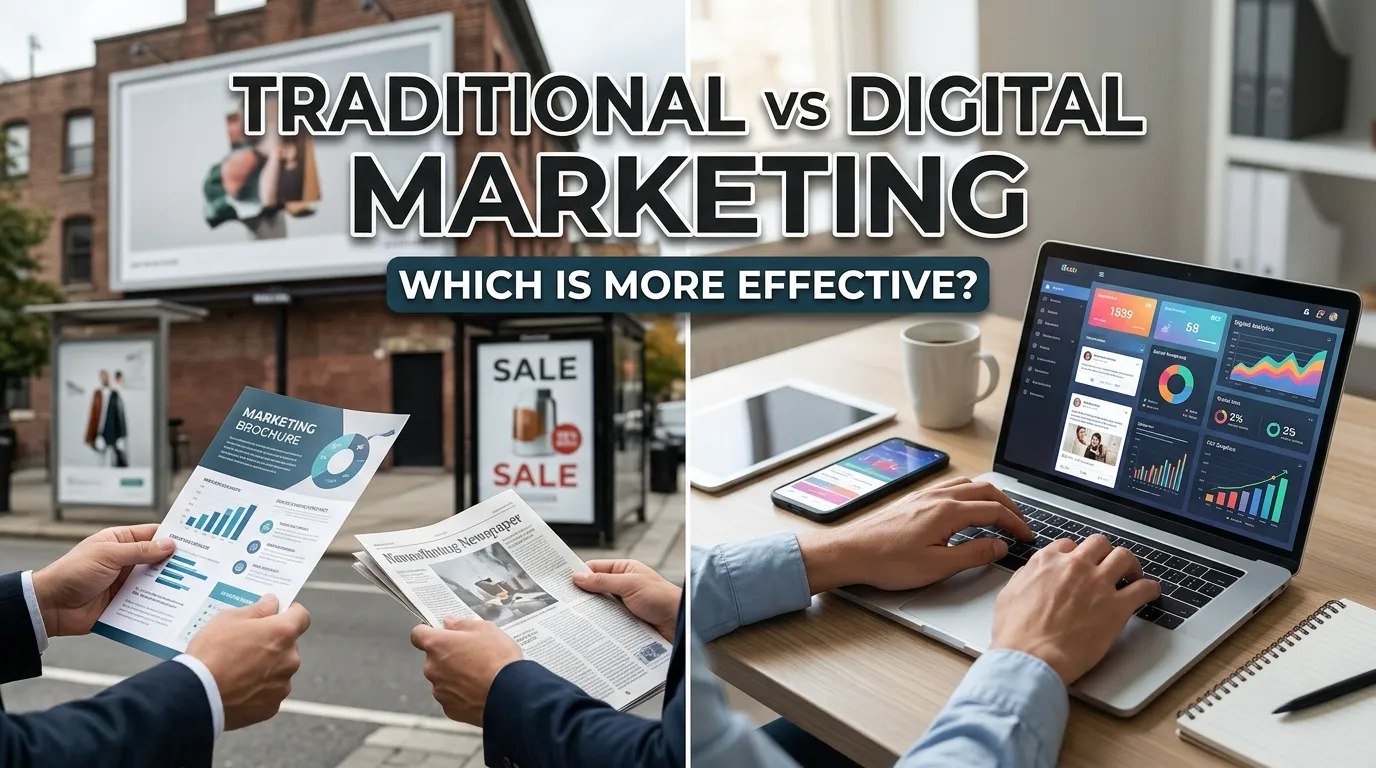 The effectiveness of a marketing strategy depends on its ability to achieve business objectives. These objectives may include increasing brand awareness, generating leads, improving customer engagement, or increasing sales. Digital marketing is particularly effective when businesses want to reach specific audiences and measure campaign performance. Companies can track website visitors, monitor advertising results, identify customer interests, and make improvements based on available data.
Search engine optimization can attract people who are actively looking for relevant information or services. Social media marketing can increase brand visibility and encourage customer engagement. Email campaigns can help businesses maintain relationships with existing customers. Traditional marketing is effective in different situations. Television advertisements can reach large audiences, while billboards can repeatedly expose people to a brand. Print advertising may also help businesses connect with readers who prefer physical publications.
The success of either method depends on factors such as campaign quality, audience preferences, message relevance, timing, and budget. Traditional Marketing vs Online Marketing should therefore be evaluated according to the specific goals of a company rather than general assumptions about which method is more effective. For small businesses, online marketing may offer an affordable starting point. For larger companies, combining television, print, outdoor advertising, SEO, and social media can create a stronger overall promotional strategy. Ultimately, the best marketing approach is one that reaches the right people, communicates a clear message, and generates measurable business value.
Conclusion
Marketing continues to evolve as technology changes the way people discover products, communicate with businesses, and make purchasing decisions. Traditional marketing remains valuable for broad brand awareness, local exposure, and offline customer engagement. Online marketing provides flexibility, advanced targeting, measurable performance, and opportunities to connect with customers across geographical boundaries. The comparison of Traditional Marketing vs Online Marketing shows that both approaches have their own strengths and limitations. Businesses should consider their target audience, objectives, budget, and industry before selecting a marketing strategy. Rather than relying entirely on one approach, many businesses can achieve better results by combining traditional advertising with digital marketing techniques. A balanced strategy can improve brand recognition, strengthen customer relationships, and support long-term business growth.
FAQ
1. What is the main difference between traditional marketing and online marketing?
The main difference is the communication channel. Traditional marketing uses offline channels such as television, radio, newspapers, magazines, and billboards. Online marketing uses internet-based platforms such as websites, social media, search engines, and email.
2. Which is better, traditional marketing or digital marketing?
Neither method is always better. Digital marketing is useful for targeted advertising, measurable results, and online customer engagement. Traditional marketing is valuable for broad exposure, local promotion, and building brand recognition through established media channels.
3. Is online marketing cheaper than traditional marketing?
Online marketing can be more affordable because businesses can start with smaller budgets and adjust their campaigns. Traditional marketing often involves higher production, printing, and broadcasting expenses. However, actual costs depend on the marketing strategy and campaign requirements.
4. What are the most popular online marketing strategies?
Popular online marketing strategies include search engine optimization, social media marketing, email marketing, content marketing, influencer marketing, paid search advertising, and video marketing. Businesses often combine several strategies to achieve better results.
5. What are some examples of traditional marketing?
Examples of traditional marketing include television commercials, radio advertisements, newspaper promotions, magazine advertisements, billboards, brochures, flyers, direct mail, and promotional events.
6. Can small businesses benefit from digital marketing?
Yes. Small businesses can use digital marketing to reach targeted customers, increase website traffic, promote products, and build brand awareness. They can start with organic content and gradually invest in paid advertising as their business grows.
7. Is traditional marketing still effective in 2026?
Yes. Traditional marketing remains useful for businesses targeting audiences that regularly consume television, radio, newspapers, and outdoor advertisements. It can also support local brand awareness and complement digital campaigns.
8. How can businesses measure digital marketing effectiveness?
Businesses can measure digital marketing performance through website traffic, click-through rates, conversion rates, customer engagement, leads, sales, and return on advertising spend. Analytics platforms help marketers understand campaign performance.
9. Can traditional marketing and online marketing work together?
Yes. Combining both approaches can create a stronger marketing strategy. For example, a company can advertise through television and billboards while using social media, SEO, and email marketing to maintain customer engagement and generate online sales.
10. What is the future of marketing?
The future of marketing will likely involve greater use of artificial intelligence, automation, personalized advertising, video content, data analytics, and interactive customer experiences. Traditional media will also continue to serve audiences that value offline communication. Businesses that adapt to changing customer behavior will have better opportunities for long-term growth.