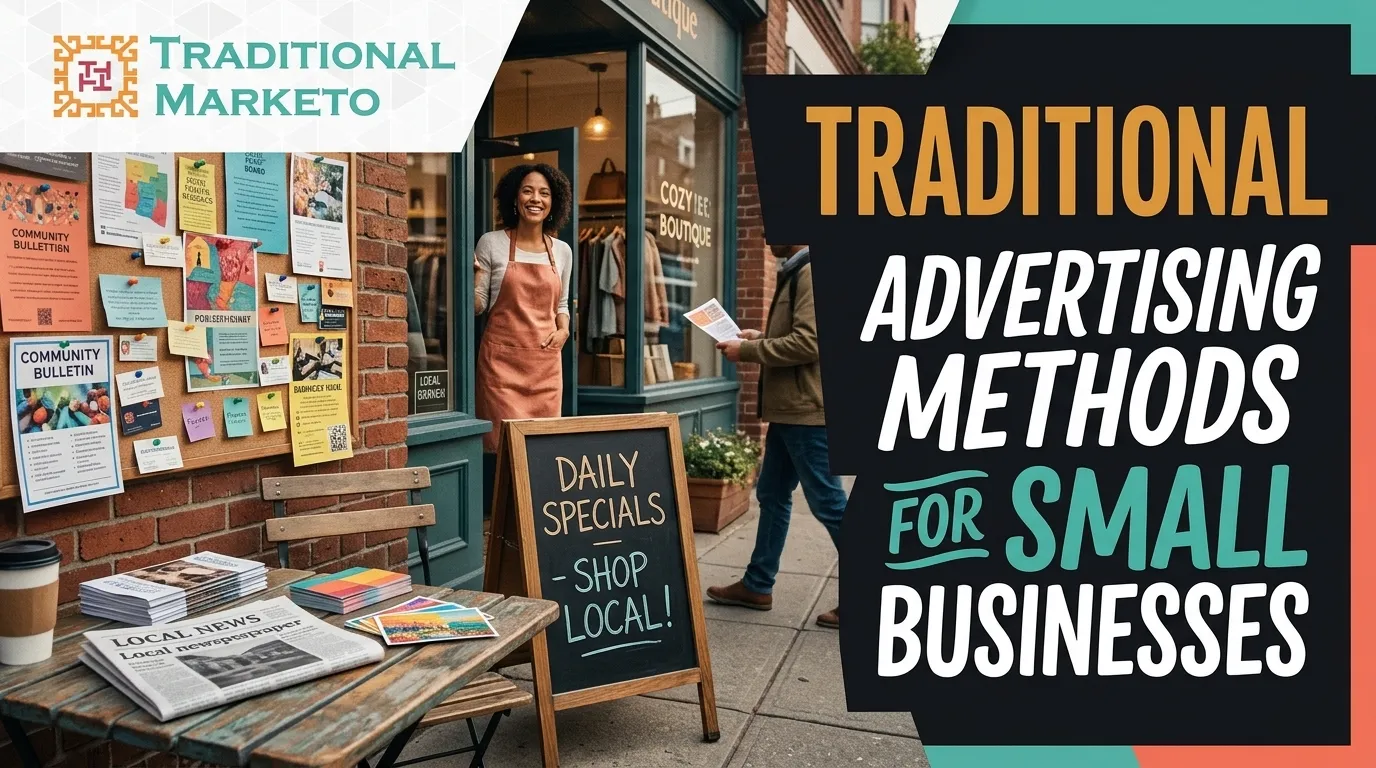
Traditional advertising remains a practical way for small businesses to build local awareness, reach customers who may not spend much time online, and establish trust in their communities. From newspaper ads and radio spots to direct mail, flyers, and outdoor displays, the right approach depends on your audience, budget, location, and goals. This guide explains how to choose and measure traditional advertising methods for small businesses, combine them with digital marketing, and make every advertising dollar work harder.
Traditional marketing strategies for small businesses
Traditional marketing includes promotional activities that reach people through offline channels. These can include print publications, radio, television, direct mail, event sponsorships, community partnerships, and outdoor signs. For a small business, the strongest strategy is not to use every channel at once. It is to choose the channels your ideal customers already notice and trust.
Start by defining the audience you want to reach. A neighbourhood bakery may benefit from local flyers, community newsletters, and roadside signage, while a specialist home-repair company may find value in local radio, direct mail, and partnerships with property managers. Set a clear objective for each campaign, such as increasing store visits, generating phone calls, promoting a seasonal offer, or introducing a new service. Traditional Advertising Methods for Small Businesses work best when the message, audience, and desired action are aligned.
Create a consistent message across every placement. Use the same business name, visual identity, offer, and contact details so people can recognise your brand. A clear call to action matters: tell readers to call, visit, bring in a coupon, or use a memorable website address. If you are planning a wider campaign, this guide to marketing campaign planning can help you think about objectives, audience, and message consistency. An audience-first approach keeps Traditional Advertising Methods for Small Businesses focused and purposeful.
Offline advertising methods for small businesses
Offline advertising puts your business in front of people in physical spaces and traditional media. Common options include flyers, brochures, posters, business cards, local newspapers, community magazines, radio, television, direct mail, transit ads, and signs outside your premises. The best channel depends on where customers spend time and how they prefer to receive information.
For example, a fitness studio could distribute introductory offers near offices and residential buildings, while a local accountant might place an informative advertisement in a community publication before tax season. A restaurant could use table cards at nearby businesses or sponsor a neighbourhood event. These approaches make Traditional Advertising Methods for Small Businesses especially useful for reaching customers within a defined service area.
Offline promotion can also support online activity. Add a QR code to a flyer, include your social media handle in a newspaper ad, or direct people to a dedicated landing page. This makes it easier to track responses and gives customers a simple next step. Keep the design readable, the offer specific, and the contact information easy to find. This connection makes Traditional Advertising Methods for Small Businesses more measurable and useful across the customer journey.
Cost-effective traditional advertising techniques
 A limited budget does not mean a business has to avoid traditional advertising. The key is to test small, focus on a narrow audience, and repeat what produces results. Rather than paying for a large campaign immediately, try a modest placement in a local newsletter, a small batch of flyers, or a short radio schedule. Compare the response before increasing your spend.
Community partnerships can reduce costs. A salon might exchange promotional materials with a nearby boutique, or a café could provide refreshments for a local event in return for a mention in event materials. Businesses can also use referral cards, customer testimonials in print, and seasonal promotions to encourage word of mouth. These practical Traditional Advertising Methods for Small Businesses can create visibility without requiring a major media budget.
For many owners, Traditional Advertising Methods for Small Businesses are most sustainable when campaigns begin with a small, measurable test. Always calculate the full cost of an advertisement, including design, printing, delivery, placement, and staff time. Track calls, coupon redemptions, enquiries, and sales that follow each campaign. A unique offer code or dedicated phone extension can help identify which channel generated a response. If an advertisement gets attention but no meaningful enquiries, review the audience, offer, timing, and message before repeating it.
Local advertising ideas for small businesses
Local advertising is particularly valuable for businesses that depend on nearby customers. Build relationships with community organisations, schools, sports clubs, neighbourhood groups, and complementary businesses. Sponsoring a local event, placing a poster on an approved community noticeboard, or contributing a useful article to a neighbourhood newsletter can introduce your business in a familiar setting.
Think about the places your customers visit during an ordinary week. A childcare centre may reach parents through family events and local publications, while a repair service may benefit from partnerships with hardware stores or housing associations. Local campaigns are often more effective when they offer something relevant to the community rather than simply repeating a sales message. This is one reason Traditional Advertising Methods for Small Businesses can help smaller brands compete for attention in a specific area.
Make sure you follow local rules before distributing materials or placing signs in public spaces. Ask permission from property owners, respect restrictions on door-to-door leafleting, and avoid cluttering shared spaces. A thoughtful local presence builds goodwill; intrusive promotion can have the opposite effect. This community-first mindset is central to effective Traditional Advertising Methods for Small Businesses.
Print advertising for small businesses
Print advertising includes flyers, brochures, posters, catalogues, postcards, business cards, and advertisements in printed publications. It gives customers something tangible to read, keep, or share. Print can be particularly effective when the information is useful beyond the moment someone sees it, such as a service list, menu, event schedule, or seasonal offer.
Good print design starts with a single main message. Use a clear headline, concise supporting information, strong images where appropriate, and readable contact details. Avoid filling every available space with text. Include your location, opening hours, website, and a clear call to action when relevant. A QR code can connect a printed item to online booking, a product catalogue, or a campaign page.
Print materials should be distributed strategically rather than indiscriminately. Place brochures where your target audience is likely to find them, and tailor the message to the location. When planned carefully, print remains one of the most flexible Traditional Advertising Methods for Small Businesses because it can be produced in small quantities and adapted for different neighbourhoods or customer groups. With careful targeting, Traditional Advertising Methods for Small Businesses can connect a printed message to a relevant audience.
Newspaper and magazine advertising
 Newspapers and magazines can help businesses reach readers who already have an interest in local news, lifestyle, hobbies, or a particular industry. Local newspapers may be suitable for announcements, grand openings, recruitment, community offers, and services aimed at residents. Specialist magazines can be useful when their readership closely matches your target customer.
Before buying space, review the publication’s audience, circulation, distribution area, advertising formats, deadlines, and rates. Ask whether the publication can provide a media kit and recent circulation information. Consider a smaller classified or display advertisement before committing to a prominent position. The size of an advertisement is not automatically a measure of its effectiveness; relevance and clarity matter more. That principle applies across Traditional Advertising Methods for Small Businesses, whatever the publication or format.
Use a trackable offer, a unique landing page, or a specific phone number to measure results. If you advertise in more than one publication, give each placement a different response code. This helps you understand which readership is generating enquiries and whether newspaper or magazine advertising deserves a place in your wider Traditional Advertising Methods for Small Businesses plan.
Radio and television advertising strategies
Radio can be a useful option for reaching commuters, local listeners, and audiences who tune in to particular programmes. A short radio advertisement should communicate the business name, main benefit, location or service area, and next step. Repetition helps listeners remember the message, so consider the station’s audience and the frequency of the advertisement rather than focusing only on the length of the spot.
Television offers sight, sound, and movement, making it suitable for products or services that benefit from demonstration. However, production and airtime can be expensive, so small businesses should carefully compare local television, regional channels, sponsorship opportunities, and targeted placements. A simple, memorable message is often more useful than an elaborate advert that leaves viewers unsure what to do.
For either medium, ask stations for audience profiles, programme schedules, coverage areas, and pricing details. These checks help owners decide whether Traditional Advertising Methods for Small Businesses can reach enough of the right listeners or viewers. Align the schedule with customer behaviour and the timing of your offer. You can also explore the benefits of television advertising for businesses when deciding whether a visual broadcast campaign fits your objectives. Radio and television can strengthen Traditional Advertising Methods for Small Businesses when the audience and budget justify the investment.
Direct mail marketing for small businesses
Direct mail involves sending promotional material to a selected group of homes or businesses. It can include postcards, letters, brochures, catalogues, invitations, and discount coupons. Unlike a general advertisement, direct mail can be tailored to a particular neighbourhood, customer type, or previous purchase.
Start with a clean, lawfully obtained mailing list and a clear reason for contacting each recipient. A home-maintenance company might send seasonal service reminders to households in its coverage area, while a retailer could mail an invitation to an upcoming store event. Keep the design focused and make the offer easy to understand. Include a deadline only when it is genuine, and explain any important terms.
Measure the campaign through response codes, QR codes, dedicated landing pages, or coupon redemption. Compare the cost per response with the value of the customers acquired. Direct mail can feel personal, but irrelevant or excessive mail can frustrate recipients. Thoughtful targeting is what makes it a useful part of a wider local promotion plan. Traditional Advertising Methods for Small Businesses become more effective when direct mail reaches the right households with a relevant offer.
Outdoor advertising and billboard marketing
 Outdoor advertising includes billboards, posters, banners, transit advertising, vehicle graphics, storefront signs, and displays in approved public or commercial spaces. It can build recognition among people who regularly travel through a particular area. For businesses with a physical location, clear exterior signage can also help customers find the premises.
Outdoor messages need to be understood quickly. Use a short headline, a recognisable brand name, a simple visual, and one clear action or contact detail. Avoid small text and complicated offers, especially when people will see the advertisement while moving. Choose a location based on traffic patterns and audience relevance, not simply the number of people passing by.
Check local permissions, placement rules, and any restrictions that apply to roadside signs or public advertising. Ask suppliers for details about visibility, installation, maintenance, and campaign duration. A well-positioned sign can reinforce brand familiarity each time potential customers pass it. It can also make Traditional Advertising Methods for Small Businesses more consistent across physical touchpoints.
Benefits of traditional advertising for small businesses
Traditional advertising can reach people who are less active online or who prefer familiar media. A printed leaflet, local radio announcement, or community sponsorship may introduce a business to customers who would not otherwise encounter its digital content. Physical advertisements can also make a brand feel established, especially when they appear in trusted local publications or community settings.
Another benefit is geographic focus. A small company that serves one town or neighbourhood may not need broad national exposure. Local print, direct mail, signage, and event promotion can concentrate the message within the area where the business operates. Traditional Advertising Methods for Small Businesses can also complement online campaigns by encouraging people to search for the brand, visit a website, follow a social account, or use a QR code.
Traditional advertising is not automatically better or more trustworthy than digital marketing, and it can be harder to measure without planning. Printing, production, and media costs can add up, while some placements reach people outside the target audience. For many brands, Traditional Advertising Methods for Small Businesses provide the local visibility that digital channels can extend. The strongest approach is often an integrated one: use offline channels to create awareness and digital channels to provide more information, capture enquiries, and build customer relationships.
For example, a retailer can connect an in-store promotion with its online shop or use digital advertising to extend the reach of a local offer. This article about Facebook ads for ecommerce explores a digital channel that can complement offline promotion, while business growth strategies offers a broader perspective on building a sustainable business. Entrepreneurs developing additional revenue streams may also find ideas in this guide to digital products for entrepreneurs.
Ultimately, successful Traditional Advertising Methods for Small Businesses are chosen with a clear purpose. Define the audience, create a relevant message, select a suitable channel, set a realistic budget, and measure the response. Keep improving based on what customers actually do rather than what a campaign looks like.
Conclusion
Traditional advertising continues to play an important role in helping small businesses build brand awareness, attract local customers, and develop lasting relationships with their communities. From newspaper and magazine advertisements to radio, television, direct mail, print materials, and outdoor promotions, each method offers unique opportunities to reach potential customers. The key is choosing the right approach based on your target audience, marketing goals, and available budget.
FAQ
1. What are traditional advertising methods for small businesses?
They are offline promotional channels such as newspapers, magazines, radio, television, flyers, direct mail, billboards, posters, and community sponsorships. Businesses choose them to reach customers through familiar media and local environments.
2. Is traditional advertising still effective for small businesses?
Yes, it can be effective when the channel matches the target audience and the campaign has a clear objective. Local businesses may find print, signage, events, and radio useful for building awareness in a defined service area.
3. What is the cheapest form of traditional advertising?
There is no single cheapest option for every business. Community partnerships, referral cards, approved noticeboards, small flyer runs, and local newsletters can be relatively affordable, but the real cost should be judged against the responses and sales they generate.
4. How can I advertise my small business locally?
Build relationships with nearby organisations and complementary businesses, sponsor relevant community events, distribute targeted print materials with permission, and use clear storefront signage. Choose locations where your likely customers already spend time.
5. Is newspaper advertising worth it for a small business?
It may be worthwhile if the publication reaches the right local or specialist readership at a reasonable cost. Ask for audience and circulation details, test a modest placement, and track responses with a unique offer or contact method.
6. How do small businesses advertise on the radio?
Contact local stations and request their audience profiles, programme schedules, coverage areas, and advertising rates. Prepare a concise script that states the business name, customer benefit, service area, and a memorable call to action.
7. What should I include in a print advertisement?
Include a clear headline, one main benefit, concise supporting details, your business name, relevant contact information, and a specific call to action. Keep the layout uncluttered and make sure the text is easy to read.
8. How do I measure the success of offline advertising?
Use unique coupon codes, QR codes, campaign-specific landing pages, dedicated phone numbers, or a simple question asking new customers how they heard about you. Compare campaign costs with qualified enquiries, new customers, and sales.
9. Can traditional and digital advertising work together?
Yes. A flyer can direct customers to a website, a billboard can promote a social media campaign, and a radio advert can encourage people to book online. Combining channels gives customers more than one way to discover and contact the business.
10. How much should a small business spend on traditional advertising?
Set a budget based on cash flow, campaign goals, and the expected value of a new customer. Start with a manageable test, track the results, and increase spending only when the campaign produces worthwhile outcomes.