You’re driving down the highway at 65 mph. Your mind is focused on your destination, the radio is playing, and traffic demands your attention. Yet somehow, that massive billboard on the side of the road manages to catch your eye, deliver its message, and stick in your memory long after you’ve passed it.
How does this happen? The answer lies in decades of psychological research about human attention, memory, and decision-making. While digital marketing dominates today’s advertising landscape, billboard advertising continues to thrive because it taps into fundamental aspects of how our brains process information.
Understanding the psychology behind effective billboard advertising can help marketers create campaigns that not only capture attention but also drive real results. From the split-second decisions our brains make about what deserves our focus to the emotional triggers that make messages memorable, successful billboards leverage specific psychological principles that have remained constant even as technology has evolved.
Grab Attention Fast
The human brain processes visual information in milliseconds. When you’re traveling at highway speeds, you have roughly 3-6 seconds to notice, read, and process a billboard message. This brief window means successful billboards must immediately hijack your brain’s attention system.
Our brains are wired to notice certain visual elements automatically. High contrast, bright colors, and motion are all critical. These techniques echo strategies used in both traditional and modern marketing, where design plays a major role in grabbing attention quickly.
Movement and unexpected elements also capture attention quickly. This is why many effective billboards use dynamic shapes, tilted text, or images that appear to break free from the billboard’s boundaries. Our brains evolved to notice changes and anomalies in our environment as a survival mechanism, and advertisers can tap into this instinct.
Size and placement within the visual field matter enormously. The center of our visual field receives the highest resolution processing, but our peripheral vision is highly sensitive to motion and contrast. Smart billboard design considers both areas, using peripheral elements to draw the eye toward central messaging.
Face recognition represents another powerful attention grabber. Humans are hardwired to notice faces, and our brains process facial features faster than almost any other visual information. Billboards featuring faces, especially those making direct eye contact with viewers, create an immediate connection that’s difficult to ignore.
Repeat for Recall
Memory formation requires repetition, and billboard advertising excels at providing it. Unlike digital ads that can be blocked or skipped, billboards create unavoidable touchpoints for commuters who travel the same routes daily. Memory formation requires repetition, and billboard advertising excels at providing it. Unlike digital ads that can be blocked or skipped, billboards create unavoidable touchpoints for commuters who travel the same routes daily.
The psychological principle of the mere exposure effect explains why repeated billboard viewing builds brand preference. Simply seeing a brand name or message multiple times increases our familiarity with it, and familiarity breeds preference. This happens even when we’re not consciously paying attention to the billboard each time we pass it.
Strategic placement along high-traffic routes creates what psychologists call “spaced repetition“—encounters spread out over time that strengthen memory formation. A commuter might see the same billboard twice daily for weeks, creating dozens of brand impressions without feeling overwhelmed by advertising frequency.
Location-based memory also plays a crucial role. Our brains excel at remembering information tied to specific places. When you consistently see a restaurant billboard at the same highway exit, your brain creates a strong association between that location and the dining option. This geographical anchoring makes the brand more likely to come to mind when you’re in that area and making food decisions.
The key is balancing repetition with message variation. While consistent branding elements should remain constant, successful billboard campaigns often rotate different creative executions or product highlights to maintain interest while building cumulative brand awareness.
Trigger Emotion
Emotional responses drive decision-making far more than rational analysis, and billboards that trigger emotional reactions create lasting impact. The most effective billboard campaigns tap into fundamental human emotions like fear, desire, humor, or nostalgia.
Fear-based messaging works particularly well for certain product categories. Insurance companies often use billboards to remind drivers about accident risks, creating anxiety that their product can resolve. However, fear appeals must be carefully calibrated—too much fear can cause people to avoid thinking about the topic entirely.
Desire and aspiration drive many successful billboard campaigns. Luxury car brands excel at this approach, showing their vehicles in settings that represent the lifestyle buyers want to achieve. These images trigger what psychologists call “approach motivation”—the desire to move toward something attractive.
Humor creates positive associations with brands, but billboard humor faces unique constraints. The joke must be understandable within seconds and shouldn’t require complex setup or explanation. Visual puns and wordplay often work well because they create a small moment of satisfaction when viewers “get” the joke.
Nostalgia appeals to our tendency to romanticize the past and can create powerful emotional connections. Food brands often use this approach, featuring imagery or messaging that reminds viewers of childhood or family experiences.
Color psychology also influences emotional responses. Warm colors like red and orange create feelings of energy and urgency, while cool colors like blue and green suggest calm and trustworthiness. The emotional tone created by color choices should align with the intended message and brand personality.
Keep It Simple
Cognitive load theory explains why simple billboard messages outperform complex ones. When our brains are already processing driving tasks, navigation decisions, and environmental awareness, there’s limited mental capacity available for processing advertising messages.
The most effective billboards follow the “seven words or less” rule. This isn’t an arbitrary constraint—it reflects the limits of working memory. Many traditional campaigns follow the same principle—simple, strong messaging that lands quickly.
Visual hierarchy guides viewers through billboard content in the intended order. Large headlines capture attention first, followed by supporting imagery, then smaller text elements. This structure mimics how our visual system naturally processes scenes, from general impression to specific details.
Single-minded messaging works better than trying to communicate multiple benefits or product features. Each billboard should focus on one key idea, whether that’s brand awareness, a specific product, or a particular benefit. Multiple messages compete for attention and reduce overall impact.
Typography choices significantly impact readability at high speeds and long distances. Sans-serif fonts generally work better than serif fonts for billboard text, and high contrast between text and background is essential. Letter spacing and line spacing must also account for viewing distance and angle.
Place It Smart
Location psychology examines how physical environments influence our mental states and decision-making processes. The most effective billboards are strategically placed where audiences are psychologically receptive to their messages.
Traffic patterns create different psychological states in drivers. Slow-moving traffic allows for more complex messages and detailed imagery, while high-speed routes require simpler, bolder approaches. Morning commute audiences may be more receptive to coffee or breakfast messages, while evening commuters might respond better to dinner or entertainment options.
Proximity to points of purchase dramatically increases billboard effectiveness. A restaurant billboard placed one mile before a highway exit can influence dining decisions made minutes later. This kind of timing and placement is at the heart of location-aware traditional advertising.
Environmental context shapes message interpretation. A fitness club billboard placed near a medical complex might emphasize health benefits, while the same brand near a shopping district might focus on appearance and confidence benefits.
Competitive considerations also matter. Being the first billboard after a highway rest stop can capture attention from refreshed drivers, while placement near competitor billboards requires stronger differentiation to stand out.
Integrating Billboard Advertising Into a Traditional Marketing Plan
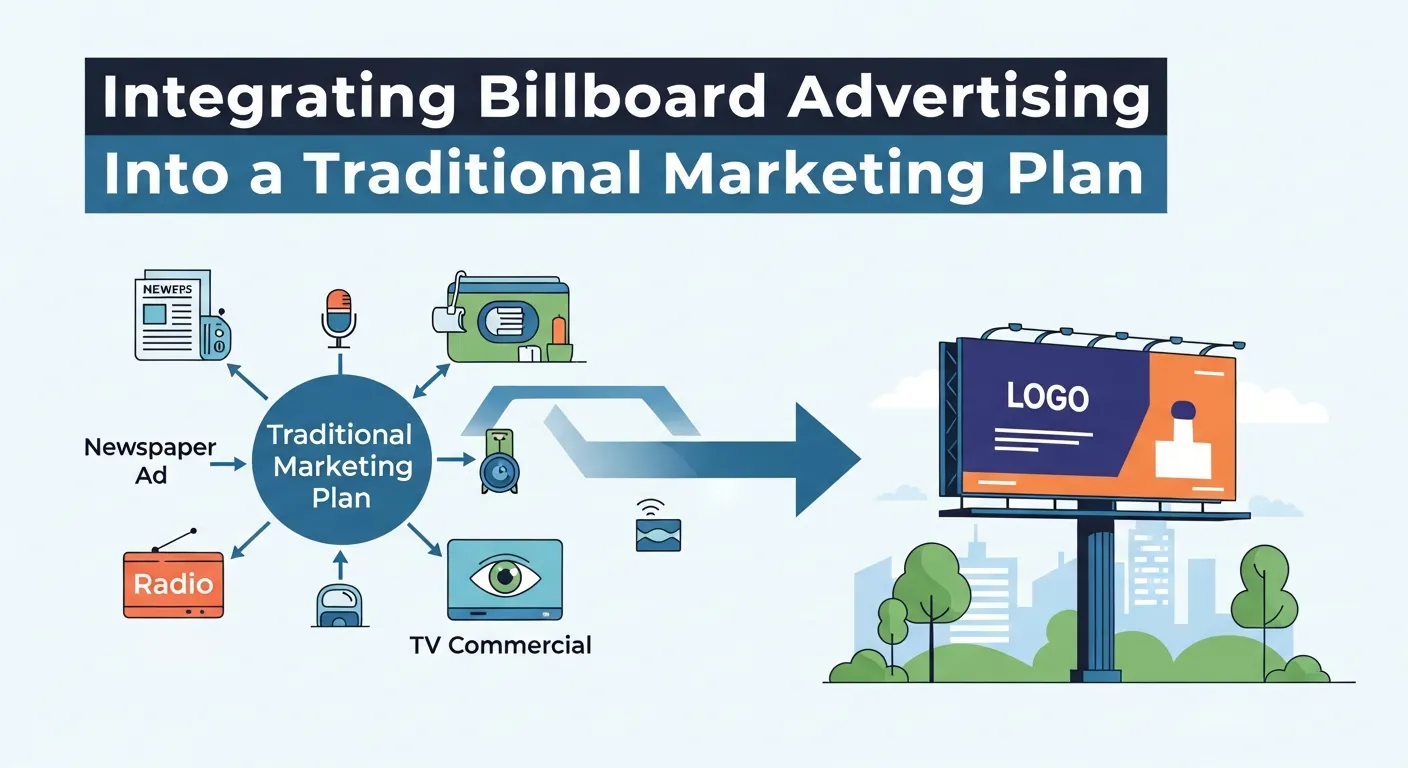
Billboard advertising is most powerful when it’s not used in isolation. As part of a broader traditional marketing plan, billboards act as high-impact awareness drivers that reinforce messaging across multiple offline and online channels. Their role is often to introduce, remind, or anchor a brand message in the physical world where purchasing decisions actually happen.
A well-structured traditional advertising campaign uses billboards to create consistent visual cues that audiences encounter repeatedly. These cues then strengthen recall when consumers hear a radio ad, receive direct mail, or see a digital promotion later. This cross-channel reinforcement increases trust and shortens the decision-making process.
From an advertising planning perspective, billboards are ideal for top- and mid-funnel objectives and play a critical role in a cohesive marketing strategy. They set expectations, create familiarity, and influence behavior long before consumers actively search for a product or service.
Key ways billboard advertising supports a traditional marketing plan:
- Reinforces brand identity through consistent visuals and messaging
- Builds awareness in specific geographic markets
- Supports time-sensitive promotions and seasonal campaigns
- Strengthens recall across radio, print, and digital channels
- Anchors marketing messages to real-world locations
How Billboard Advertising Fits Within Traditional Marketing
| Marketing Channel | Role in the Campaign | How Billboards Support It |
|---|---|---|
| Billboards | Awareness & recall driver | High-frequency, location-based exposure |
| Radio Advertising | Message reinforcement | Familiar visuals boost audio recall |
| Print Media | Detailed information | Billboards spark interest before deeper reading |
| Direct Mail | Targeted engagement | Prior exposure increases response rates |
| In-store Promotions | Point-of-purchase conversion | Location memory influences buying decisions |
When aligned correctly, billboard advertising becomes the visual backbone of a cohesive traditional marketing plan rather than just a standalone tactic.
Measuring Billboard Advertising Success With Offline Marketing Metrics

One common misconception is that billboard advertising is difficult to measure. While it doesn’t offer clicks or impressions like digital ads, modern offline marketing metrics provide valuable insight into campaign performance when applied strategically.
Effective measurement starts during the advertising planning phase. Clear objectives—such as increased foot traffic, brand recall, or local inquiries—make it easier to track outcomes. Billboards often influence behavior indirectly, so success should be evaluated using a combination of quantitative and qualitative metrics.
Rather than asking, “Did people see the billboard?” marketers should ask, “Did behavior change after the billboard went up?”
Common offline marketing metrics used for billboard advertising:
- Lift in store visits or location-based foot traffic
- Increase in branded search volume
- Call tracking from location-specific phone numbers
- Redemption of billboard-specific promo codes
- Brand recall and awareness survey results
Offline Metrics for Evaluating Billboard Advertising
| Metric Type | What It Measures | Why It Matters |
|---|---|---|
| Foot Traffic Analysis | Changes in physical visits | Shows real-world behavioral impact |
| Sales Lift by Region | Revenue changes near billboard locations | Connects exposure to conversions |
| Brand Recall Surveys | Audience memory and awareness | Validates message effectiveness |
| Call & Inquiry Tracking | Direct response from viewers | Captures intent driven by exposure |
| Search Volume Trends | Increases in branded searches | Indicates heightened brand interest |
By tying billboard placement to location data and campaign timing, marketers can clearly demonstrate how billboard advertising contributes to overall campaign performance—especially within a larger traditional advertising campaign.
Maximizing Your Billboard Impact
The psychology behind billboard advertising reveals why this traditional medium remains effective in our digital age. By understanding how attention, memory, emotion, and cognition work, advertisers can create billboard campaigns that genuinely influence consumer behavior.
Successful billboard advertising isn’t about shouting the loudest—it’s about understanding how the human brain processes visual information under specific conditions. The most effective campaigns combine attention-grabbing design with psychologically informed messaging, strategic repetition, and smart placement decisions.
As you develop your next billboard campaign, remember that you’re not just buying advertising space—you’re participating in a psychological conversation with your audience. Make that conversation count by respecting the cognitive constraints of your medium while leveraging the powerful psychological principles that make billboards memorable and persuasive.
Conclusion
Billboard advertising remains a powerful and relevant tool in today’s marketing landscape because it leverages fundamental psychological principles of attention, memory, and emotion. Unlike digital ads, which can be skipped, muted, or blocked, billboards create unavoidable touchpoints that reinforce brand awareness, build familiarity, and influence real-world behavior.
The most effective campaigns are simple, visually striking, emotionally resonant, strategically placed, and repeated over time. When integrated thoughtfully into a broader traditional marketing plan—alongside radio, print, direct mail, or digital campaigns—billboards act as high-impact anchors that strengthen overall messaging and drive measurable results.
Frequently Asked Questions About Billboard Advertising
1. Why is billboard advertising still effective in the digital age?
Billboard advertising remains effective because it reaches audiences during moments when they can’t skip, block, or mute ads. By leveraging visual attention, repetition, and location-based memory, billboards complement digital efforts within a broader traditional marketing plan.
2. How does billboard advertising influence consumer behavior?
Billboard advertising works by triggering psychological responses related to attention, memory, and emotion. Simple messaging, repeated exposure, and strategic placement help brands stay top-of-mind and influence real-world purchasing decisions, especially near points of sale.
3. How many words should a billboard message have?
Most effective billboard advertising campaigns use seven words or fewer. This aligns with how the brain processes information quickly, particularly when viewers are driving or navigating traffic.
4. What role does repetition play in billboard advertising?
Repetition strengthens brand recall through the mere exposure effect. Seeing the same billboard daily along a commute builds familiarity and trust, making it a powerful tool in long-term advertising planning.
5. How do businesses measure the success of billboard advertising?
While billboards don’t offer clicks or impressions like digital ads, offline marketing metrics such as increased foot traffic, location-based sales lifts, brand recall surveys, and promotional code tracking help measure effectiveness.
6. Where should billboards be placed for maximum impact?
Strategic placement is critical. High-traffic routes, areas near purchase locations, and environments aligned with the brand message all improve performance. Smart placement is a key component of any successful traditional advertising campaign.
7. Are billboards better for brand awareness or direct response?
Billboard advertising excels at brand awareness but can also support direct response when paired with clear calls to action, location proximity, or mobile-friendly elements like short URLs or memorable slogans.
8. How does billboard advertising fit into a traditional marketing plan?
Billboards serve as high-impact, top-of-funnel touchpoints that reinforce messaging across other channels. When integrated with radio, print, or digital media, they strengthen consistency and reach within a traditional marketing plan.
9. What industries benefit most from billboard advertising?
Industries such as retail, food and beverage, real estate, healthcare, automotive, entertainment, and insurance benefit significantly from billboard advertising—especially when targeting local or commuter-based audiences.
10. What makes a billboard campaign successful?
A successful billboard advertising campaign combines strong visual design, emotionally resonant messaging, strategic repetition, and thoughtful placement. Effective advertising planning ensures the message aligns with the audience’s mindset, location, and timing.
Learn more about: The Resurgence of Print Marketing: How to Drive ROI with Direct Mail