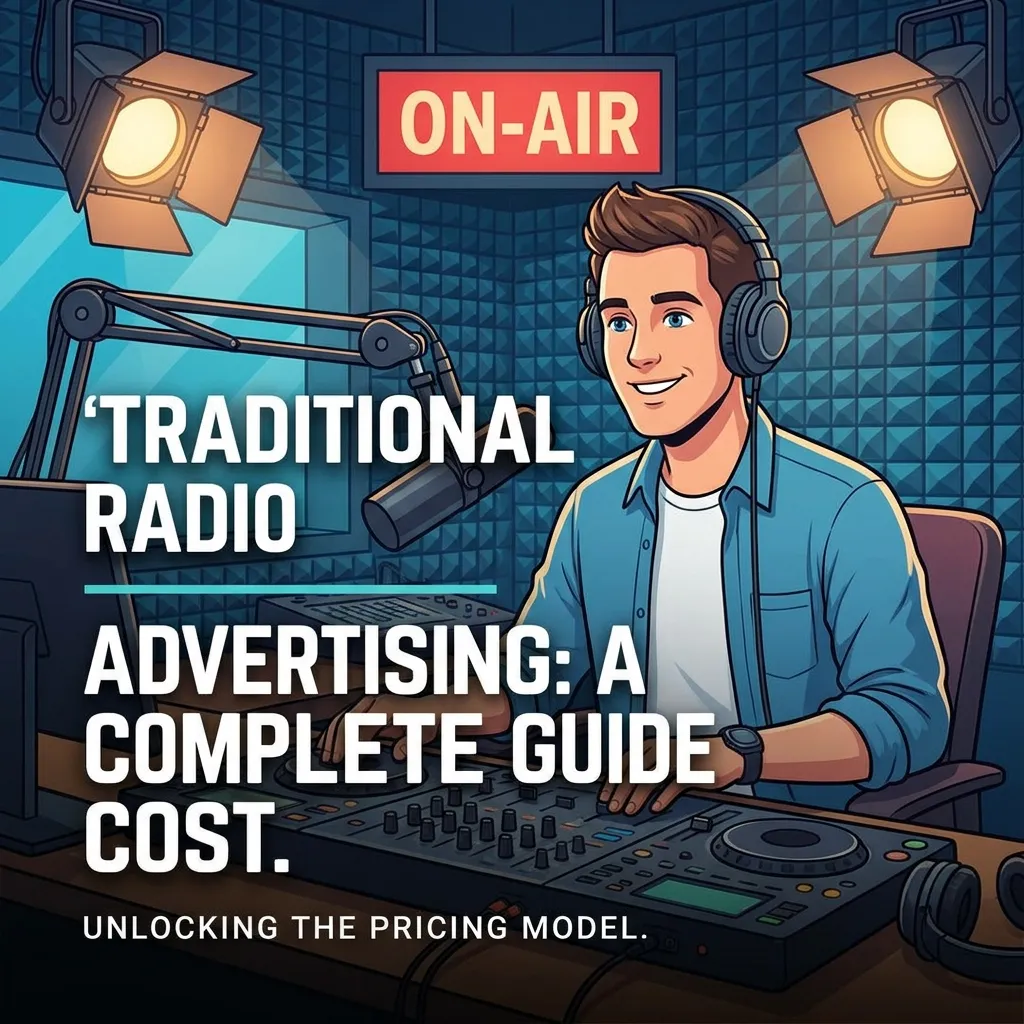
Traditional radio advertising cost can vary widely depending on the market, station audience, ad length, time slot, frequency, campaign duration, and production requirements. Unlike digital advertising, where advertisers can often adjust budgets and targeting in real time, traditional radio advertising is usually purchased according to airtime, audience reach, daypart, and negotiated station rates.
For businesses considering radio as part of their marketing strategy, understanding the complete cost structure is essential. The total investment usually includes both the cost of producing the commercial and the cost of purchasing airtime. Other factors, such as the number of spots, station popularity, geographic market, seasonal demand, and sponsorship opportunities, can also affect the final budget.
This guide explains traditional radio advertising cost, the major pricing factors, common radio ad formats, budgeting methods, production expenses, cost-saving strategies, and ways to measure campaign performance.
What Is Traditional Radio Advertising?
Traditional radio advertising is a form of offline advertising where businesses pay radio stations to broadcast promotional messages to listeners. These advertisements can promote products, services, events, locations, special offers, or brand messages.
Unlike digital advertising, radio relies primarily on audio communication. Advertisers use voiceovers, music, sound effects, dialogue, and memorable messaging to capture attention.
Traditional radio advertising can be particularly useful for businesses that want to reach audiences within a specific geographic market. Local restaurants, retailers, automotive dealerships, healthcare providers, real estate companies, educational institutions, financial businesses, and service providers can all use radio to increase awareness.
A radio campaign may include:
- 15-second advertisements
- 30-second advertisements
- 60-second advertisements
- Sponsored segments
- Host-read advertisements
- Promotional announcements
- Event sponsorships
- Drive-time campaigns
- Contest sponsorships
- Seasonal promotions
The cost depends on how and where the advertisement is purchased.
How Much Does Traditional Radio Advertising Cost?
There is no single fixed traditional radio advertising cost because radio stations use different pricing structures and serve different markets.
As a broad planning reference, industry guides commonly report local radio advertising costs ranging from hundreds to several thousand dollars per week, depending on market size, audience, frequency, and placement. For example, some published estimates place weekly radio advertising budgets around $200 to $5,000, while individual 30-second spots can vary substantially between markets.
These numbers should be treated as planning benchmarks rather than guaranteed rates.
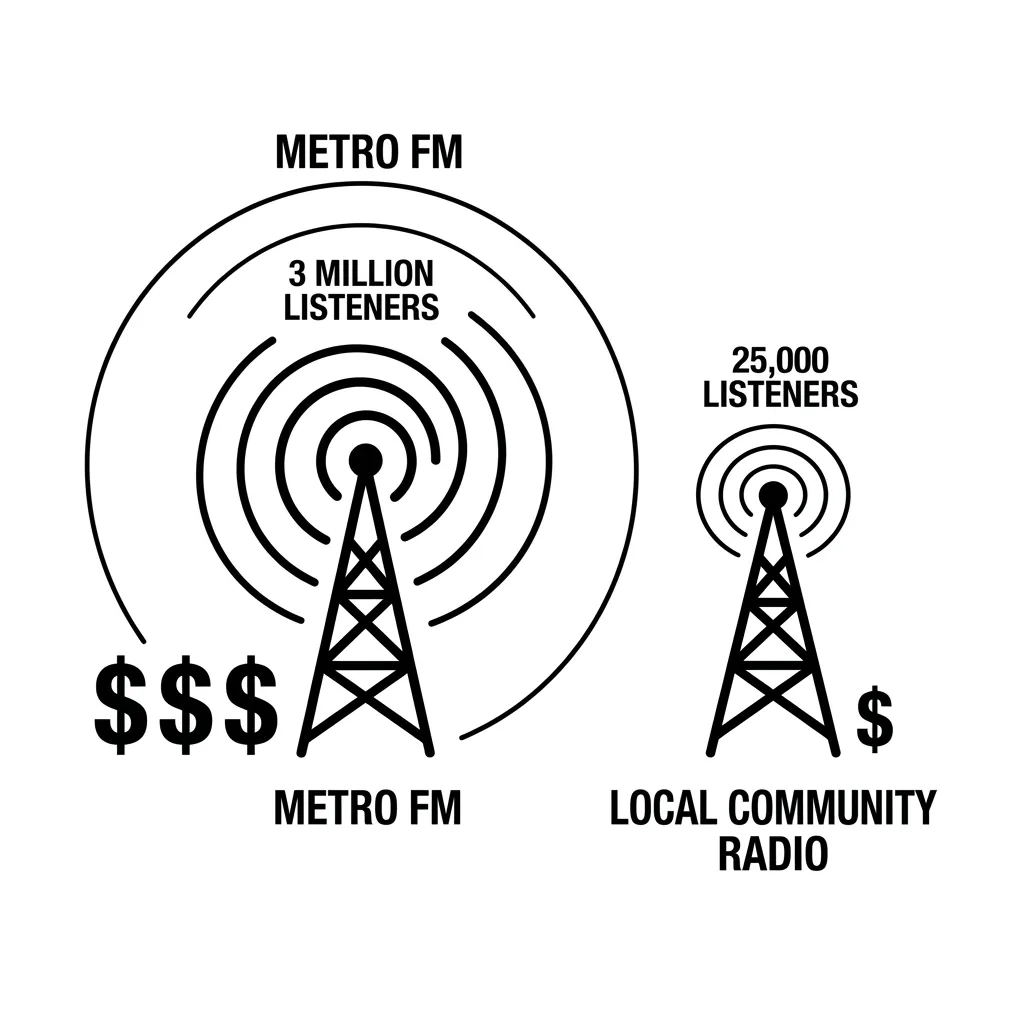
A small local market may offer considerably lower rates than a large metropolitan market. Similarly, a low-listenership time slot can be less expensive than a popular morning or afternoon drive-time slot.
The basic cost structure is:
Total Radio Advertising Cost = Production Cost + Airtime Cost + Additional Campaign Costs
Additional costs may include creative development, professional voice talent, music licensing, sponsorship fees, promotional materials, or agency management.
What Factors Affect Traditional Radio Advertising Cost?
Several factors determine how much a business ultimately pays for radio advertising.
1. Market Size
Market size is one of the most important pricing factors.
Advertising in a major metropolitan market generally costs more because the station can reach a larger potential audience. Smaller communities may offer lower rates but also provide a smaller listening base.
For example, a radio campaign targeting a large city may cost significantly more than a campaign targeting a smaller regional market.
Businesses should therefore evaluate both the price and potential audience rather than choosing a station solely because it has the lowest rate.
2. Station Audience
The size and characteristics of a station’s audience also affect pricing.
A station with a strong audience in the advertiser’s target demographic may charge more because advertisers are purchasing access to a valuable listener group.
Important audience characteristics can include:
- Age
- Gender
- Location
- Household income
- Lifestyle
- Interests
- Listening habits
- Purchasing behavior
A smaller but highly relevant audience may sometimes be more valuable than a larger audience with poor demographic alignment.
3. Time of Day
Radio advertising is commonly divided into different dayparts.
Typical dayparts include:
- Morning drive
- Midday
- Afternoon drive
- Evening
- Late night
- Overnight
Morning and afternoon drive periods can attract strong demand because many people listen while commuting. Higher listener demand can increase advertising rates.
Off-peak periods may be cheaper, but advertisers should consider whether the reduced price is worth the potential reduction in audience exposure.
4. Advertisement Length
The length of the commercial directly affects the amount of airtime purchased.
Common formats include 15-second, 30-second, and 60-second advertisements.
A 60-second commercial generally requires more airtime than a 30-second commercial. However, pricing does not always increase in a perfectly proportional way because stations may offer packages or negotiated rates.
Shorter ads can work well for simple offers or brand reminders, while longer ads provide more space for storytelling and detailed explanations.
5. Advertising Frequency
Frequency refers to how often the same advertisement is broadcast.
A business may purchase:
- A few spots per week
- Several spots per day
- Morning and evening placements
- Weekly campaign packages
- Multi-week campaigns
Higher frequency increases total spending, but repeated exposure can also improve message recall.
The objective is not simply to purchase the largest number of spots. Businesses should determine an appropriate balance between reach, frequency, audience quality, and budget.
6. Campaign Duration
A campaign running for one week will naturally require a different budget from a campaign running for three months.
Longer campaigns may sometimes provide opportunities for negotiated package rates.
For example, a business might negotiate a monthly advertising package that includes a certain number of spots, sponsorship opportunities, or promotional mentions.
7. Competition for Airtime
Radio advertising inventory can become more expensive when demand is high.
Seasonal events, holidays, elections, major sporting events, and other high-demand periods may influence availability and pricing.
Businesses should plan campaigns early when possible, especially if they need premium time slots.
8. Geographic Coverage
A local radio campaign can focus on a specific city or community. Regional campaigns may cover a wider area.
The larger the geographic coverage, the more stations or larger networks may be required.
Advertisers should therefore determine where their customers actually live before purchasing broader coverage.
Traditional Radio Advertising Production Cost
Airtime is only one part of the total advertising budget.
Businesses also need to consider the cost of producing the commercial.
Production expenses may include:
- Scriptwriting
- Voiceover
- Professional actors
- Music
- Sound effects
- Recording
- Audio editing
- Mixing
- Creative direction
Some radio stations provide production assistance as part of an advertising package. Others may charge separately.
A simple local advertisement may require relatively limited production resources, while a professionally produced campaign with multiple voices, music, sound effects, and extensive editing can cost more.
For businesses with limited budgets, the most important priority is not necessarily expensive production. The message should be clear, relevant, memorable, and easy to understand.
30-Second vs. 60-Second Radio Advertising
Choosing the right ad length is another important budgeting decision.
30-Second Radio Ads
A 30-second commercial is useful when the advertiser needs to communicate a focused message.
It can include:
- Brand introduction
- Main benefit
- Offer
- Location
- Website
- Phone number
- Call to action
Because the message must be concise, advertisers should avoid unnecessary information.
60-Second Radio Ads
A 60-second commercial provides more room for storytelling and explanation.
It can be useful for:
- Complex services
- Healthcare businesses
- Financial services
- Real estate
- Product explanations
- Promotional campaigns
- Story-driven advertising
However, longer ads require more airtime and may increase the campaign budget.
How Radio Stations Price Advertising
Radio advertising may be sold using different pricing approaches.
One common method is based on the cost to reach a thousand listeners, commonly referred to as CPM. Another approach involves negotiated rates for individual spots or advertising packages.
The final rate can depend on:
- Audience size
- Market
- Station popularity
- Daypart
- Advertisement length
- Frequency
- Campaign duration
- Sponsorship
- Negotiated package
Because radio advertising is often locally negotiated, advertisers should request a media kit or rate card from the station and compare available packages.
Radio Advertising Packages
Many radio stations offer advertising packages instead of selling every spot individually.
A package may include:
- Multiple daily spots
- Weekly advertising
- Morning drive placements
- Afternoon drive placements
- Sponsorship mentions
- Promotional announcements
- Event partnerships
- Host-read messages
Packages can sometimes provide better value than purchasing individual placements.
However, businesses should carefully review the actual number of impressions, time slots, audience profile, and campaign duration before accepting a package.
A cheap package is not necessarily valuable if most of the spots reach an irrelevant audience.
How to Calculate a Traditional Radio Advertising Budget

A simple budgeting process can make radio advertising easier to manage.
Step 1: Define the Objective
Determine whether the campaign is designed to generate:
- Brand awareness
- Website visits
- Phone calls
- Store visits
- Leads
- Sales
- Event registrations
- Product awareness
Step 2: Define the Target Audience
Identify the people most likely to become customers.
Consider location, demographics, interests, and purchasing behavior.
Step 3: Choose the Market
Decide whether the campaign should be local, regional, or broader.
Step 4: Select Stations
Compare stations based on audience relevance, reach, reputation, programming, and pricing.
Step 5: Select Dayparts
Choose the time periods that best match the audience.
Step 6: Determine Frequency
Decide how many times the advertisement needs to run each week.
Step 7: Estimate Production
Add the cost of scriptwriting, voiceover, editing, music, and other creative requirements.
Step 8: Calculate Total Cost
Use:
Airtime Cost + Production Cost + Additional Fees = Estimated Campaign Cost
This gives the business a clearer picture of the actual investment.
Example of a Radio Advertising Budget
Suppose a local business wants to run a four-week campaign.
The business might allocate its budget approximately as follows:
- Radio airtime: $2,000
- Commercial production: $400
- Creative development: $200
- Promotional tracking: $100
Estimated campaign investment:
$2,700
This is only an example. Actual traditional radio advertising cost can vary significantly depending on the market, station, campaign frequency, and negotiated rate.
How to Reduce Traditional Radio Advertising Cost
Businesses do not always need to spend heavily to run an effective radio campaign.
Negotiate Package Rates
Ask stations about multi-week or bulk advertising packages.
Compare Multiple Stations
Request proposals from several stations before making a decision.
Consider Off-Peak Slots
Lower-demand time periods may offer cheaper rates.
However, always compare the audience quality before choosing a cheaper placement.
Keep the Message Focused
A concise advertisement can reduce production complexity.
Reuse Creative Assets
A strong commercial may be adapted for different campaign periods rather than producing a completely new advertisement every week.
Purchase Longer Campaigns
Some stations may offer more favorable rates for longer commitments.
Track Results
If a campaign is not producing measurable business value, continuing to spend money does not make sense.
How to Choose the Right Radio Station
Choosing a station based only on price can be a mistake.
Instead, evaluate:
Audience Relevance
Does the station reach your target customers?
Geographic Coverage
Does the station reach the locations where your customers live?
Listening Habits
When does your target audience listen?
Programming
Does the programming match your customer profile?
Reputation
Does the station have a strong reputation in the local market?
Advertising Flexibility
Can the station provide suitable time slots and package options?
A strong station-audience match can be more valuable than simply selecting the cheapest available rate.
Traditional Radio Advertising and Marketing Strategy
Radio advertising should not exist in isolation.
It can work alongside other traditional and digital channels.
For example:
Radio Advertisement → Brand Awareness → Website Search → Website Visit → Lead → Conversion
A radio campaign can introduce a business to potential customers, while other marketing channels provide additional information and conversion opportunities.
Businesses can also combine radio with print advertising, outdoor advertising, television, social media, search marketing, and email campaigns.
For a broader understanding of radio-focused marketing, businesses can explore radio marketing as part of a wider traditional media strategy.
Traditional Radio Advertising and Digital Marketing
Traditional radio advertising can complement digital marketing rather than compete with it.
A listener may hear an advertisement and then search for the business online.
This makes brand consistency important.
The same:
- Business name
- Offer
- Brand message
- Website
- Phone number
- Promotional code
should be used consistently across channels.
Businesses can also create dedicated landing pages or campaign-specific URLs to help measure radio-generated traffic.
Traditional Radio Advertising and Marketing Automation
Radio can create awareness, but digital systems can help businesses manage what happens after someone responds.
For example, a listener may hear an advertisement, visit a landing page, submit a form, and become a lead.
At that point, marketing automation and CRM systems can help manage follow-up communication.
Businesses interested in understanding how these systems work together can review this guide on Marketing Automation and CRM Integration.
This type of integration can connect lead information, campaign activity, follow-up workflows, and sales information, helping businesses create a more connected customer journey.
How to Measure Radio Advertising Performance
Measuring traditional radio advertising can be more challenging than measuring some digital campaigns, but businesses can still track meaningful results.
Website Traffic
Monitor website traffic during and after the campaign.
Branded Searches
Look for increases in searches for the company or product name.
Phone Calls
Use a dedicated phone number when practical.
Promo Codes
Give radio listeners a unique promotional code.
Dedicated Landing Pages
Create a landing page specifically for the radio campaign.
Lead Generation
Track how many inquiries or leads can be associated with the campaign.
Sales
Compare sales activity before, during, and after the advertising period.
Reach and Frequency
Monitor estimated reach and exposure frequency when station audience data is available.
Businesses can also learn more about offline marketing metrics to understand how traditional campaigns can be evaluated.
Traditional Radio Advertising ROI
Return on investment should be considered alongside reach and awareness.
A basic ROI calculation is:
ROI = (Revenue Generated – Campaign Cost) ÷ Campaign Cost × 100
For example, if a campaign costs $2,000 and generates $5,000 in attributable profit or revenue according to the business’s chosen measurement framework, the resulting return should be evaluated against the original investment.
However, not every radio campaign produces immediate sales.
Brand awareness campaigns may influence customers later, making attribution more difficult.
Businesses should therefore consider both direct-response metrics and longer-term brand outcomes.
Common Traditional Radio Advertising Mistakes
Choosing a Station Only Because It Is Cheap
Low cost does not automatically mean good value.
Ignoring Audience Fit
A large audience is not useful if it does not include your potential customers.
Using a Complicated Message
Listeners may not remember a message that contains too much information.
Weak Call to Action
The audience should understand exactly what to do after hearing the advertisement.
Poor Frequency Planning
Too few spots may not create enough awareness, while excessive frequency can waste budget.
Failing to Track Responses
Without tracking, businesses may struggle to determine whether the campaign generated value.
Ignoring Other Channels
Radio often performs better as part of an integrated marketing strategy rather than as an isolated channel.
Traditional Radio Advertising Best Practices
A successful radio campaign should follow several practical principles.
Keep the Message Simple
Focus on one primary benefit or offer.
Make the First Few Seconds Interesting
Listeners may not remain engaged if the advertisement starts slowly.
Repeat Important Information
Repeat the brand name and essential contact information naturally.
Use a Strong Call to Action
Tell listeners what they should do next.
Match the Message to the Audience
Use language and offers that make sense for the station’s listeners.
Use Professional Audio
Clear voice recording and balanced sound can improve the overall quality of the advertisement.
Maintain Brand Consistency
Use the same messaging across radio, website, social media, and other advertising channels.
Is Traditional Radio Advertising Worth the Cost?
Traditional radio advertising can be worth the investment when a business has a clearly defined audience, suitable geographic market, strong creative message, and a practical measurement system.
It may be particularly useful for:
- Local businesses
- Regional brands
- Retail businesses
- Restaurants
- Automotive businesses
- Healthcare providers
- Real estate companies
- Financial services
- Event promotion
- Community-focused organizations
The key is not simply to ask, “How much does radio advertising cost?”
A better question is:
“What business result can this radio investment realistically produce?”
A $1,000 campaign that reaches the right audience and generates qualified customers may be more valuable than a $5,000 campaign that reaches a much larger but irrelevant audience.
Traditional Radio Advertising vs Other Advertising Channels
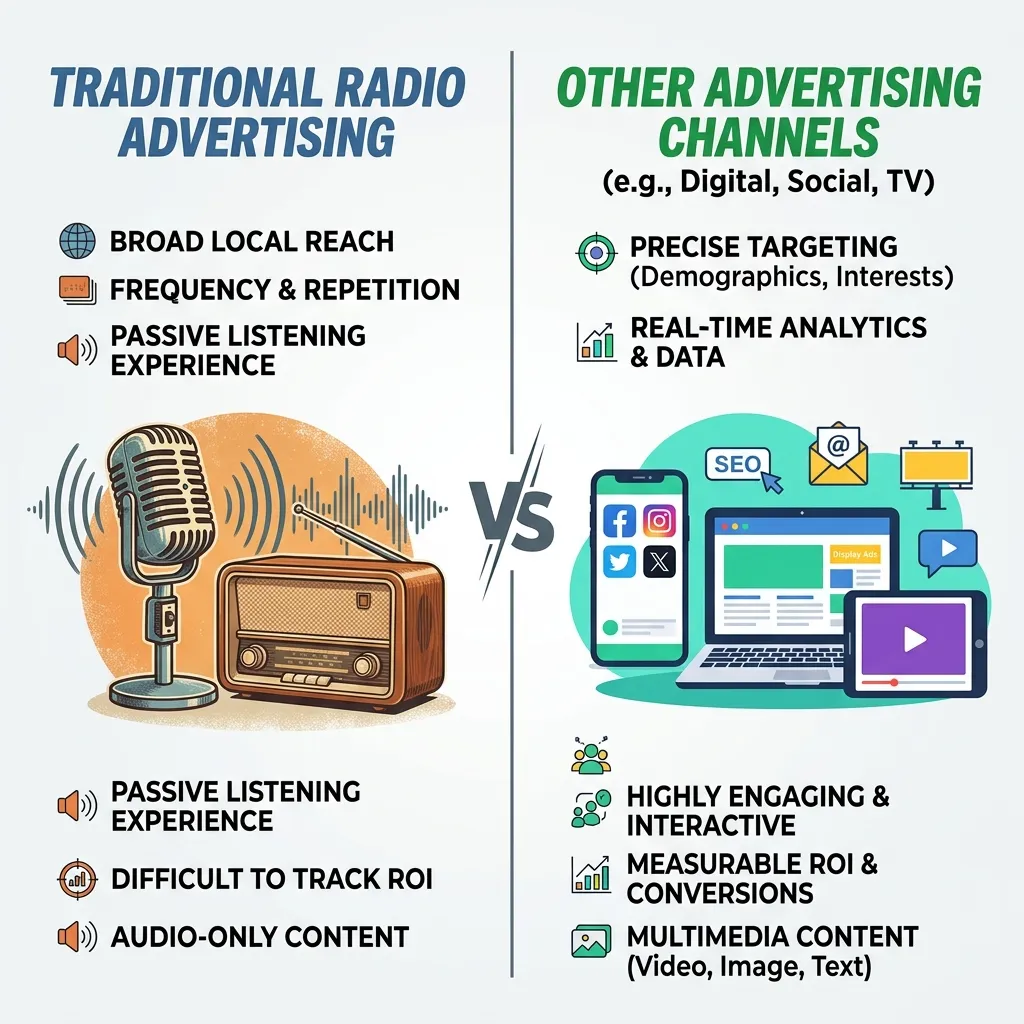
Radio has different strengths compared with other channels.
Radio vs Television
Television provides visual storytelling, while radio relies on audio.
Radio production can be simpler and may offer more accessible local advertising opportunities.
Radio vs Print
Print provides a physical format that audiences can read at their own pace. Radio provides immediate audio exposure and can reach people while they are driving or performing other activities.
Radio vs Digital Advertising
Digital advertising typically provides more detailed targeting and immediate performance data. Radio can provide broad local awareness and repeated exposure.
Radio vs Outdoor Advertising
Outdoor advertising is highly visual and location-based, while radio can communicate a more detailed spoken message.
For a broader view of traditional advertsing channels, businesses can also explore traditional advertising.
Conclusion
Traditional radio advertising remains a useful option for businesses that need local awareness, repeated exposure, and direct communication with listeners. Understanding traditional radio advertising cost allows businesses to build realistic budgets and avoid spending based only on advertised spot prices.
By evaluating market size, station audience, daypart, ad length, frequency, production expenses, and campaign results, businesses can make better advertising decisions. The strongest campaigns focus on the right audience, deliver a memorable message, provide a clear call to action, and connect radio exposure with measurable business activity.
Frequently Asked Questions
1. How much does traditional radio advertising cost?
Traditional radio advertising cost varies by market, station, audience size, daypart, ad length, frequency, and campaign duration. Local campaigns may cost hundreds of dollars per week, while larger campaigns can require several thousand dollars or more.
2. What is the average cost of a 30-second radio ad?
There is no universal average because radio rates vary significantly between markets and stations. A 30-second advertisement in a small market may cost considerably less than one in a large metropolitan market.
3. Is radio advertising expensive for small businesses?
It does not necessarily have to be. Small businesses can focus on local stations, specific geographic markets, off-peak periods, and negotiated advertising packages to control spending.
4. What is included in radio advertising cost?
Costs can include airtime, commercial production, voiceover, music, editing, sponsorships, creative development, and other campaign-related expenses.
5. Does a 60-second radio ad cost more than a 30-second ad?
Usually, longer advertisements require more airtime and may cost more. However, actual pricing depends on the station, campaign package, daypart, and negotiated agreement.
6. What time is radio advertising most expensive?
High-demand periods such as morning and afternoon drive time can be more expensive because they may attract larger or more valuable audiences.
7. How often should a radio advertisement run?
The ideal frequency depends on the campaign objective, audience, budget, and market. Advertisers should balance repeated exposure with efficient budget allocation.
8. How can I reduce radio advertising costs?
Businesses can compare stations, negotiate packages, consider suitable off-peak placements, simplify production, commit to longer campaigns when beneficial, and continuously measure performance.
9. How do I measure radio advertising ROI?
Businesses can track website traffic, branded searches, phone calls, promo codes, dedicated landing pages, leads, sales, reach, and frequency. Combining several metrics provides a stronger view of campaign performance.
10. Is traditional radio advertising still effective?
Yes, it can be effective for businesses that want local or regional awareness, repeated exposure, brand recognition, and direct promotional messaging. Effectiveness depends heavily on audience fit and campaign execution.