In-store promotions are powerful retail marketing tactics designed to boost sales by influencing customer decisions at the point of purchase. Through effective visual merchandising, signage, and strategic product placement, businesses can enhance engagement, encourage impulse buying, and improve overall store conversions.
The Importance of In-Store Promotions
While digital advertising and online marketplaces continue to flourish, in-store promotions remain a powerful tool for retailers looking to differentiate themselves. Unlike purely virtual campaigns, in-store tactics engage multiple senses—sight, touch, smell, and sometimes taste—creating memorable experiences that drive purchase intent. For example, point-of-sale displays featuring interactive touchscreens or illuminated shelving can capture attention more effectively than a static banner ad, leading to a higher conversion rate.
Moreover, in-store promotions enable immediate feedback and flexibility. Retailers can observe foot-traffic patterns, measure dwell time, and gather anecdotal insights from shoppers as they navigate displays. This real-time intelligence allows marketers to tweak pricing, signage, or product placement on the fly, ensuring promotions remain relevant and impactful. According to research from the U.S. Census Bureau (https://www.census.gov), consumers are more inclined to make unplanned purchases when they engage directly with products, highlighting the persuasive value of tactile marketing.
Another advantage of well-executed in-store promotions is cross-selling. By bundling complementary items—such as offering a free accessory with the purchase of electronics—you can boost average order value and introduce customers to new product lines. In-store promotions also strengthen brand perception by demonstrating commitment to customer experience. When shoppers leave with a positive impression, they’re more likely to return and recommend your business to others, amplifying long-term growth.
Diverse Types of In-Store Promotions
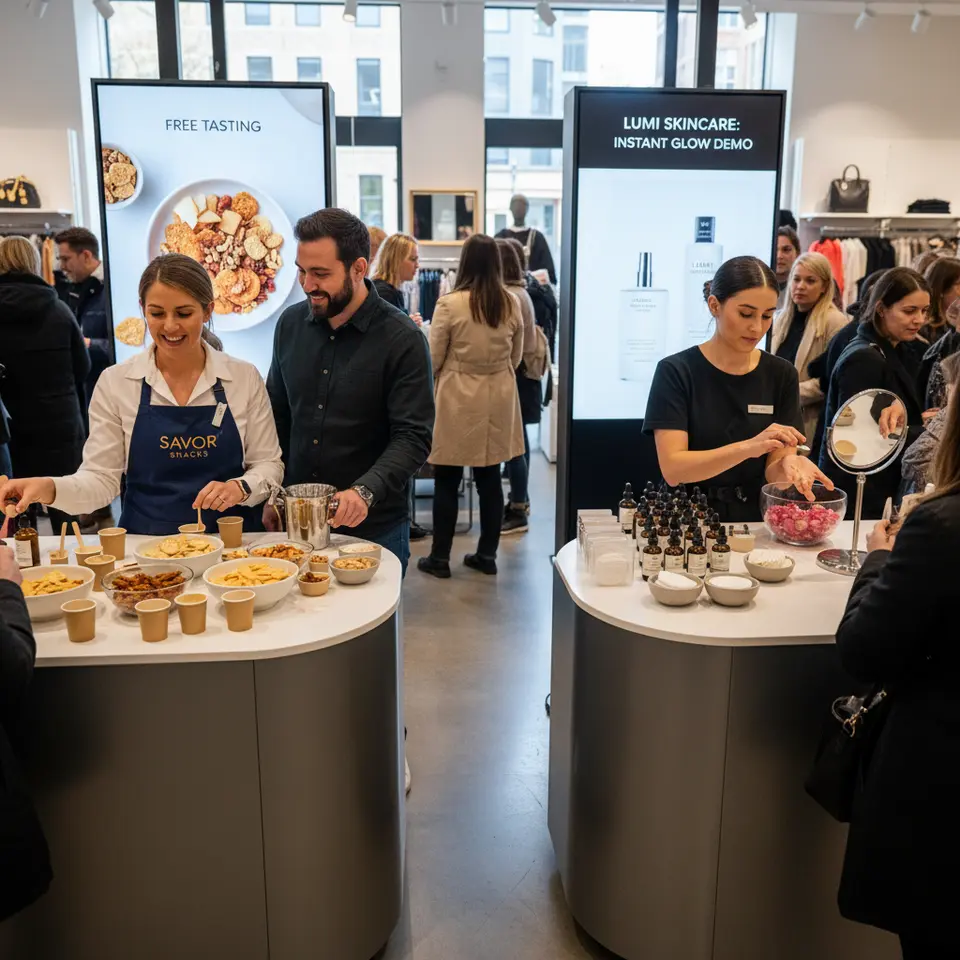 To capture consumer interest , retailers can choose from a wide array of in-store promotional tactics. Understanding the strengths and applications of each can help you craft a balanced campaign tailored to your goals.
Point-of-Sale Displays
Point-of-sale (POS) displays—such as countertop stands or endcap installations—are strategically positioned near checkout areas to influence last-minute purchases. Clear messaging, bold visuals, and time-limited offers (e.g., “Buy One, Get One 50% Off”) can nudge customers toward impulse buys. Well-designed POS displays should include a concise headline, supporting copy, and an obvious call to action to guide shoppers seamlessly.
Shelf Talkers and Danglers
Shelf talkers are small, attention-grabbing signs attached to shelves that highlight key features, discounts, or ingredient benefits. Danglers hang from ceiling fixtures, directing foot traffic down specific aisles. These tools are ideal for breaking the monotony of densely packed shelves and pointing customers to featured products without overwhelming them.
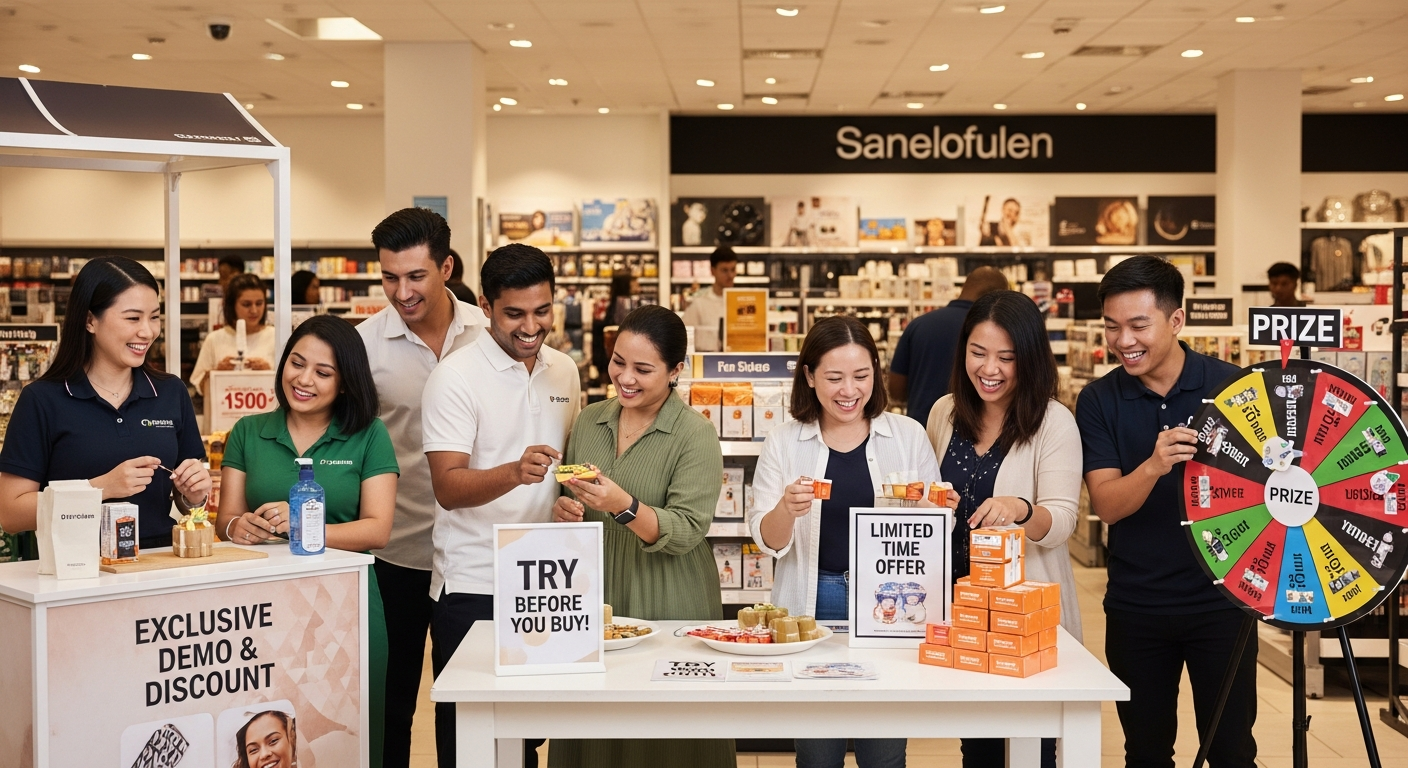
Sampling Stations and Live Demonstrations
Free samples and in-store demonstrations are among the most persuasive in-store promotions. Allowing customers to try new products—whether it’s a gourmet snack or a skincare serum—builds trust and mitigates purchase hesitation. Trained brand ambassadors can engage shoppers, answer questions, and showcase applications, resulting in higher conversion rates. For best practices on sampling compliance and safety, refer to guidelines from the Centers for Disease Control and Prevention (https://www.cdc.gov).
In-Store Events and Workshops
Hosting themed events or workshops transforms your store into a community destination. A cooking retailer might offer a free recipe demo, while a craft store could run a weekend DIY tutorial. These experiences encourage extended visits and create shareable moments on social media, amplifying your reach organically.
Coupons and Loyalty Programs
Discount coupons, punch cards, and point-based loyalty schemes incentivize repeat visits and higher spend. Offering exclusive in-store perks—such as members-only flash sales—reinforces customer commitment and provides valuable data for personalized marketing in the future.
Planning and Strategy for Effective Promotions
Successful in-store promotions begin with clearly defined objectives that guide every stage of the campaign. Without a focused goal, even the most creative promotions may fail to deliver measurable results. Businesses must first determine whether the objective is to clear seasonal inventory, introduce a new product line, increase average order value, or improve overall foot traffic. Each goal requires a different promotional approach, messaging style, and resource allocation strategy.
Once objectives are set, identifying the target audience becomes essential. Modern retailers rely on data-driven insights from Google Analytics, POS systems, and loyalty programs to understand customer behavior in detail. These insights help create accurate buyer personas that reflect real shopping patterns, preferences, and purchasing power. By tailoring promotions to specific groups—such as budget-conscious families, tech-savvy consumers, or eco-conscious shoppers—brands can significantly increase engagement and conversion rates.
Promotion Planning Framework
| Element |
Description |
Impact |
| Objective Setting |
Define clear promotion goals |
Ensures focused strategy |
| Audience Targeting |
Identify key customer segments |
Improves relevance |
| Timing Strategy |
Choose peak shopping periods |
Increases foot traffic |
| Channel Integration |
Use online + offline promotion |
Expands reach |
| Budget Planning |
Allocate and monitor spending |
Controls ROI |
Timing plays a critical role in the success of in-store promotions. Aligning campaigns with high-traffic periods such as weekends, payday cycles, holidays, local festivals, or store anniversaries can dramatically improve visibility and sales performance. Coordinating promotions with external events ensures higher customer turnout and stronger engagement.
In today’s connected marketing environment, cross-channel integration is no longer optional—it is essential. Retailers should promote in-store events through email newsletters, social media campaigns, SMS alerts, and mobile app notifications. This multi-channel approach ensures customers are informed in advance and more likely to visit the store.
Key Planning Steps
- Set clear promotional objectives (sales, clearance, awareness)
- Identify target customer segments using data insights
- Build detailed buyer personas for better personalization
- Align promotions with peak traffic periods
- Integrate online and offline marketing channels
- Allocate a structured budget with flexibility
- Track expected ROI before campaign launch
Budget planning is another crucial element of promotion strategy. A comprehensive budget should account for design costs, printing materials, signage, staffing requirements, digital promotion, and potential giveaways or discounts. Including a contingency buffer ensures flexibility in case of unexpected expenses or opportunities to scale successful campaigns.
Retailers should also continuously compare forecasted ROI against historical performance data. This allows businesses to refine strategies, optimize spending, and prioritize the most profitable promotional activities. Data-driven decision-making ensures that each campaign builds on previous learnings rather than operating in isolation.
Designing Engaging Visual Merchandising
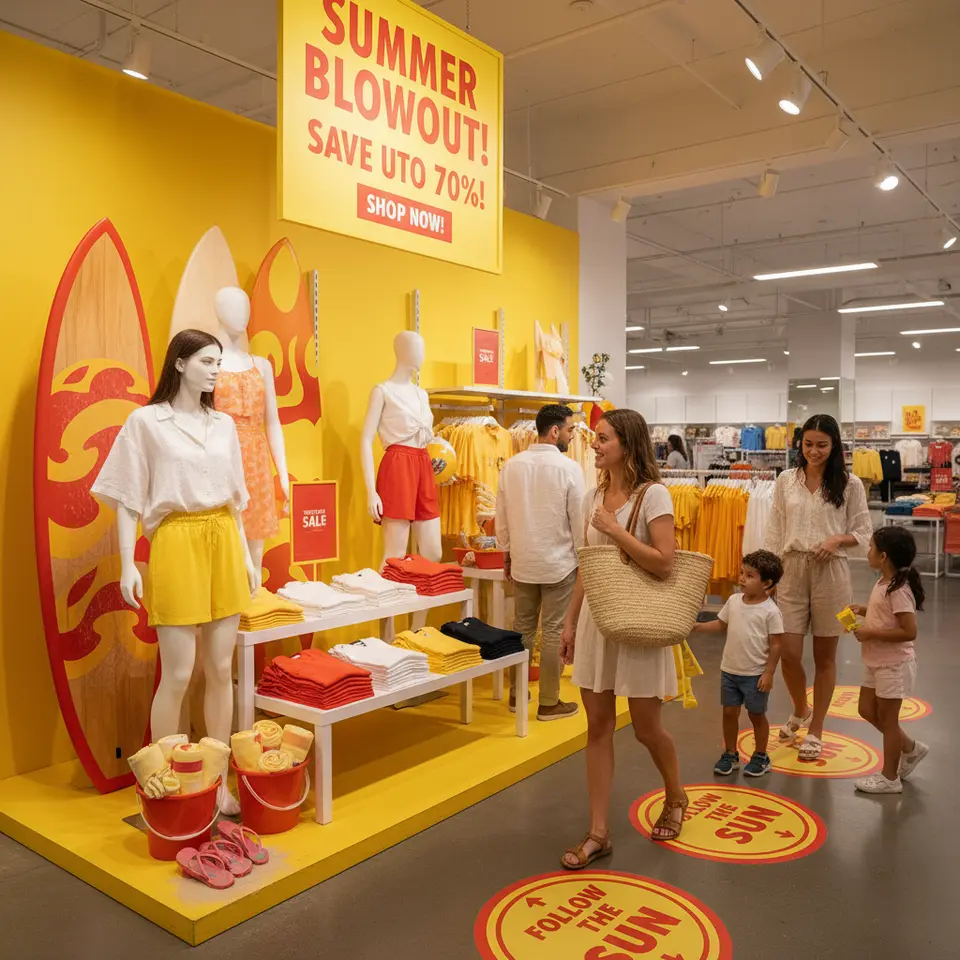
Visual Merchandising for Effective In-Store Promotions
Visual merchandising is the art of designing an engaging and persuasive shopping environment that subtly influences customer behavior and purchasing decisions. A well-executed display not only attracts attention but also communicates value instantly, guiding shoppers toward promotional products and featured offers.
The first step is selecting a cohesive color palette that aligns with your brand identity while ensuring strong visual contrast for promotional messaging. Bright and bold colors such as red, yellow, or orange can effectively highlight discounts and limited-time offers, especially when placed against neutral store backgrounds. This contrast ensures that key messages stand out immediately in a busy retail environment.
Equally important is maintaining a clear visual hierarchy. Customers should be able to understand the offer within seconds. Use large, bold headlines to communicate the main promotion, followed by short and simple supporting details such as discount percentages, bundle offers, or free gift thresholds. Finally, include a strong call-to-action that guides behavior, such as “Shop Now,” “Limited Time Offer,” or “Try It Today.” Overcrowding should always be avoided, as cluttered displays can confuse customers and reduce engagement.
Visual Merchandising Structure
| Element |
Purpose |
Impact |
| Color Contrast |
Highlight promotions |
Increases visibility |
| Headlines |
Communicate main offer |
Grabs attention quickly |
| Supporting Text |
Explain details |
Improves clarity |
| Call-to-Action |
Drive customer action |
Boosts conversions |
| Props & Themes |
Enhance storytelling |
Improves engagement |
Key Visual Merchandising Techniques
- Use bold and consistent color themes for promotions
- Maintain a clean and minimal display layout
- Focus on one primary message per display
- Place products at eye level for maximum visibility
- Use lighting to highlight key promotional items
- Guide customer movement with floor decals or signage
- Regularly update displays to maintain freshness
Incorporating thematic elements and props adds depth to your promotional storytelling. For example, a summer sale can be enhanced with beach-inspired decor such as surfboards, umbrellas, and tropical visuals, while a back-to-school campaign may include notebooks, chalkboards, and classroom props. These immersive elements help create an emotional connection with customers and make promotions more memorable.
Lighting and spatial design also play a critical role in influencing customer behavior. Strategic use of spotlights can draw attention to featured products, while ambient lighting can set the overall mood of the store. Floor decals can guide foot traffic toward high-priority areas, and well-placed seating or trial zones encourage customers to interact with products more comfortably.
Ultimately, effective visual merchandising transforms a retail space into an engaging experience. By combining color psychology, structured messaging, thematic storytelling, and strategic layout design, retailers can significantly enhance customer engagement and drive higher conversion rates.
Empowering Staff and Measuring Impact

Empowering Staff and Measuring Impact
Your frontline team is essential for translating in-store promotions into tangible sales. Strong execution depends heavily on how well employees understand, communicate, and deliver promotional messages. That’s why comprehensive training is the foundation of every successful retail campaign. Staff should be educated on promotional objectives, product knowledge, and key talking points so they can confidently engage customers.
To ensure consistency, businesses can align their approach with proven frameworks from traditional marketing for small businesses, where clear messaging and structured execution drive stronger customer engagement.
Providing simple scripts, talking points, or FAQs helps employees maintain consistency while still allowing natural conversation flow. Rather than sounding robotic, staff should be encouraged to personalize recommendations based on customer needs. This reinforces the value proposition of featured products and improves conversion rates.
Retailers that focus on structured execution often perform better when applying insights from traditional marketing strategies digital age, which emphasizes blending offline execution with modern customer behavior trends.
Key Staff Empowerment Strategies
- Provide structured training on product knowledge and promotions
- Offer simple scripts and customer FAQs
- Encourage personalized recommendations
- Train staff on upselling and cross-selling techniques
- Reinforce brand messaging consistency
Motivation is equally important. Incentive programs tied to performance—such as bonuses for upselling, recognition awards, or friendly in-store competitions—can significantly improve staff engagement. A motivated team not only drives higher sales but also enhances customer experience through better service and enthusiasm.
These principles align closely with insights from why traditional marketing still delivers ROI, which highlights how human interaction remains a powerful driver of conversion in offline marketing environments.
Measuring Success and Performance
Measuring success is crucial for continuous improvement. Retailers should track key performance indicators (KPIs) such as sell-through rate, average transaction value, and incremental sales lift during promotional periods compared to baseline performance.
| KPI |
What It Measures |
Why It Matters |
| Sell-through Rate |
Product sales speed |
Indicates demand strength |
| Average Transaction Value |
Customer spending per visit |
Measures upselling success |
| Sales Lift |
Increase vs baseline |
Shows promotion effectiveness |
| Customer Feedback |
Satisfaction level |
Improves future campaigns |
For deeper insights, businesses often rely on frameworks like offline marketing metrics, which help evaluate real-world campaign effectiveness beyond digital data.
Customer feedback tools such as surveys or in-store kiosks also provide valuable qualitative insights. These help identify customer sentiment, preferences, and areas needing improvement.
Advanced measurement tools like heat mapping and foot-traffic tracking can reveal which areas of the store attract the most attention. This data is extremely useful when planning future layouts or optimizing product placement. Retailers exploring more advanced offline strategies often refer to traditional advertising strategy for brands to refine in-store visibility tactics.
Post-Campaign Analysis
A strong post-campaign review should include:
- Total revenue generated during promotion
- Net profit vs promotional cost
- Conversion rate improvement
- Customer engagement levels
- Staff performance impact
Comparing results against historical data helps businesses understand what worked and what needs improvement. This process ensures continuous refinement of future promotions.
Retailers can further strengthen insights by learning from how to create a successful traditional marketing campaign, which emphasizes structured evaluation and long-term strategy improvement.
FAQ
1. What are in-store promotions?
In-store promotions are retail marketing tactics used inside physical stores to increase sales through discounts, displays, and special offers.
2. How do in-store promotions increase sales?
They attract customer attention, encourage impulse buying, and improve product visibility at the point of purchase.
3. What are examples of in-store promotions?
Examples include discount displays, buy-one-get-one offers, free samples, and seasonal product bundles.
4. What is point-of-purchase (POP) marketing?
POP marketing refers to promotional materials placed near or at checkout areas to influence last-minute buying decisions.
5. How important is visual merchandising in retail?
Visual merchandising is crucial because it enhances store appeal, guides customer behavior, and highlights key promotional products.
6. How can staff improve in-store promotions?
Trained staff can boost promotions by engaging customers, recommending products, and clearly explaining offers.
7. What KPIs should be tracked for in-store promotions?
Key KPIs include sales lift, sell-through rate, average transaction value, and customer engagement levels.
8. How do you measure the success of in-store promotions?
Success is measured by comparing promotional sales data with baseline performance and analyzing ROI.
9. What makes an in-store promotion successful?
Clear goals, strong visuals, trained staff, good timing, and effective customer targeting make promotions successful.
10. Are in-store promotions still effective in the digital age?
Yes, because they directly influence buying decisions at the point of purchase and create real-time customer engagement.
Conclusion
In-store promotions remain one of the most powerful retail marketing strategies for driving immediate sales and enhancing customer experience. When combined with strong planning, effective visual merchandising, well-trained staff, and accurate performance tracking, they can significantly boost store performance. By using data-driven insights and aligning promotions with customer behavior, retailers can create impactful campaigns that not only increase revenue but also build long-term brand loyalty.