Looking at real-world traditional radio advertising examples is one of the fastest ways to understand what actually works on air. This guide breaks down the most common radio ad formats, walks through examples by industry, and explains why certain approaches consistently outperform others.
Reading about radio advertising theory only goes so far. Seeing how different formats, tones, and structures actually play out in practice is what helps a business write a script that performs rather than one that simply fills airtime. This guide walks through traditional radio advertising examples across several formats and industries, showing what separates a forgettable 30-second spot from one that drives calls, visits, or sales.
Radio has a long history of rewarding simplicity. Unlike a visual ad, a radio spot only has sound to work with, so every example worth studying tends to share a few traits: a clear hook, a single focused message, and a call-to-action a listener can act on immediately. The sections below break these traits down by format and by industry, so a business can see which style fits its own campaign.
Why Studying Traditional Radio Advertising Examples Matters
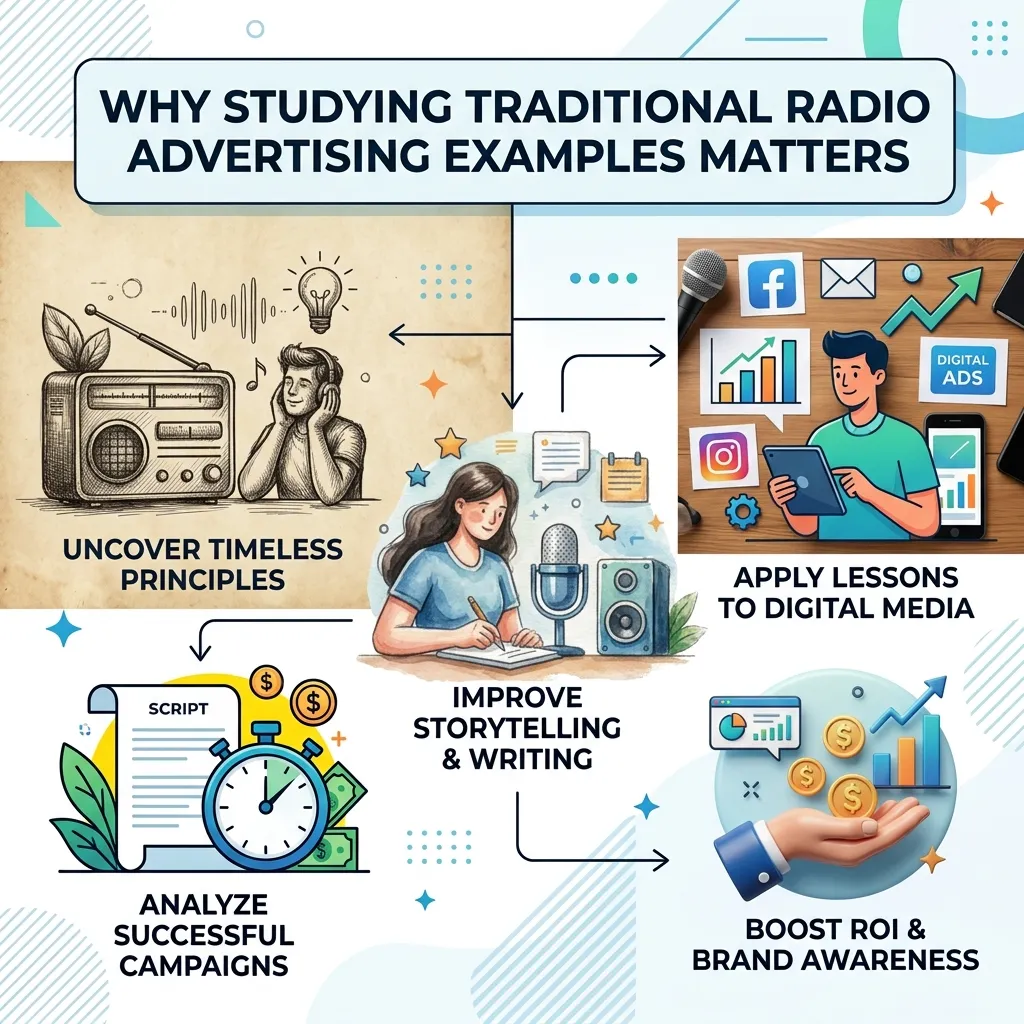
Before writing a script, it helps to understand the patterns that make radio ads memorable. Radio listeners are usually doing something else — driving, working, cooking — which means an ad has only a few seconds to earn attention before it becomes background noise. The strongest traditional radio advertising examples all solve this problem in a similar way: they open with something unexpected, a question, or a relatable scenario rather than a generic brand introduction.
Studying a range of examples also reveals how much tone and pacing matter. A furniture store’s ad and an urgent-care clinic’s ad shouldn’t sound the same, even if both are 30 seconds long and end with a phone number. Reviewing our guide on traditional radio advertising strategy is a useful companion to this piece, since it covers how stations sell airtime and how that shapes which format makes sense for a given budget.
Common Formats Seen in Traditional Radio Advertising Examples
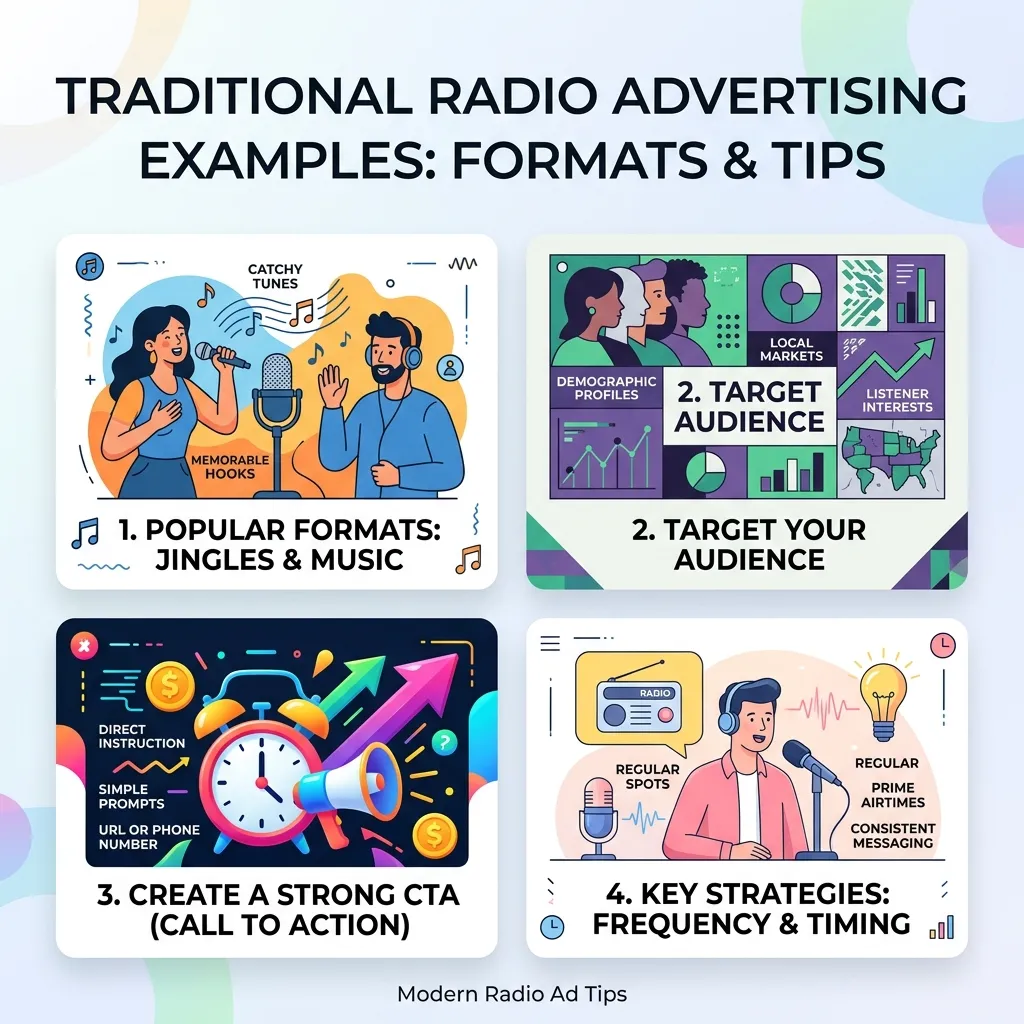
Most radio ads fall into a small number of recognizable formats. Understanding each one makes it much easier to evaluate examples and decide which structure fits a specific campaign.
The Problem-Solution Spot
This is one of the most common examples in local business marketing. The ad opens by describing a relatable problem — a leaky faucet, a cluttered garage, a car that won’t start — then introduces the business as the solution, closing with a simple call-to-action. This format works because it mirrors how people actually think about a purchase: they notice a problem first, then look for who can fix it.
The Testimonial Spot
Testimonial-style ads feature a real or voice-acted customer describing their experience with a business. These examples tend to work well for service businesses — dentists, contractors, auto shops — because hearing a peer’s voice carries more credibility than a brand simply describing itself. The key to a strong testimonial spot is specificity; a vague compliment is far less convincing than a concrete detail about what the business actually did.
The Sale or Urgency Spot
Retailers and seasonal businesses often rely on urgency-driven traditional radio advertising examples — a limited-time sale, a weekend-only event, or a countdown to an expiration date. These spots tend to be short, fast-paced, and heavy on repetition of the offer and the deadline, since the entire goal is to prompt immediate action rather than long-term brand recall.
The Host-Read Endorsement
Rather than a scripted, produced ad, this format has the on-air host read the copy in their own voice, sometimes adding their own commentary or a personal anecdote about the business. Listeners who trust the host tend to transfer some of that trust to the brand, which is why this format performs particularly well on stations with loyal, long-time audiences.
The Jingle or Branded Sound
A short, memorable jingle or sound logo is one of the oldest radio ad examples still in regular use. A catchy few seconds of music paired with a business name can outlast the rest of the ad in a listener’s memory, which is why many long-running local businesses still open or close their spots with the same few notes year after year.
For more detail on how these formats get planned, produced, and scheduled, our complete guide to traditional radio advertising covers the production process from script to airtime in more depth.
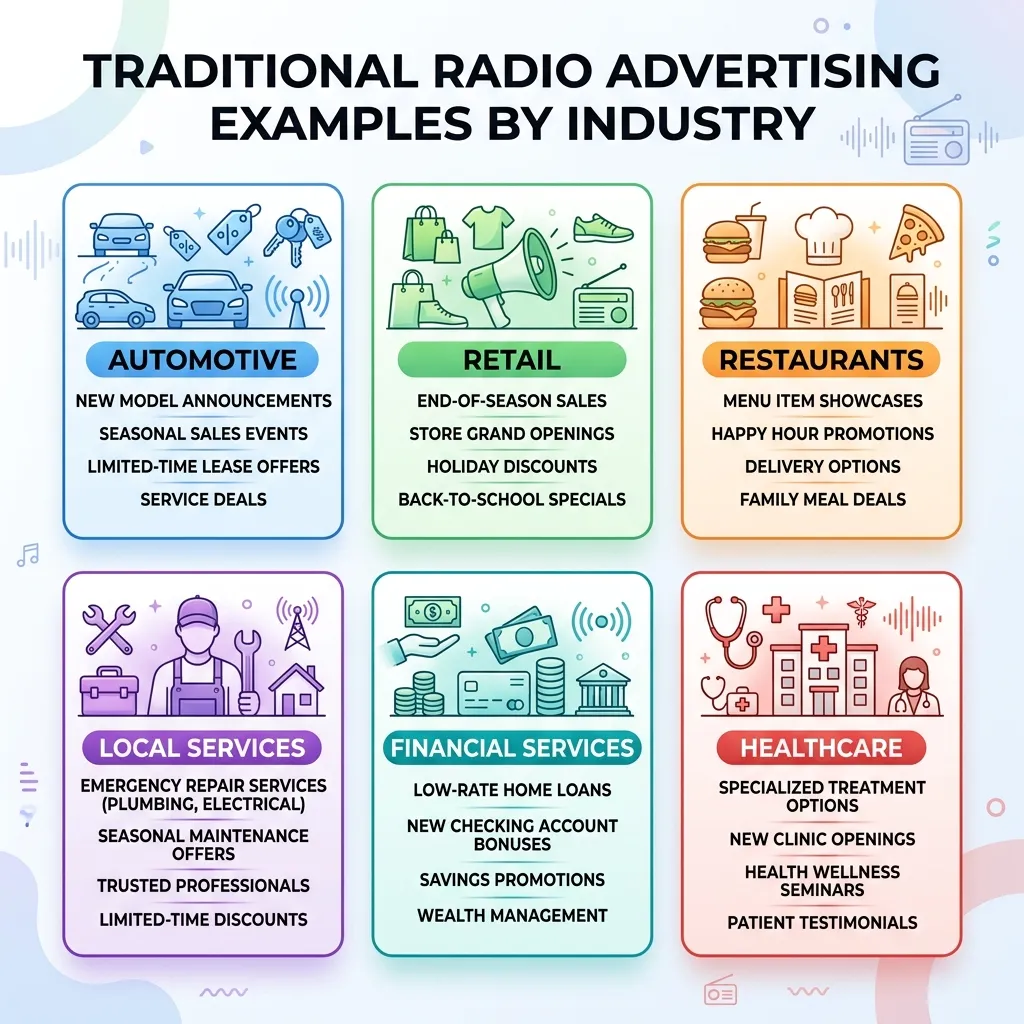
Traditional Radio Advertising Examples by Industry
Restaurants and Local Food Businesses
Restaurant ads tend to lean heavily on sensory language — describing a dish’s smell, texture, or flavor in a way that a visual ad would show instead of tell. A typical example might open with a host describing a specific menu item, mention a limited-time special, and close with the location and hours. Repetition of the restaurant’s name and cross street is common, since listeners are often driving and need a quick, actionable detail.
Home Services and Contractors
Plumbers, HVAC companies, and contractors frequently use the problem-solution format described above, often paired with a testimonial. Because these purchases tend to be reactive — something breaks and needs fixing quickly — ads in this category usually emphasize speed, licensing, and a phone number repeated multiple times within the spot.
Healthcare and Medical Practices
Medical and dental practices typically favor a calmer, more reassuring tone than retail or urgency-driven spots. Traditional radio advertising examples in this category often focus on trust, credentials, and patient comfort rather than aggressive calls-to-action, since healthcare decisions usually involve more deliberation than an impulse purchase.
Automotive Dealers and Repair Shops
Auto dealers are known for high-energy, fast-talking spots packed with pricing details, financing offers, and urgency. Repair shops, by contrast, tend to favor a more trust-based approach similar to home services — highlighting certifications, honesty, and fast turnaround rather than discounts alone.
Retail and Seasonal Businesses
Retailers rely heavily on the sale-and-urgency format, often layering multiple deadlines — “this weekend only,” “while supplies last” — to create a sense of immediacy. These spots are usually shorter and more repetitive than other formats, since the message needs to be absorbed quickly by a listener who may only catch part of the ad.
Financial and Professional Services
Banks, insurance agencies, and law firms tend to sit closer to the healthcare tone on the spectrum — calm, trustworthy, and light on urgency. These ads often lean on credentials, years in business, or a specific guarantee rather than a countdown or discount, since the purchase decision usually involves more research and comparison than an impulse buy. Repetition still matters here, but the emphasis shifts toward reinforcing a name and a reason to trust it over time rather than prompting an immediate call.
What Makes a Radio Ad Example Actually Work
Across all of these examples, a few shared principles keep showing up:
- A single, clear message. The strongest examples resist the urge to list every product or service and instead focus on one offer or idea.
- Repetition of the essentials. Business name, offer, and call-to-action typically repeat at least twice, since listeners can’t rewind an ad the way they can rescroll a page.
- A tone that matches the audience. High-energy urgency works for a weekend sale but feels wrong for a healthcare provider; matching tone to context is part of what separates effective examples from forgettable ones.
- A believable, specific detail. Vague claims (“the best service in town”) are far less memorable than something concrete a listener can picture.
- A simple call-to-action. A phone number, a short web address, or “just ask for” instructions tend to outperform anything a listener would need to write down while driving.
These same principles show up across broadcast advertising more broadly, not just radio — our overview on creating a television ad that captivates covers similar hook-and-structure fundamentals that translate well to an audio-only format, and the piece on how to write a television advertisement walks through scripting principles that apply just as directly to a 30-second radio spot.
How to Use These Examples When Writing Your Own Script
The goal of reviewing traditional radio advertising examples isn’t to copy one directly, but to identify which format and tone fit a specific business and audience. A useful process looks like this:
- Identify the goal. Is the ad meant to drive immediate calls, build long-term brand recall, or both? Urgency-driven formats suit the former; jingles and host-read endorsements suit the latter.
- Match the format to the industry. A dentist’s office and a furniture outlet shouldn’t sound the same, even if both are advertising on the same station.
- Draft multiple versions. Testing two or three script variations across a flight often reveals which angle resonates before committing an entire budget to one approach.
- Read it aloud before recording. A script that reads well on paper doesn’t always sound natural spoken at a conversational pace; reading it aloud catches awkward phrasing early.
- Keep the offer and action consistent, even while rotating creative. Refreshing the script periodically is fine, but the core offer and call-to-action should stay recognizable so repeat listeners don’t lose the thread.
Budgeting for a Campaign Built Around These Formats
Choosing the right format from the examples above is only part of the equation — budget also shapes which approach makes sense. A produced spot with music, sound effects, and a voice actor costs more to create than a simple host-read ad, though it often airs at the same rate once it’s scheduled. Businesses working with a tighter budget may lean toward host-read endorsements or a straightforward problem-solution script, since these formats require less production time while still following the same core principles that make the more elaborate examples work.
Our guide on traditional radio advertising cost breaks down how production and airtime costs vary by format and market, which is useful context before deciding whether a jingle-based campaign or a simpler testimonial spot fits a given budget. In general, the format matters less than execution — a well-written, well-placed host-read ad can outperform an expensive, poorly targeted produced spot.
Testing and Measuring Which Example-Style Script Performs Best

Once a format has been chosen and a script written, it’s worth treating the first few weeks of a campaign as a test rather than a finished product. Running two versions of a script — perhaps a problem-solution spot against a testimonial-style ad — across the same station and daypart can reveal which approach actually drives more calls or visits before a business commits a full budget to one direction.
Simple tracking methods work well here: a dedicated phone extension for each script version, a mention of a specific offer code, or simply asking new customers which station they heard about the business on. Because radio doesn’t offer the built-in analytics of a digital campaign, this kind of manual tracking is usually the most practical way to tell which of the examples covered above is actually resonating with a local audience, rather than relying on assumptions about which format “should” work best.
Conclusion
Traditional radio advertising examples are most useful not as scripts to copy but as a map of what actually works within the constraints of a 30-second, audio-only format. Whether a business chooses a problem-solution spot, a testimonial, an urgency-driven sale ad, a host-read endorsement, or a memorable jingle, the same fundamentals keep showing up: a single clear message, meaningful repetition, a tone that matches the audience, and a call-to-action a listener can act on immediately. Studying examples across industries — and matching the right format to the right business — is usually the fastest way to write a radio ad that performs rather than one that simply airs.
Frequently Asked Questions About Traditional Radio Advertising Examples
What are the most common types of traditional radio advertising examples?
The most common formats are problem-solution spots, testimonial ads, urgency or sale-driven spots, host-read endorsements, and jingles or branded sound logos.
Which industries use radio advertising most effectively?
Home services, restaurants, automotive dealers, healthcare practices, and retail businesses are among the most common users of radio advertising, each favoring a slightly different tone and format.
Should a radio ad example be copied directly for a new business?
No. Examples are best used as a guide for structure and tone, not copied word for word, since a script should reflect the specific business, offer, and audience it’s targeting.
Why do so many radio ad examples repeat the business name multiple times?
Because listeners can’t glance back at an ad the way they can rescan a webpage, repeating the business name and offer helps ensure the key details are actually retained.
What makes a testimonial-style radio ad effective?
Specificity. A testimonial that includes a concrete detail about the business’s service tends to be far more convincing than a vague, generic compliment.
Are jingles still used in modern radio advertising?
Yes. Short, memorable jingles remain common, particularly among long-running local businesses, because a distinctive sound can outlast spoken details in a listener’s memory.
How long should a typical radio ad example run?
Most radio ads run 15, 30, or 60 seconds, with 30-second spots being the most common length for local business advertising.
What’s the difference between a produced spot and a host-read example?
A produced spot is pre-recorded with music and voiceover, while a host-read ad is delivered live by the on-air personality, often in a more conversational and trusted tone.
Do urgency-driven radio ad examples work for every type of business?
Not always. Urgency works well for retail and seasonal sales but can feel out of