Traditional marketing remains an effective way for businesses to build brand awareness, reach local audiences, establish trust, and influence consumer purchasing decisions. Although digital marketing has transformed how companies communicate with customers, traditional methods such as television commercials, radio advertising, newspapers, billboards, brochures, and direct mail continue to deliver value. The effectiveness of traditional marketing depends on the target audience, campaign objectives, budget, advertising channel, and ability to measure results. By combining traditional approaches with digital strategies, businesses can create a balanced marketing plan that reaches customers across multiple channels.
Traditional Marketing Effectiveness
Traditional marketing effectiveness refers to how successfully offline promotional activities help businesses achieve their marketing goals. These goals may include increasing brand recognition, attracting new customers, promoting products, improving customer loyalty, and generating sales. Despite the growing popularity of online advertising, traditional marketing remains relevant because it reaches people through familiar and accessible channels.
Television advertisements, radio commercials, newspaper promotions, billboards, and printed materials can expose a brand to a broad audience. For example, a billboard placed near a busy shopping district can introduce a business to thousands of potential customers every day. Similarly, a local radio advertisement can help a restaurant promote a special offer to listeners in its service area.
The effectiveness of traditional marketing depends on choosing the right channel and delivering a message that resonates with the intended audience. Businesses that understand customer preferences, select suitable advertising locations, and maintain consistent branding can achieve meaningful results. Although tracking conversions may be more challenging than with digital campaigns, unique discount codes, dedicated phone numbers, customer surveys, and promotional offers can help measure performance.
Benefits of Traditional Marketing
One of the main benefits of traditional marketing is its ability to establish a strong physical presence in the marketplace. Printed advertisements, outdoor displays, and television commercials can make a business more recognizable, especially when customers encounter the same message repeatedly. This repeated exposure can improve brand recall and help customers remember a company when they need a particular product or service.
Traditional marketing also reaches people who may not regularly use social media, search engines, or other online platforms. Older consumers, local communities, and audiences with limited internet access may respond particularly well to newspapers, radio, and printed promotional materials. Businesses can use these channels to connect with customers who might otherwise be difficult to reach.
Another important benefit is the credibility that some traditional media can provide. Professional print advertisements, established publications, and well-produced television campaigns may create a sense of legitimacy. Physical materials such as brochures, product catalogs, and business cards also give customers something tangible to keep and review.
Furthermore, traditional marketing can strengthen community relationships. Sponsoring a local event, distributing flyers, or advertising through community newspapers allows a business to become more familiar to residents. When these activities are relevant to local needs, they can support long-term customer relationships and encourage word-of-mouth recommendations.
Traditional Marketing vs Digital Marketing
 Traditional marketing and digital marketing differ mainly in the channels they use to reach customers. Traditional marketing relies on offline methods, including television, radio, newspapers, magazines, billboards, direct mail, and face-to-face promotional activities. Digital marketing uses online channels such as websites, search engines, email, social media, and paid internet advertising.
Traditional marketing is often useful for building broad awareness and reaching audiences in specific geographic areas. A television advertisement can introduce a product to a large audience, while a billboard can repeatedly expose commuters to a brand. However, these campaigns may require substantial upfront investment and offer less precise audience targeting.
Digital marketing provides more opportunities for personalized communication, real-time performance tracking, and rapid campaign adjustments. Businesses can measure website visits, clicks, leads, and online purchases to understand how their campaigns perform. For example, companies can improve customer communication through email marketing automation, which helps deliver relevant messages based on customer actions and preferences.
Neither approach is universally superior. Traditional marketing can build familiarity and local visibility, while digital marketing can support precise targeting and measurable conversions. The most suitable option depends on business goals, audience behavior, budget, and the nature of the product or service. Many companies achieve better results by combining both approaches instead of relying entirely on one channel.
Traditional Advertising Methods
Traditional advertising includes several established methods that businesses can use to promote products and services. Television advertising is one of the most recognizable options because it combines visual storytelling, sound, and motion. It can be particularly effective for products that benefit from demonstrations or emotional storytelling, although production and airtime costs can be high.
Radio advertising provides an alternative for reaching commuters, local listeners, and audiences who regularly tune in to specific stations. A memorable message, recognizable voice, and repeated advertisement can help a business remain familiar to potential customers. Radio can also be useful for promoting local events, retail discounts, and seasonal offers.
Newspapers and magazines allow businesses to present detailed information in a familiar format. Local newspapers can help small companies reach nearby residents, while specialized magazines may connect advertisers with readers who have particular interests. Billboards and other outdoor advertisements are effective for increasing visibility in busy areas, especially when the message is short, clear, and easy to remember.
Direct mail, brochures, flyers, catalogs, and business cards provide additional promotional opportunities. These materials can communicate product details, prices, locations, and contact information directly to potential customers. Television campaigns can also evolve alongside changing viewing habits, making it useful for advertisers to explore future TV advertising trends and strategies when planning their media investments.
Advantages and Disadvantages of Traditional Marketing
Traditional marketing offers several advantages, including broad exposure, strong local reach, tangible promotional materials, and opportunities to build familiarity through repeated advertising. Businesses can reach audiences in public spaces, households, and communities without depending entirely on internet access. Some traditional channels are also effective for creating emotional connections through memorable stories, recognizable jingles, and visual advertisements.
However, traditional marketing has limitations. Television commercials, billboards in premium locations, and large print campaigns can be expensive. Smaller businesses may struggle to afford widespread exposure, particularly when competing with established brands. Printing and distributing promotional materials can also create additional costs.
Another disadvantage is the difficulty of measuring performance accurately. A company may know how many newspapers were distributed or how many people potentially passed a billboard, but these figures do not necessarily reveal how many customers made a purchase because of the advertisement. Traditional campaigns may also take longer to modify once materials have been printed or media placements have been purchased.
Environmental considerations can matter as well, especially when campaigns involve large quantities of paper, plastic displays, or disposable promotional materials. Businesses can address some of these challenges by selecting suitable channels, avoiding excessive distribution, using recyclable materials, and introducing tracking methods that connect offline advertising to measurable business outcomes.
Traditional Marketing Strategies for Businesses
 Effective traditional marketing strategies begin with a clear understanding of the target audience. Businesses should identify their ideal customers, their geographic locations, their purchasing habits, and the media they regularly consume. This information helps companies choose suitable advertising channels instead of spending money on campaigns that reach people unlikely to become customers.
Consistent branding is another important strategy. A company’s logo, colors, message, and value proposition should remain recognizable across billboards, brochures, television commercials, and other promotional materials. Consistency reinforces brand identity and helps customers associate different advertisements with the same business.
Seasonal campaigns can also improve engagement when promotions match customer needs and buying habits. For example, retailers may advertise school supplies before the academic year begins, while restaurants may promote special menus during holidays. Businesses can develop more relevant campaigns by studying seasonal marketing strategies and aligning promotions with important purchasing periods.
A successful strategy also requires regular evaluation. Businesses should establish measurable objectives, such as increasing store visits, generating inquiries, or improving sales in a particular location. They can then compare results with campaign costs to determine whether their chosen methods are worthwhile. Adjusting the message, advertising location, or frequency of exposure can help improve future performance.
Examples of Traditional Marketing
Traditional marketing appears in many everyday business activities. A neighborhood restaurant might distribute flyers offering a discount to nearby residents. If the flyer includes a unique promotional code, the restaurant can identify how many customers responded to the campaign. This approach is relatively straightforward and can be effective when the promotion reaches people who live or work nearby.
A clothing retailer might use billboards and newspaper advertisements to announce a seasonal sale. The billboard builds awareness among commuters, while the newspaper advertisement communicates product categories, sale dates, and store locations. Together, these channels can encourage potential customers to visit the shop.
Large consumer brands may use television commercials to introduce new products or strengthen brand recognition. A memorable advertisement featuring an everyday situation can help customers connect a product with a particular need or emotion. Radio sponsorships and event promotions can provide additional exposure among relevant audiences.
Traditional marketing can also support entrepreneurs exploring new business opportunities. For instance, someone launching a small retail operation may advertise through community newspapers, distribute brochures, or participate in local trade fairs. Researching viable e-commerce business ideas can help entrepreneurs decide whether to combine these offline activities with an online store, allowing them to reach customers through both physical and digital channels.
Traditional Marketing ROI
Return on investment, or ROI, measures whether the financial benefits of a marketing campaign justify its cost. Traditional marketing ROI can be evaluated by comparing the additional profit attributable to a campaign with the amount spent on advertising.
A basic formula is:
ROI = ((Incremental profit − Marketing cost) ÷ Marketing cost) × 100
For example, suppose a business spends $2,000 on a direct-mail campaign and generates $5,000 in additional profit that can reasonably be attributed to the campaign. Its ROI would be 150%. This means the campaign generated $3,000 more in attributable profit than it cost.
Accurate measurement is essential. Businesses should distinguish profit from revenue because a campaign that generates substantial sales may still be unprofitable after product costs, staffing, distribution, and advertising expenses are considered.
Tracking methods such as unique coupon codes, dedicated telephone numbers, customer questionnaires, and campaign-specific landing pages can improve attribution. Comparing sales before and after a campaign may also provide useful information, although seasonal changes and other factors can affect the results.
Traditional marketing ROI should be evaluated over an appropriate period. Some campaigns generate immediate purchases, while others primarily improve brand recognition and influence future buying decisions. Businesses should consider both short-term sales and longer-term customer value when assessing campaign performance.
Effectiveness of Offline Marketing
Offline marketing remains useful because many purchasing decisions are influenced by experiences outside the internet. People encounter advertisements while traveling, shopping, attending events, reading publications, or interacting with businesses in their communities. These experiences can make a brand familiar before a customer searches for it online or visits a physical store.
Local businesses can benefit particularly from offline promotion because their customers may live within a relatively small geographic area. A billboard near a shopping center, a leaflet delivered to nearby households, or sponsorship of a community event can help generate awareness among potential customers who are realistically able to visit.
Offline marketing can also support digital conversions. A customer might see a printed advertisement, search for the business later, and complete a purchase through its website. Without asking customers how they discovered the company or using appropriate tracking methods, the business might incorrectly attribute that sale entirely to digital marketing.
For this reason, businesses should evaluate offline marketing as part of the complete customer journey. Its value may extend beyond immediate responses to include brand familiarity, store visits, recommendations, and increased interest in other marketing channels.
Traditional Marketing in the Modern Era
Traditional marketing continues to evolve as consumer habits and advertising technologies change. Businesses increasingly combine offline exposure with online tools to make campaigns more interactive and measurable. For example, a printed brochure can include a QR code that directs customers to a product page, while a billboard can promote a website where visitors can learn more about an offer.
This combination allows companies to preserve the familiarity of traditional advertising while benefiting from digital convenience. A television advertisement may introduce a product, a social media campaign may encourage engagement, and an email sequence may help convert interested customers into buyers.
Businesses can strengthen this approach by developing a coordinated digital marketing strategy that connects offline promotions with online customer experiences. Consistent messaging across channels helps customers recognize the brand and understand its value proposition regardless of where they encounter it. Modern consumers also expect relevant communication and convenient purchasing options. Traditional campaigns should therefore provide clear information, realistic promises, accessible contact details, and an easy next step. Companies that combine creativity, audience understanding, and measurable objectives can continue to use traditional marketing effectively in a changing marketplace.
Traditional Marketing Techniques for Small Businesses
Small businesses do not need enormous advertising budgets to benefit from traditional marketing. The key is to select affordable techniques that reach a relevant audience and support a specific business objective. Local flyers, business cards, community newspaper advertisements, storefront signs, and partnerships with nearby organizations can provide practical starting points. Networking and event participation are particularly useful for service providers and businesses that depend on personal relationships. Attending local fairs, sponsoring community activities, or distributing samples at relevant events allows entrepreneurs to introduce their products directly to potential customers. These interactions can build trust and generate recommendations.
Small businesses should also take advantage of their local knowledge. A neighborhood bakery, for example, may understand when residents shop, which community events attract visitors, and which locations receive the most foot traffic. Using this information to schedule promotions can make a limited budget more effective. Rather than investing in every available advertising channel, businesses should test a few methods and track the results. If flyers produce inquiries but newspaper advertisements generate little response, future spending can be directed toward the more productive channel. This measured approach reduces waste and allows businesses to improve their marketing over time.
Impact of Traditional Advertising on Consumer Behavior
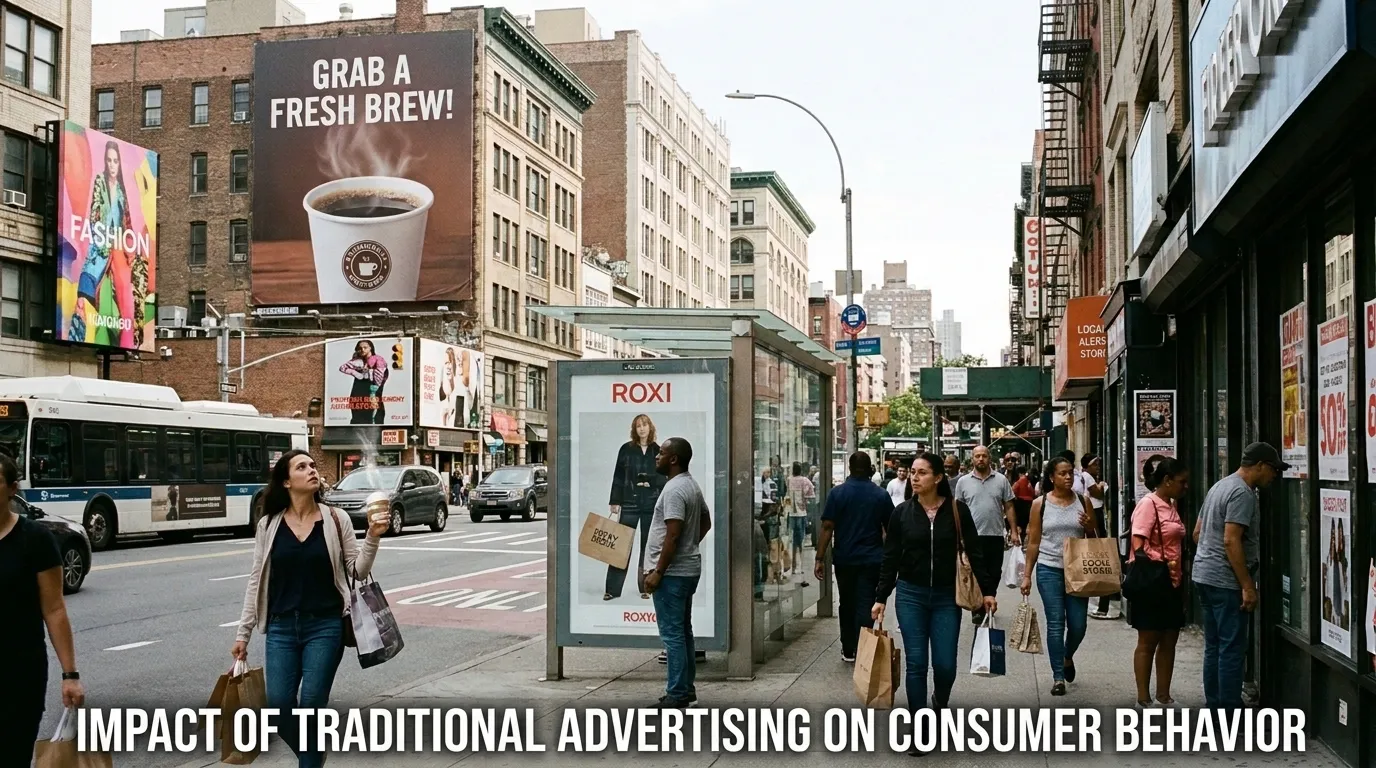 Traditional advertising can influence consumer behavior by increasing awareness, shaping perceptions, creating emotional associations, and reminding customers about products or services. Repeated exposure to a recognizable brand may make it easier for consumers to recall that brand when they are ready to purchase. Emotional storytelling is another important influence. Television commercials, radio advertisements, and print campaigns can connect products with feelings such as happiness, comfort, security, or belonging. When these associations match customer needs and expectations, they may contribute to favorable attitudes toward a brand.
Traditional advertising can also create a sense of urgency. Limited-time newspaper offers, promotional mailers, and outdoor announcements can encourage consumers to visit a store or consider a purchase before an offer expires. However, these tactics are most effective when the offer is genuine and the advertised product delivers the promised value.
Consumer responses vary according to personal preferences, income, culture, age, previous experiences, and purchasing needs. An advertisement that attracts one audience may be irrelevant to another. Businesses should therefore research their customers, communicate honestly, and evaluate whether advertising influences meaningful outcomes rather than simply generating exposure. Ultimately, traditional advertising works best when it reaches the right people with a relevant message at an appropriate time. By combining audience insight with consistent branding and reliable measurement, businesses can use traditional marketing to influence purchasing decisions and build lasting customer relationships.
Conclusion
Traditional marketing remains an effective way to build brand awareness, reach local audiences, and earn customer trust. Methods such as television, radio, billboards, and print advertising still offer valuable benefits. By combining traditional marketing with digital strategies, businesses can reach more customers, improve marketing results, and achieve long-term growth.
FAQ
1. How effective is traditional marketing?
Traditional marketing can be highly effective for building brand awareness, reaching local audiences, establishing credibility, and influencing purchasing decisions. Its success depends on the target audience, advertising channel, campaign message, and marketing budget.
2. What are the four main types of traditional marketing?
The four commonly recognized types are print advertising, broadcast advertising, direct mail, and outdoor advertising. These include newspapers, magazines, television, radio, promotional mail, billboards, and posters.
3. Is traditional marketing still effective in 2026?
Yes, traditional marketing remains relevant in 2026, particularly for local promotion, broad brand awareness, community engagement, and audiences who respond to offline media. Its effectiveness improves when businesses connect offline campaigns with digital channels.
4. What are the biggest advantages of traditional marketing?
The main advantages include broad audience exposure, local visibility, tangible promotional materials, repeated brand exposure, and opportunities to establish trust through familiar media and personal interactions.
5. What are the disadvantages of traditional marketing?
Common disadvantages include high advertising costs for some channels, limited audience targeting, slower campaign adjustments, environmental concerns associated with printed materials, and difficulties measuring exact conversions.
6. Is traditional marketing better than digital marketing?
Neither approach is always better. Traditional marketing can be effective for local visibility and broad awareness, while digital marketing offers detailed targeting and convenient performance tracking. Combining both can help businesses reach customers at different stages of the buying journey.
7. How can small businesses use traditional marketing?
Small businesses can distribute flyers, print business cards, advertise in local newspapers, display storefront signs, sponsor community events, and participate in trade fairs. Choosing methods that reach nearby potential customers can help control costs.
8. How do you measure traditional marketing ROI?
Businesses can measure ROI by comparing the profit attributable to an advertising campaign with its cost. Unique coupon codes, dedicated phone numbers, customer surveys, promotional landing pages, and sales comparisons can help evaluate campaign performance.
9. Which traditional marketing method is the most effective?
The most effective method depends on the business and its audience. Television can offer broad exposure, radio can reach local listeners, billboards can increase visibility, and direct mail can deliver targeted promotional messages. Businesses should select channels according to their goals and budgets.
10. Can traditional marketing and digital marketing work together?
Yes, these approaches can complement each other. Businesses can use television, print advertisements, and billboards to generate awareness while using websites, social media, and email campaigns to engage interested customers and encourage purchases.