Long before digital screens dominated our daily lives, businesses relied on tangible, physical channels to connect with audiences. Traditional Marketing remains a foundational pillar of commerce, bridging the gap between brands and consumers through physical touchpoints and broadcast mediums that command genuine attention. This definitive guide explores Traditional Marketing, detailing its fundamental definition, core types, and tangible examples. You will discover how offline advertising channels operate, compare their effectiveness against digital strategies, evaluate key benefits, and learn expert implementation frameworks to maximize offline campaign ROI.
Understanding the Historical Roots and Evolution of Traditional Marketing
The foundational principles of modern commerce trace directly back to early forms of offline promotion, where merchants used physical signage, word-of-mouth networks, and printed broadsheets to attract buyers. Understanding how Traditional Marketing evolved provides critical context for why physical promotional channels continue to hold immense psychological sway over consumers today. Unlike digital ads that flash briefly on a smartphone screen and disappear with a single swipe, physical media occupies space in the real world. This physical presence creates a distinct cognitive imprint, anchoring brand recall in the human brain through tangible touch, visual permanence, and local community immersion.
In eras past, businesses operated with limited channels, relying heavily on mass-reach broadcast networks and print journalism to broadcast value propositions to wide demographics. While audience targeting lacked the surgical precision enabled by modern algorithms, the sheer scale and authority commanded by television networks, national newspapers, and prominent billboards established immediate corporate credibility. Consumers naturally associated brands that invested in Traditional Marketing with stability, longevity, and financial reliability. As digital channels surged over the past two decades, many analysts prematurely declared offline advertising obsolete. However, market research consistently demonstrates that consumer trust in printed materials and broadcast media remains remarkably high, often surpassing digital banner ads tainted by pop-ups and cyber-security concerns.
Furthermore, the psychology of tactile engagement reveals that physical collateral—such as high-quality product catalogs, glossy magazines, and direct mail brochures—triggers heightened emotional processing in the brain. Neuromarketing studies indicate that physical media requires less cognitive effort to comprehend and leaves a deeper memory trace. By examining these historical roots, modern marketing professionals recognize that Traditional Marketing is not a relic of the past, but rather a robust, sensory-rich medium capable of cutting through the overwhelming digital noise of the twenty-first century. Integrating offline channels into an omni-channel strategy allows brands to leverage the permanence of physical spaces alongside the speed and interactivity of online platforms, creating a balanced and resilient strategy.
The Primary Categories and Core Channels of Traditional Marketing
 Navigating the landscape of offline promotion requires a thorough understanding of its distinct categories and operational channels. Each channel of Traditional Marketing serves specific consumer touchpoints, ranging from commuters driving past massive roadside billboards to families gathered around evening television broadcasts.
- Print Advertising: Encompasses newspapers, magazines, trade journals, and academic publications, offering targeted reach to dedicated reader demographics who engage deeply with editorial content.
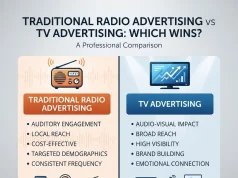
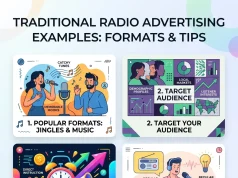
- Broadcast Media: Includes television and radio commercials, reaching mass audiences simultaneously through sight, sound, motion, and audio-driven storytelling.
- Direct Mail: Consists of physical postcards, flyers, catalogs, and promotional letters delivered directly to residential or commercial postal mailboxes.
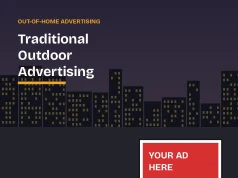
- Outdoor Advertising: Involves billboards, transit shelter posters, vehicle wraps, and digital out-of-home displays positioned in high-traffic physical locations.
- Event Marketing: Relates to trade shows, conferences, sponsored community gatherings, pop-up shops, and experiential brand activations that facilitate face-to-face interaction.
Each of these core channels operates on distinct economic and logistical principles within Traditional Marketing. For instance, print advertising relies heavily on editorial alignment, where placing an ad in a specialized hobbyist magazine ensures that the target audience is already passionate about the niche. Broadcast media, on the other hand, prioritizes massive reach during peak viewing hours, such as evening news broadcasts or major sports events. Direct mail thrives on personalized copywriting and high-quality cardstock, giving recipients a tangible object they can hold, examine, and place on a kitchen counter. Outdoor advertising capitalizes on repetitive exposure along daily commuter routes, building unconscious brand familiarity over weeks and months.
Comparative Analysis: Traditional Marketing vs Digital Marketing
Evaluating the operational differences between offline and online promotional strategies is essential for building a balanced annual budget. While digital campaigns offer granular tracking, Traditional Marketing excels in building deep brand trust and reaching local demographics with zero digital friction.
| Strategic Dimension | Traditional Marketing | Digital Marketing |
| Primary Mediums | Print, TV, Radio, Billboards | Social Media, SEO, PPC, Email |
| Cost Structure | High upfront production and placement costs | Scalable budgets with low initial entry barriers |
| Targeting Precision | Broad demographic and geographic targeting | Hyper-targeted based on behavior and search intent |
| ROI Measurement | Difficult to track directly without unique offers | Real-time analytics, click tracking, and conversion funnels |
| Consumer Trust | Generally perceived as established and authoritative | Susceptible to ad-fatigue and digital skepticism |
| Lifespan of Asset | Long-term physical presence (magazines, signs) | Transient digital impressions that vanish on scroll |
Analyzing this comparison reveals that neither methodology is universally superior; rather, they serve complementary functions within an advanced corporate framework. Traditional Marketing requires careful upfront capital allocation because producing a television commercial or printing thousands of glossy catalogs involves fixed expenses regardless of immediate return. However, once deployed, these physical assets endure. A magazine left in a doctor’s office waiting room or a billboard posted along a major highway delivers continuous impressions for months without recurring click-through fees. Digital marketing, conversely, allows for agile pivoting and real-time budget adjustments, but it suffers from severe saturation. Users encounter thousands of digital ads daily, leading to widespread banner blindness and ad-blocker adoption. By combining the enduring authority of Traditional Marketing with the precision analytics of digital platforms, modern enterprises achieve superior market penetration, capturing both immediate digital conversions and long-term brand equity.
Evaluating Strategic Advantages and Tangible Benefits of Traditional Marketing
Deploying offline promotional campaigns yields unique strategic advantages that digital-only frameworks struggle to replicate. One of the most significant benefits of Traditional Marketing is the profound level of trust and credibility associated with physical media. Consumers have been conditioned over generations to view printed books, newspapers, and broadcast television as regulated, authoritative sources of information. When an advertisement appears in a respected national publication or on a prime-time news network, that credibility transfers directly to the advertised brand. This psychological halo effect makes Traditional Marketing exceptionally effective for luxury goods, financial institutions, healthcare providers, and high-ticket B2B services where consumer hesitation is high and trust is paramount.
Another major benefit is local market domination and hyper-local targeting efficiency. Local service providers—such as regional contractors, dental practices, community banks, and boutique retailers—often find that Traditional Marketing yields a higher return on investment than broad digital campaigns. Placing a billboard near a busy neighborhood intersection or mailing discount coupons to every household within a five-mile radius ensures 100 percent saturation of the immediate geographic consumer base. Furthermore, physical promotional items and print collateral eliminate digital distractions. When a consumer reads a direct mail piece at home, they are not simultaneously receiving push notifications, opening email tabs, or navigating away to social media feeds. This undivided attention span dramatically increases message retention and comprehension, leading to higher-quality inbound inquiries and sustained customer loyalty over extended business lifecycles through effective Traditional Marketing tactics.
Common Pitfalls and Strategic Mistakes to Avoid in Traditional Marketing
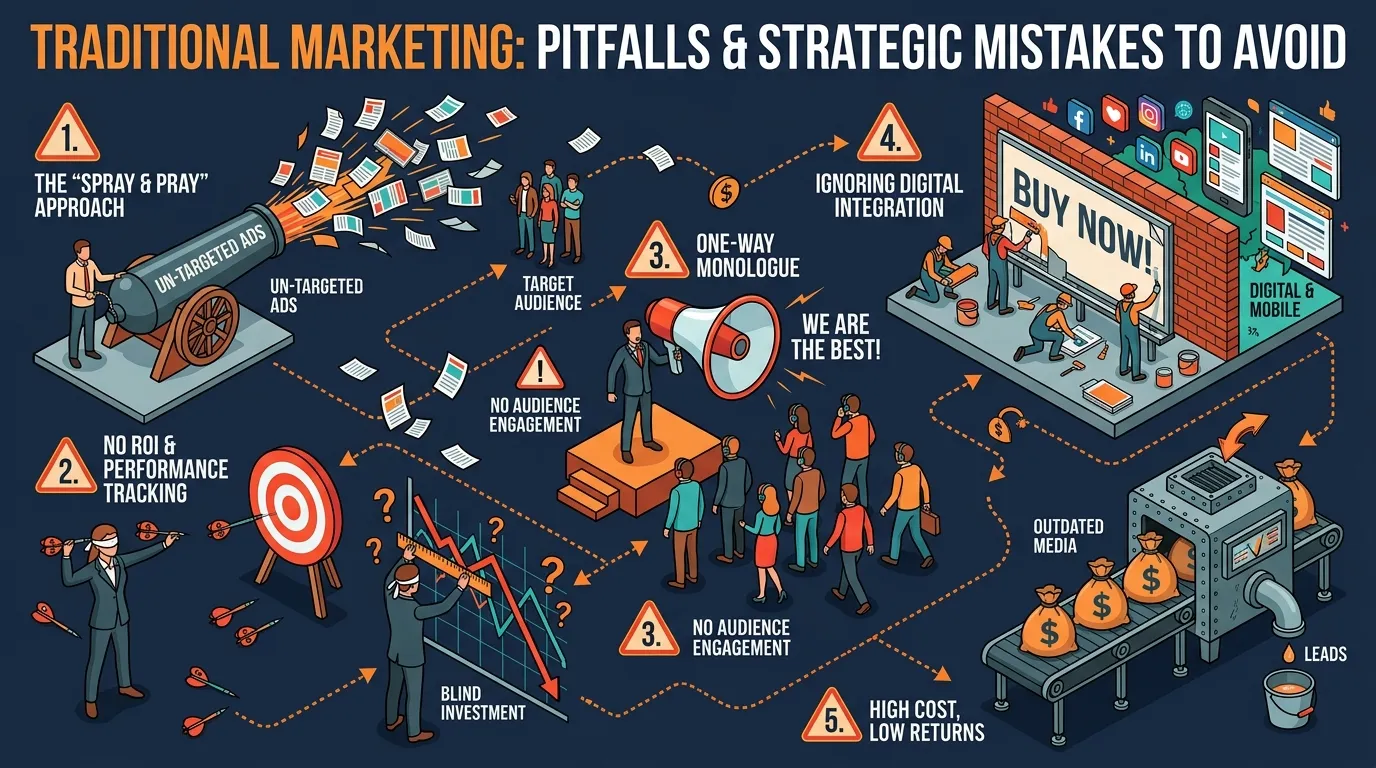 Executing offline campaigns without rigorous planning can lead to wasted capital and missed revenue opportunities. Avoiding common operational missteps ensures that every dollar invested in Traditional Marketing delivers measurable business value and strengthens brand equity.
- Failing to Implement Tracking Mechanisms: Launching print ads or billboards through Traditional Marketing without dedicated landing page URLs, unique phone numbers, or QR codes makes calculating exact campaign return on investment nearly impossible.
- Neglecting Target Audience Alignment: Placing broadcast commercials or magazine spreads in high-cost outlets that do not align with the core buyer persona results in massive budget leakage.
- Ignoring Creative Quality Standards: Utilizing cheap paper stock for direct mail or low-production-value visuals for print ads signals poor quality, actively damaging consumer perception of the brand.
- Relying Solely on Short-Term Metrics: Expecting immediate digital-style conversion spikes from long-term brand awareness mediums like billboards or sponsorships leads to premature campaign cancellation.
Mitigating these risks requires disciplined project management and continuous performance auditing within Traditional Marketing. When designing direct mailers or print advertisements, marketing teams must incorporate distinct call-to-action elements, such as exclusive promo codes or customized tracking links, bridging the offline-to-online data gap. Additionally, creative assets must undergo rigorous pre-testing within focus groups to ensure the visual hierarchy and copywriting resonate deeply with the intended demographic. Organizations should also establish realistic attribution windows, recognizing that Traditional Marketing builds cumulative awareness over extended durations. By addressing these potential pitfalls proactively, businesses protect their advertising budgets and maximize the long-term profitability of their offline initiatives.
Pro Tips and Expert Frameworks for Optimizing Traditional Marketing Campaigns
Achieving peak performance with offline advertising demands adherence to proven industry frameworks and creative optimization techniques. Expert marketers understand that success in Traditional Marketing lies in meticulous audience research, compelling copywriting, and seamless integration with broader corporate marketing ecosystems.
One foundational expert tip is to treat physical collateral as an interactive gateway rather than a static endpoint. Modern campaigns successfully bridge physical and digital worlds by integrating scannable QR codes onto direct mail pieces, product packaging, and billboard displays used in Traditional Marketing. When a consumer scans a QR code from a physical magazine ad to redeem an exclusive discount, the offline impression instantly transitions into a trackable digital conversion event. This seamless blending of mediums eliminates the traditional difficulty of attributing Traditional Marketing spend to revenue generation.
Another advanced strategy involves localized geo-fencing and timing synchronization. If a brand runs a radio advertisement or a transit billboard campaign through Traditional Marketing in a specific metropolitan region, digital advertising teams should simultaneously deploy localized social media and search ads targeting the exact same zip codes. This multi-channel saturation reinforces the core message across multiple sensory touchpoints, significantly increasing brand recall and conversion velocity. Furthermore, expert copywriters emphasize the power of sensory language and minimalism in print design. Overcrowding a billboard or a brochure with excessive text destroys readability for commuters and casual readers. Instead, high-performing Traditional Marketing assets focus on a single compelling value proposition, a striking hero image, and a crystal-clear call to action that can be digested in under three seconds. By implementing these expert frameworks, organizations transform standard offline advertisements into high-converting revenue engines.
Conclusion
Mastering Traditional Marketing empowers brands to forge deep, memorable connections that digital screens alone cannot replicate. By blending physical reach with modern tracking methods, businesses unlock powerful omni-channel growth. Traditional Marketing remains essential for long-term trust, local domination, and brand permanence. Ready to elevate your outreach? Implement these proven offline strategies today and watch your brand resonance soar.
FAQ
1. What is Traditional Marketing and how does it work?
Traditional Marketing refers to promotional methods that do not rely on the internet, utilizing physical and broadcast channels such as print media, television, radio, billboards, and direct mail to communicate brand value and reach target consumer demographics directly.
2. What are the most effective types of Traditional Marketing?
The most effective types vary by industry, but print advertising in specialized magazines, broadcast commercials on television and radio, targeted direct mail campaigns, and high-visibility outdoor billboards consistently deliver strong brand awareness and local market penetration.
3. How does Traditional Marketing differ from digital marketing?
Traditional Marketing uses physical and offline broadcast mediums with a focus on long-term brand permanence and broad reach, whereas digital marketing utilizes online channels like search engines and social media to achieve hyper-targeted, real-time trackable conversions.
4. Is Traditional Marketing still relevant in the digital age?
Yes, Traditional Marketing remains highly relevant because it commands undivided consumer attention, builds exceptional trust and credibility, and reaches local audiences effectively while cutting through the severe saturation and fatigue of digital ad spaces.
5. What are the primary advantages of print and broadcast advertising in Traditional Marketing?
Key advantages include high consumer trust, powerful sensory engagement, long asset lifespan, zero digital ad-blocker interference, and the ability to establish immediate corporate authority and prestige within targeted geographic or demographic markets.
6. How can businesses track the ROI of Traditional Marketing campaigns?
Businesses can track offline ROI in Traditional Marketing by integrating dedicated tracking mechanisms into their physical materials, such as unique promotional discount codes, custom landing page URLs, dedicated phone tracking numbers, and scannable QR codes.
7. What are common mistakes companies make with offline Traditional Marketing?
Common mistakes include failing to include tracking mechanisms, targeting the wrong demographic channels, utilizing low-quality design or print materials, and abandoning campaigns prematurely before long-term brand awareness can compound into sales.
8. How much budget should be allocated to Traditional Marketing?
Budget allocation depends heavily on business type and target audience; B2C brands, local service providers, and luxury goods companies often allocate between 20 to 50 percent of their total marketing budget to Traditional Marketing channels depending on strategic goals.
9. Can Traditional Marketing be integrated with digital campaigns?
Absolutely. Modern omni-channel marketing strategies routinely combine Traditional Marketing channels like print and direct mail with digital assets by using QR codes, hashtags, and synchronized local geo-targeted digital ads to create cohesive customer journeys.
10. What industries benefit the most from Traditional Marketing?
Industries that rely heavily on local presence, high consumer trust, and tangible product interaction—such as healthcare, real estate, automotive, finance, legal services, luxury retail, and local hospitality—benefit immensely from Traditional Marketing strategies.