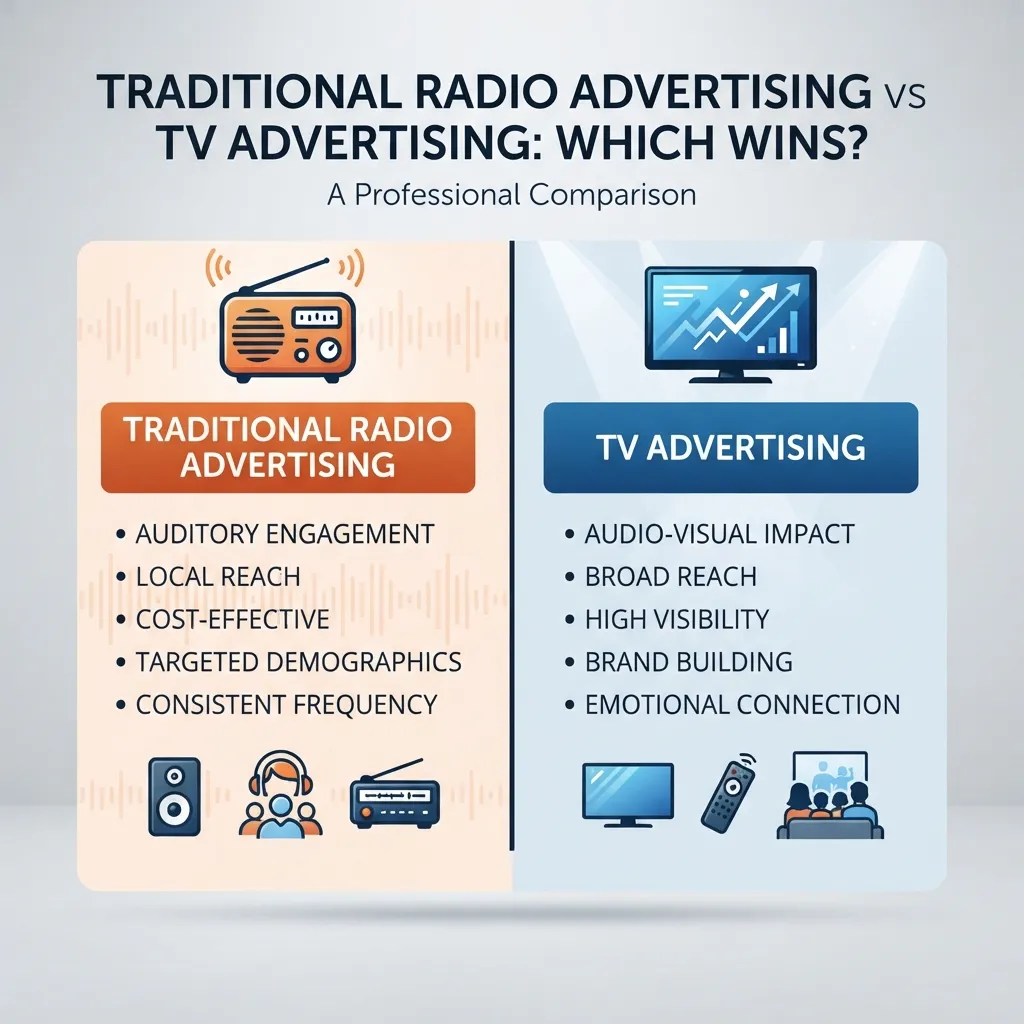
Comparing traditional radio advertising vs TV advertising comes down to trade-offs: radio is cheaper and faster to launch, while television offers visual storytelling and stronger emotional impact. This guide breaks down cost, reach, production, targeting, and measurement for both channels, then explains which businesses tend to get more from each.
Businesses planning a broadcast campaign almost always face the same question early on: should the budget go to radio, television, or some split between the two? Both channels reach large local audiences, both rely on repetition to build recall, and both have been around long enough that their strengths are well documented. But they work very differently in practice, and choosing the wrong one for a given business can waste a significant portion of an advertising budget.
The comparison of traditional radio advertising vs TV advertising isn’t really about which medium is objectively better. It’s about matching a channel to a specific goal, budget, product, and audience. A local plumber and a regional furniture chain have very different needs, and the right answer for one is often the wrong answer for the other. This guide walks through the practical differences — cost, production demands, audience reach, targeting precision, and measurement — so a business can make that decision based on its own circumstances rather than general assumptions.
The Core Difference: Sound Versus Sight and Sound
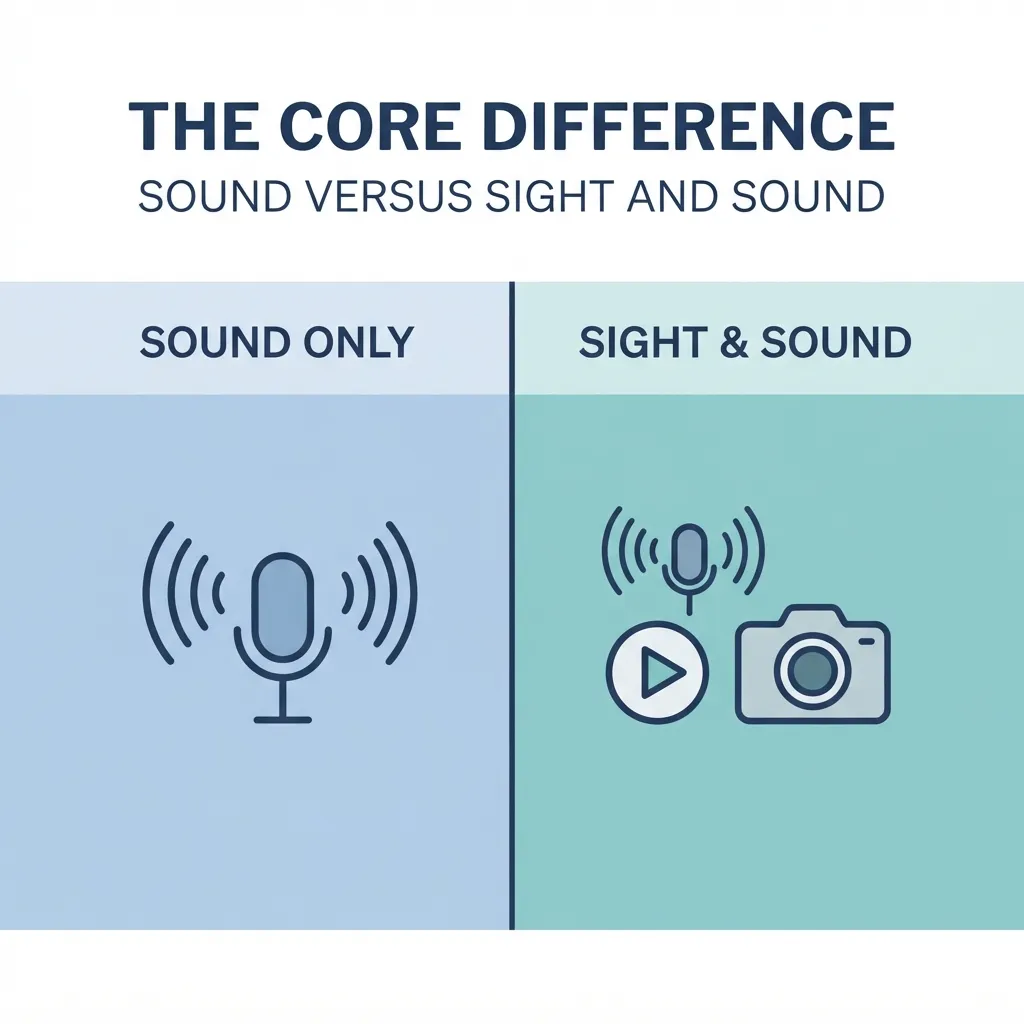
The most fundamental distinction is obvious but worth stating clearly. Radio works with audio alone, which means every idea has to be carried by voice, music, and sound effects. Television combines audio with moving images, allowing a brand to demonstrate a product, show a location, or convey emotion visually in ways radio simply can’t.
This shapes everything downstream. A restaurant can describe a dish on radio, but television can show it. A car dealership can list financing terms on radio, but television can show the vehicle. For products where appearance matters — clothing, food, vehicles, home improvements — this visual capability is a genuine advantage.
Radio’s constraint, however, comes with a corresponding strength: it reaches people during moments when they cannot look at a screen. Commuters, workers, and people doing chores are all reachable by radio in ways television isn’t, and that captive-attention quality is part of why radio has remained relevant. Our guide on traditional radio advertising strategy covers how advertisers typically structure campaigns around those listening occasions.
Cost Comparison: Radio Versus Television
When businesses compare traditional radio advertising vs TV advertising, cost is usually the deciding factor for small and mid-sized businesses, and here the gap is substantial.
Production Costs
A radio spot can be produced relatively cheaply. Many stations will record and produce a basic spot in-house as part of an airtime package, meaning a business may pay little or nothing extra for production. Even a professionally produced radio ad with voice talent and licensed music typically costs a fraction of a television commercial.
Television production is a different proposition. Even a simple local commercial involves filming, lighting, editing, and often on-camera talent. Costs escalate quickly with production value, and a poorly produced television ad can actively damage a brand’s credibility in a way a plain radio spot usually doesn’t. Our overview of traditional TV commercial production breaks down what goes into that process and where costs accumulate.
Airtime Costs
Airtime follows a similar pattern. Radio spots generally cost less per placement than television spots in the same market, which means a radio budget buys substantially more frequency. Since both channels depend on repetition, this matters: a business with a modest budget can often achieve meaningful frequency on radio while the same budget on television buys only a handful of spots that never accumulate enough repetition to register.
Television airtime varies enormously by daypart and program. Prime-time slots on popular local programming command far higher rates than late-night or daytime inventory, and the premium for high-visibility placements can be steep.
The Practical Upshot
For businesses working with limited budgets, radio generally allows a sustained campaign where television would only permit a short burst. That said, a well-placed television campaign can generate impact that radio can’t match, so the question isn’t purely which is cheaper — it’s which delivers more value at a given budget level.
Reach and Audience Comparison
On reach, traditional radio advertising vs TV advertising is less about raw audience size than timing: both channels reach broad local audiences, but they reach them at different moments and in different states of attention.
Radio reaches people in motion. Drive-time listening remains the strongest radio daypart, catching commuters who are actively listening but unable to engage with a screen. Radio also reaches workplaces, retail environments, and homes during daytime hours when television viewing is lower.
Television reaches people at rest. Evening viewing dominates, catching audiences who are settled, attentive, and more receptive to longer-form storytelling. Live sports and news programming in particular still draw large simultaneous audiences that few other channels can match.
Neither is universally larger — it depends on the market, the station, and the target demographic. A business trying to reach contractors and trades workers may find radio far more efficient; one targeting families during evening hours may find television more effective.
Targeting and Precision
Traditional radio advertising vs TV advertising also differ in how precisely they can target.
Radio stations tend to have well-defined format audiences — country, news-talk, classic rock, sports — which correlate reasonably well with demographic and psychographic profiles. Choosing the right station format is effectively the targeting mechanism, and it works well for businesses whose customers cluster around identifiable interests.
Television offers targeting through program selection and daypart, and local cable in particular allows geographic targeting down to specific zones within a market. Modern addressable and connected TV options extend this further, though those sit outside the scope of purely traditional broadcast buying.
In both cases, targeting is coarser than digital advertising. Neither channel can match the individual-level precision of a search or social campaign, which is why both are generally used for awareness rather than direct-response conversion — though direct-response formats exist in both media.
Speed and Flexibility
On speed, traditional radio advertising vs TV advertising isn’t a close comparison — radio has a clear structural advantage.
A radio campaign can go from concept to air in days. Copy can be rewritten, re-recorded, and updated quickly, which makes radio well suited to time-sensitive promotions, weather-dependent offers, and rapidly changing inventory. A host-read live spot can even be adjusted the same day.
Television requires longer lead times. Production scheduling, editing, and station delivery deadlines all add time, and revising a commercial means re-editing or reshooting rather than simply re-recording a script. For businesses with frequently changing offers, this rigidity is a real limitation.
Emotional Impact and Brand Building

Television’s combination of image, motion, sound, and music gives it strong emotional range. A well-crafted television commercial can build brand associations that are difficult to achieve through audio alone, which is part of why national brands continue to invest heavily in the medium despite its cost.
Radio compensates through intimacy and repetition. A familiar host’s voice carries a trust that a polished national commercial often lacks, and the sheer frequency achievable within a radio budget builds recall through exposure rather than production value. Many local businesses build strong brand recognition purely through years of consistent radio presence.
For a broader look at how these dynamics play out across both media, our peers’ analysis of why TV commercials still work explains the persistence of television’s emotional advantage, while the trust-and-repetition argument applies equally to a consistent radio presence.
Measurement and ROI
Measuring traditional radio advertising vs TV advertising presents a similar challenge on both sides: neither channel offers the built-in analytics of digital advertising, but both can be tracked with reasonable effort.
Common approaches work across both:
- Dedicated phone numbers or extensions tied to each campaign
- Unique promo codes mentioned only on air
- Custom landing pages referenced in the spot
- “How did you hear about us?” tracking at point of sale
- Brand lift surveys, often offered by stations as part of larger packages
Radio’s lower cost per spot generally makes it easier to test — a business can run two script variations across different dayparts without committing a large budget. Television testing is more expensive, which means campaigns are usually planned more carefully upfront and adjusted less frequently.
For businesses evaluating whether either channel is delivering, our peers’ ROI-focused guide on whether TV advertising works lays out measurement frameworks that translate well to radio campaigns too.
Which Businesses Suit Which Channel
Some general patterns hold reasonably well:
Radio tends to suit: home services and contractors, auto repair, local restaurants, professional services, businesses with frequently changing promotions, and any business needing sustained frequency on a limited budget.
Television tends to suit: furniture and appliance retailers, car dealerships, home improvement companies, healthcare systems, and businesses whose product benefits meaningfully from visual demonstration or whose budget supports adequate frequency.
Both together often work better than either alone for businesses with sufficient budget. Radio extends frequency and reaches audiences during daytime hours, while television carries the emotional and visual weight. Our guide on local television advertising covers how smaller advertisers approach TV buying without national-scale budgets.
Building a Combined Broadcast Strategy
For businesses that can afford both, the question shifts from choosing one to allocating between them. A common approach uses television to establish the brand message and radio to maintain frequency between television flights, keeping the business present in listeners’ minds at a lower cost per exposure.
Consistency matters here. The same offer, tagline, and brand voice should carry across both channels so that a listener who hears the radio spot recognizes it when the television commercial airs. Fragmented messaging across channels dilutes the recall benefit that makes multi-channel broadcast worthwhile in the first place.
Timing also matters. Concentrating both channels into the same period creates stronger short-term impact, while alternating flights extends presence over a longer window at the same total cost. Which approach fits depends on whether the goal is a specific event or sustained awareness. Our guide on traditional marketing strategies covers how to sequence multi-channel campaigns without overspending on any single format.
Common Mistakes When Choosing Between Radio and TV
A few recurring errors show up when businesses weigh traditional radio advertising vs TV advertising, and most of them trace back to budget misjudgment rather than creative failure.
The most common is spreading a television budget too thin. A business that can afford eight television spots across a month will almost always get more value moving that money to radio, where the same amount buys enough repetition to actually register with listeners. Television rewards frequency just as radio does, and a campaign that airs too infrequently simply doesn’t accumulate recall.
A second mistake is treating radio as a cheap substitute for television rather than a different medium with its own requirements. Scripts written as television copy with the visuals removed rarely work — radio needs writing built around sound from the start, with the business name and offer repeated because listeners can’t glance back at an ad.
A third is inconsistent creative across channels. Businesses running both often use different taglines, offers, or voices on each, which wastes the reinforcement that makes a combined campaign worthwhile. Keeping the core message identical across radio and television lets each channel strengthen the other rather than competing for the same mental space.
Finally, many businesses skip tracking entirely on both channels, assuming broadcast simply can’t be measured. Even basic methods — a dedicated phone extension, an on-air-only promo code — provide enough signal to tell whether a station, daypart, or channel is worth renewing.
Conclusion
The choice between traditional radio advertising vs TV advertising ultimately comes down to budget, product, and goals rather than any inherent superiority of one medium. Radio offers lower costs, faster turnaround, and the frequency needed to build recall on a modest budget — making it the practical default for most small local businesses. Television offers visual demonstration and emotional range that radio cannot replicate, justifying its higher cost for businesses whose products benefit from being seen and whose budgets can support meaningful repetition.
For many businesses, the most effective answer isn’t either-or. Using radio to sustain frequency and television to carry the visual message, with consistent creative across both, typically produces stronger results than concentrating an entire budget in a single channel. Whichever direction a business takes, the fundamentals stay the same: a clear message, enough repetition to register, and consistent tracking to know whether the investment is actually working.
Frequently Asked Questions
1. Is Traditional Radio Advertising vs TV Advertising cheaper?
Traditional Radio Advertising vs TV Advertising generally favors radio when comparing production and airtime costs. Radio spots can often be produced at a lower cost, while television commercials may require filming, editing, and higher placement fees.
2. Which channel reaches more people?
In a Traditional Radio Advertising vs TV Advertising comparison, reach depends on the market, audience, and media consumption habits. Radio can perform strongly during commuting and daytime hours, while television often attracts larger audiences during prime time and live events.
3. Can a small business afford television advertising?
Yes, especially through local cable providers that offer geographically targeted inventory. However, when comparing Traditional Radio Advertising vs TV Advertising, radio may allow some small businesses to achieve greater frequency within a limited budget.
4. Which channel is better for building brand emotion?
Television offers strong emotional storytelling through visuals, motion, and music. Radio builds connections through voice, storytelling, host credibility, and repetition. The better option depends on the campaign’s creative objectives.
5. How quickly can each campaign launch?
Radio campaigns can often move from script to air within days. Television usually requires more time for production, editing, approvals, and delivery, making speed an important factor in a Traditional Radio Advertising vs TV Advertising decision.
6. Which is easier to measure?
Both channels can use dedicated phone numbers, promotional codes, customer surveys, and other tracking methods. Radio can be easier to test in some cases because lower spot costs may allow advertisers to experiment with multiple versions.
7. Do businesses need to choose one or can they use both?
Businesses can use both channels. A Traditional Radio Advertising vs TV Advertising strategy does not have to be an either-or decision. Television can provide visual impact, while radio can help maintain frequency between television campaigns.
8. Which channel works better for time-sensitive promotions?
Radio can be more flexible for short-term promotions because scripts can often be changed and recorded quickly. This flexibility can make radio useful when speed is an important consideration.
9. Does radio still reach younger audiences?
Yes, although audience behavior varies by age, location, and station format. In a Traditional Radio Advertising vs TV Advertising comparison, advertisers should examine the specific audience of each channel rather than relying on age alone.
10. How much repetition does each channel need to work?
Both channels benefit from frequency. Radio generally costs less per spot, which may allow a fixed budget to generate more repetitions. Television may require a larger investment to achieve similar exposure levels.
11. Which channel suits service businesses better?
Local service businesses such as plumbers, electricians, and repair companies can benefit from radio because their services often do not require visual demonstrations. However, the appropriate choice depends on the target audience and campaign goals.
12. What’s the biggest mistake when choosing between the two?
A common mistake is choosing a channel without considering whether the budget can provide sufficient frequency and reach. A Traditional Radio Advertising vs TV Advertising decision should account for audience, campaign objectives, creative requirements, budget, and desired exposure.